
A failed AdBlue dosing test means your vehicle’s own self check, the one that confirms AdBlue is actually being injected into the exhaust in the right amount, hasn’t come back clean. It’s not the same as a low fluid warning. It’s not automatically a pump or injector failure either. It’s the system telling you the dose it measured doesn’t match the dose it expected.
That distinction matters. A dosing test failure is a result, not a diagnosis. Something upstream, the pump, the injector, a sensor, a blocked line, or even the fluid quality itself, caused the actual dose to come up short or wrong, and the test simply caught it. Working out which one it actually is, that’s the real job.
Here’s what the dosing test is checking, why it fails, what you’ll notice on the dash, and how we work out what’s genuinely behind it rather than guessing.
What Is the AdBlue Dosing Test Checking?
Every SCR equipped diesel runs ongoing checks on how much AdBlue is being injected relative to how much the ECU calculated it should inject, based on engine load, exhaust temperature, and NOx output. Not a one off test done at a garage. A continuous background process the vehicle runs constantly while you’re driving.
When the actual dose consistently falls outside the expected range, the system logs a dosing failure and stores a fault code. Less a single pass or fail exam, more the vehicle noticing over time that what’s going in doesn’t match what should be going in.
What Does “Failed” Actually Mean in Practice?
A few different things, which is exactly why a dashboard warning alone doesn’t tell you much. The dose could be too low, not enough AdBlue reaching the exhaust stream. It could be too high, less common but it happens, usually pointing at a stuck open injector. Or the timing could be off, AdBlue injected at the wrong point in the exhaust cycle even if the total amount’s roughly right.
Each of those points toward a different part of the system. Which is why the right next step is proper diagnosis, not replacing whichever part seems most likely.
What Actually Causes a Dosing Test to Fail
A weak or failing pump is one of the more common causes. Can’t build or maintain the pressure the injector needs to dose accurately, and the actual amount delivered falls short of what the ECU calculated. Test fails as a direct result.
A clogged or faulty injector gets you to much the same place from a different angle. Crystallised urea, debris, general wear, all of it can restrict how the injector sprays AdBlue into the exhaust, even when the pump’s delivering fluid at the correct pressure behind it.
Sensor inaccuracy plays a part too. If the pressure or NOx sensors feeding data into the dosing calculation are reporting incorrect values, the ECU ends up comparing the actual dose against a target that’s already wrong. Can trigger a failure even when the actual dosing hardware’s working fine.
Low AdBlue quality or contamination is a genuine cause people overlook constantly. AdBlue needs to sit at roughly 32.5% urea concentration to work as intended. Diluted, old, or contaminated fluid changes how much actual urea reaches the exhaust per dose, even when every mechanical part’s behaving exactly as it should.
A blocked or restricted line between the tank and injector can starve the system of flow in a way that looks, from the test’s perspective, identical to a pump problem, even though the pump itself tests fine in isolation.
Symptoms You Might Notice
The AdBlue warning light’s usually first, often with a dashboard message referencing the AdBlue or emissions system rather than naming the dosing test specifically.
Some drivers notice nothing at all beyond the warning light itself. Dosing failures don’t always change how the engine feels day to day, not immediately anyway.
Reduced engine performance tends to follow if the fault’s left unaddressed, since the ECU treats a persistent dosing failure as grounds to limit how the engine runs rather than risk emissions it can’t verify. From there, a restart countdown often appears. The familiar pattern most AdBlue faults eventually settle into.
Can You Keep Driving With This Fault?
For a short while, generally yes, especially if no countdown message has appeared yet and the warning light’s the only thing showing. The engine isn’t being damaged by a failed dosing test on its own.
That said, a dosing failure rarely resolves itself. Whatever’s behind it, a weak pump, a restricted injector, poor quality fluid, tends to stay exactly where it is or get worse the longer it’s left. Getting it checked while you’re still just dealing with a warning light beats waiting for a countdown to force the issue.
How We Diagnose a Failed Dosing Test
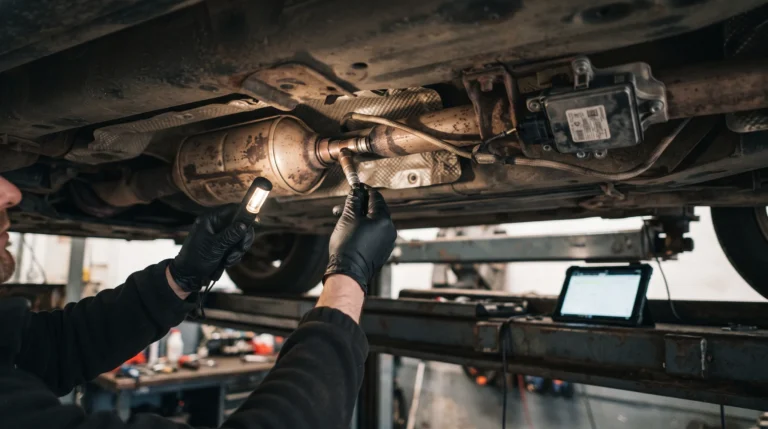
We start with a full fault code scan. The specific code stored usually narrows things toward low dosing, high dosing, or a timing related fault before we’ve even opened the bonnet.
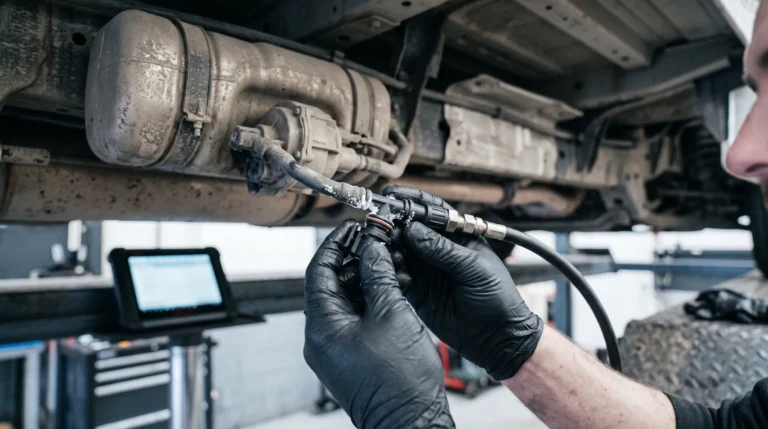
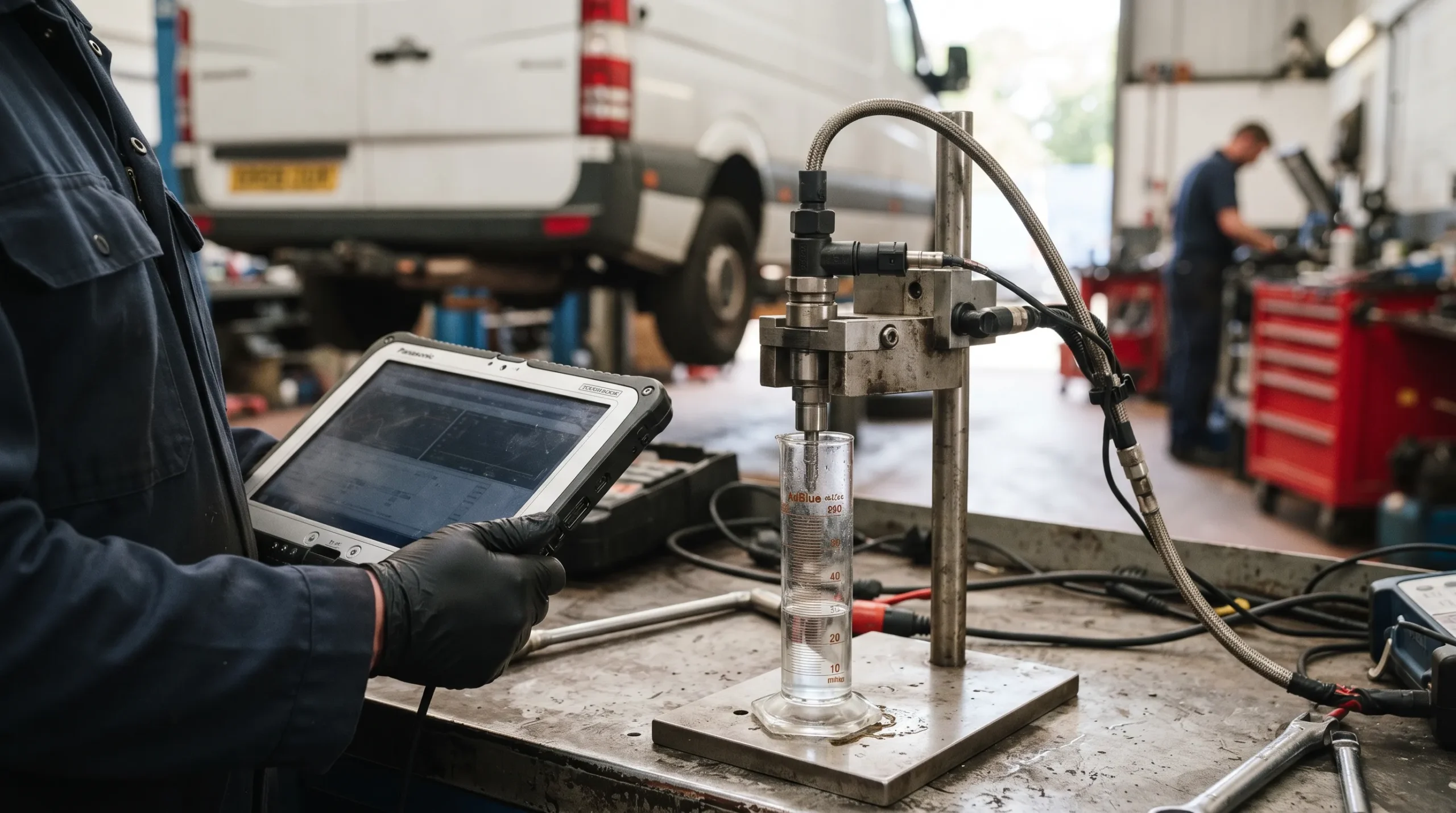
From there we check actual pump pressure and injector performance directly, rather than trusting the dashboard warning alone. This is the step that separates a genuine pump or injector fault from a dosing failure caused by something further upstream, like fluid quality or a sensor feeding bad data into the calculation.
We test the AdBlue itself too, where contamination or dilution’s a possibility. No amount of mechanical repair fixes a dosing failure caused by fluid that’s below spec to begin with.
If the hardware, pump, injector, lines, all check out and the fluid’s confirmed good, we move to the sensors feeding the dosing calculation. A sensor reporting an inaccurate value can make a perfectly functioning system look like it’s failing a test it’s actually passing.
The Fault Codes You’re Likely to See
P204F points to reductant dosing control trouble generally, often the first code to show when dosing falls outside the expected range. P2047 and P2048 relate specifically to reductant injector circuit faults, low or high depending on the exact code. P20BB and similar codes point toward reductant level or quality sensor circuits rather than the dosing hardware itself.
Which code your vehicle actually stores depends on how the manufacturer’s own system flags the specific type of dosing discrepancy it’s picked up. A code reader tells you a dosing problem exists. It doesn’t tell you, on its own, whether that’s a pump issue, an injector issue, or a fluid quality issue. Which is exactly why proper diagnosis matters more than the code alone.
Dosing Failure, Pump Fault, or Injector Fault? Why It’s Easy to Mix Up
All three can produce a near identical picture from the driver’s seat. Warning light, a stored code, reduces performance if it’s left long enough. The only reliable way to tell them apart is measuring actual pump pressure and injector output directly, rather than assuming the component that usually fails is the one responsible this time.
We had a van recently where the dosing test had failed repeatedly over several weeks, and the previous garage had already replaced the injector once with no change. Injector was fine both times, as it turned out. The actual cause was AdBlue topped up from an old, improperly sealed container, fluid concentration well below where it needed to be. Drained the tank, refilled with fresh AdBlue, and the fault cleared completely and stayed cleared.
Does This Happen the Same Way on Every Make?
The underlying principle stays consistent across every SCR equipped diesel, though exactly which component tends to sit behind a dosing failure varies by manufacturer and how the system’s built. We see dosing test failures regularly on Volkswagen, Audi, BMW, Mercedes, Ford, Vauxhall, Peugeot, Citroën, Jaguar and Land Rover models. Our vehicles page has more manufacturer specific detail if you want to check your particular model first.
A handful of model specific faults connect to this too. Our guides on a Mercedes AdBlue light that keeps coming back on, Peugeot AdBlue faults, Audi AdBlue system faults, the Ford Transit P20EE fault and a Volkswagen AdBlue warning light after refill all cover dosing related symptoms on those specific vehicles.
Related AdBlue Guides Worth Reading
Quite a few of our other guides connect closely with this one, since a dosing test failure so often traces back to a fault covered elsewhere on the site. If a weak pump turns out to be the cause, our guides on AdBlue losing pressure without needing a new pump and AdBlue pump repair or replace cover that side in depth, alongside our piece on AdBlue pump replacement cost if cost is what you’re trying to work out.
If the injector looks more likely, our guides on AdBlue injector repair or replace and an injector not opening the dosing valve are worth reading, and our AdBlue purge valve fault guide covers a related valve issue that can present with similar symptoms.
Fluid and sensor related causes get their own coverage too. Our articles on AdBlue contamination repair, AdBlue quality faults and NOx sensor versus AdBlue quality sensor are worth a look if fluid or sensor accuracy is what you’re trying to rule in or out. Our guide on the AdBlue system not holding pressure and our AdBlue tank module communication fault piece both cover related failure patterns within the same system.
Warning light behaviour gets covered from a few different angles as well. See our guides on an AdBlue warning light that won’t clear, the AdBlue warning light generally, what the AdBlue warning symbol actually means, an AdBlue light that won’t stop flashing and the AdBlue sign appearing on your dashboard. Our piece on AdBlue fault after 10 to 20 miles and our guide on what happens when you get no engine restart in X miles both cover what tends to follow once a dosing related fault’s been left too long.
Our broader AdBlue system fault codes explained guide and general AdBlue fault guide both give wider context beyond just this one fault, and if crystallisation turns out to be behind your specific case, our article on whether AdBlue crystallisation can be repaired covers that process properly.
Our Services for This Kind of Fault
Fixing a dosing test failure properly usually draws on more than one of our core services, depending what’s actually found. Our AdBlue diagnosis service is always where this starts, confirming exactly what’s causing the failure before anything gets replaced. From there, our AdBlue repair service covers the pump, injector, or sensor work itself, and our AdBlue reset service clears the fault properly once the underlying cause is genuinely resolved.
If a NOx sensor feeds bad data into the dosing calculation, our NOx sensor service covers that side specifically, and our general AdBlue fix page gives a wider view of what we handle. For commercial vehicles, our HGV remapping service covers related emissions work on larger diesel fleets.
What Does This Typically Cost to Fix?
Diagnosis and repair for a failed dosing test starts from £249, a starting price rather than a fixed one, since the actual cost depends entirely on whether the cause turns out to be the pump, the injector, a sensor, or simply the fluid itself. We always confirm the exact cause and give a firm price before anything goes ahead.
Our page on system repair cost in the UK and what to expect sets out the wider cost picture across different AdBlue faults.
Areas We Cover
We carry out AdBlue diagnosis and repair right across London and well beyond it, and every area we cover has its own dedicated page with local detail.
North London: Barnet and Enfield see a steady stream of this particular fault, since frequent short, stop start journeys feed the crystallisation and fluid quality issues that sit behind a lot of dosing failures. We also cover Haringey, Camden, Islington, Waltham Forest and Harrow.
East London: Hackney, Tower Hamlets, Newham and Redbridge make up a big part of our coverage, along with Barking and Dagenham, Havering and Greenwich.
South London: Lambeth, Southwark and Lewisham, plus Bromley, Bexley and Sutton further toward the edge of the city. We also cover Merton, Wandsworth, Kingston upon Thames and Richmond upon Thames.
West London: Ealing, Hammersmith and Fulham and Hounslow, along with Hillingdon, Brent, Kensington and Chelsea and Westminster.
Further into the South East: We cover Slough, Esher, Epsom, Sevenoaks, Dartford, Loughton and St Albans, with our wider South East England page covering the region more broadly.
The Midlands and Shropshire: Wolverhampton, Solihull, Walsall, Dudley and Coventry, along with Stratford upon Avon, Rugby, Leamington Spa and Warwick. Further out, Lichfield, Cannock, Stafford, Stoke on Trent and Nuneaton, plus Bridgnorth, Oswestry, Telford and Shrewsbury. Our Warwickshire, Staffordshire, West Midlands and Shropshire region pages cover each of those areas more broadly.
East Midlands and Lincolnshire: Peterborough, Stamford, Spalding, Market Deeping, Grantham and Bourne, with our East Midlands and Lincolnshire page covering the wider region.
Scotland: Dalkeith, Bonnyrigg, Bathgate, Musselburgh, Livingston, Penicuik and Broxburn, plus Edinburgh and Glasgow.
Further north: Leeds and Sheffield round out our wider coverage.
Not sure which page covers your postcode? Our main AdBlue repair London page and the full locations directory both list everywhere we currently work.
01Does a failed dosing test always mean a pump replacement?
No. A weak pump’s one possible cause among several, including a faulty injector, poor fluid quality, or an inaccurate sensor. Proper diagnosis identifies which one applies before anything gets replaced.
02Can bad quality AdBlue really cause a dosing test to fail on its own?
Yes. If the fluid’s concentration is below the roughly 32.5% urea it needs to be, every dose delivered contains less actual urea than the system expects, even if the pump and injector are both working correctly.
03Will topping up with fresh AdBlue fix this by itself?
Sometimes, if contaminated or diluted fluid was the actual cause. Won’t fix a mechanical pump, injector, or sensor fault though, so it’s worth getting the cause confirmed rather than hoping a refill sorts it.
04How do I know if it’s the pump, the injector, or the fluid?
You genuinely can’t tell from the dashboard alone, since all three produce a near identical warning. Testing actual pump pressure, injector output, and fluid quality directly is the only way to confirm which one’s actually responsible.
05Can a general garage diagnose a dosing test failure properly?
A general garage can read the stored code, but confirming the actual cause behind a dosing failure usually needs equipment and experience specific to SCR systems. Plenty of these vehicles end up with a specialist after a general diagnosis hasn’t fully resolved things.
06Is it dangerous to keep driving once this warning appears?
Not dangerous to you as a driver directly, but ignoring it raises the risk of reduced performance or eventually a restart countdown once the system decides emissions compliance can’t be guaranteed.
07Does this fault affect HGVs as well as cars and vans?
Yes, the same underlying principle applies to any diesel vehicle running SCR emissions control. For commercial vehicles, our HGV remapping page covers related work on larger diesel fleets.
08How quickly can a dosing test failure usually be resolved?
Once the actual cause is confirmed, most repairs are same day. A pump or injector replacement, if that turns out to be the cause, can take a little longer depending on parts availability.
09Can this fault come back after a repair?
Not if the genuine cause was properly identified and fixed rather than a part swapped on a guess. That’s exactly why we test pressure, injector output, and fluid quality before deciding what actually needs doing.
10Does cold weather make dosing failures more likely?
Indirectly, yes, particularly where crystallisation’s a factor. Cold weather increases the chance of AdBlue sitting still long enough to crystallise and affect pump or injector performance, which can then show up as a dosing failure.
Book Your AdBlue Diagnosis
Dashboard showing an AdBlue warning and you suspect a failed dosing test? Get in touch through our contact page and we’ll book a proper diagnosis before anything gets replaced unnecessarily. Catching this early is almost always the easier and cheaper route.