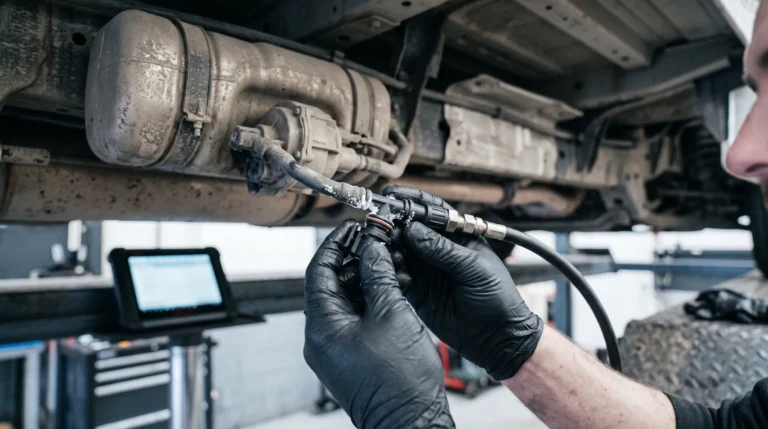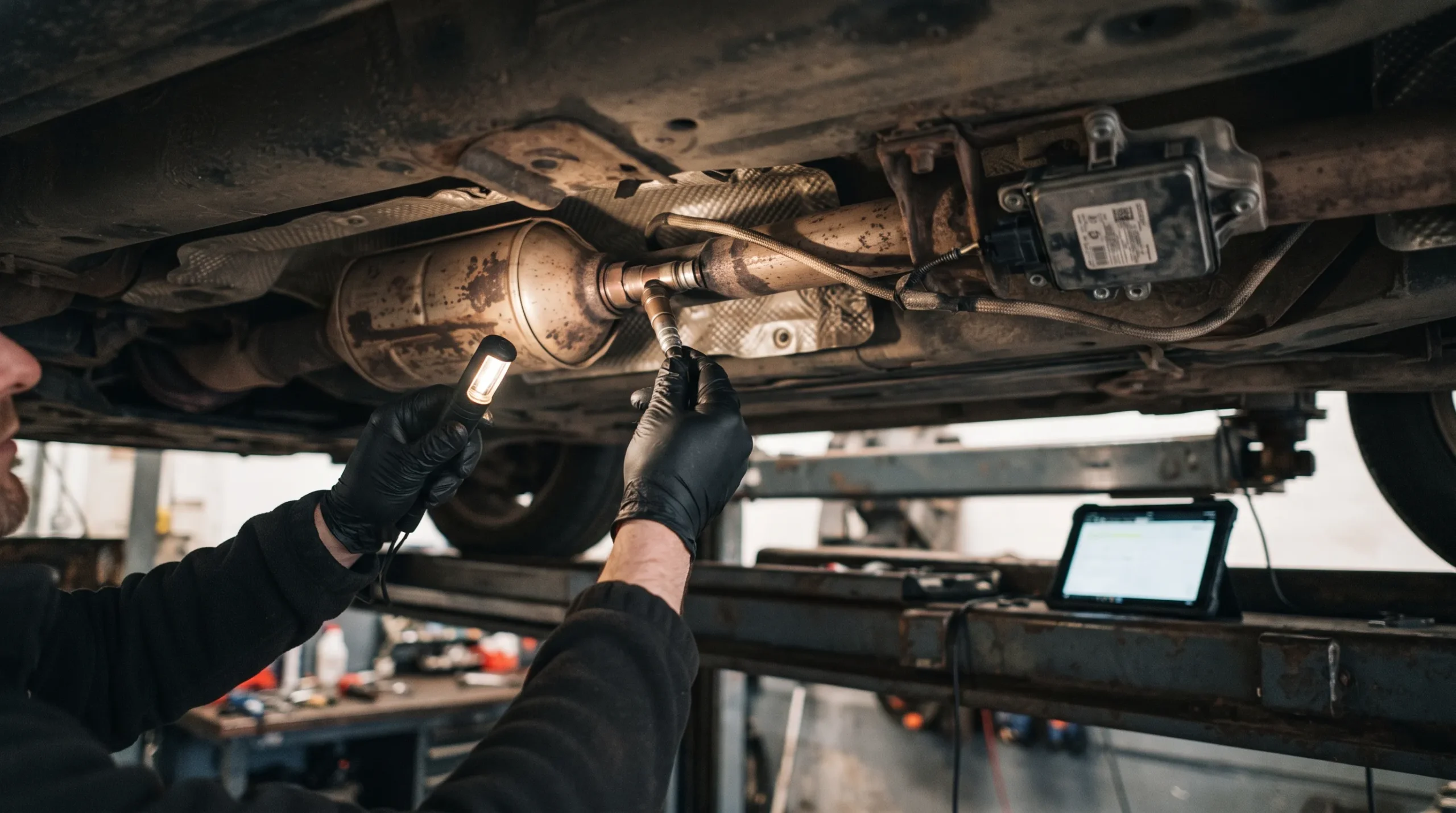

An AdBlue NOx sensor fault means one of the sensors monitoring nitrogen oxide levels in your exhaust, usually one positioned before the SCR catalyst and one after it, has stopped giving the ECU an accurate reading. It’s a different fault to a pressure or quality sensor issue, even though all three sit within the same broader AdBlue and SCR system and can produce a fairly similar looking warning on the dash.
That distinction genuinely matters. A NOx sensor’s whole job is confirming the SCR system is actually reducing emissions the way it’s supposed to, by comparing nitrogen oxide levels before and after AdBlue’s been dosed into the exhaust stream. Get a fault here, and the ECU loses its way of verifying the AdBlue system’s doing its job properly, even if the pump, injector and tank are all working completely fine.
We’ll go through what these sensors actually do, what causes them to fail, what you’ll notice on the dash, and how we diagnose this one properly rather than reaching for a sensor replacement on a guess.
What Do NOx Sensors Actually Do?
Most SCR equipped diesels run two NOx sensors. One sits upstream of the SCR catalyst, measuring nitrogen oxide levels in the exhaust before AdBlue’s had any chance to act on them. The second sits downstream, measuring NOx levels after the SCR process has run its course. The ECU compares the two readings constantly, confirming the catalyst’s actually converting NOx into nitrogen and water the way it’s designed to.
When that comparison doesn’t add up, either because the downstream reading isn’t dropping enough relative to the upstream one, or because one of the sensors simply stops reporting a credible number, the system logs a fault. It’s an important distinction from an AdBlue quality or pressure sensor fault, since those monitor the fluid itself rather than the actual emissions outcome the fluid’s meant to produce.
What Actually Causes a NOx Sensor Fault
A failed sensor is one of the most common causes, and it’s mechanically unsurprising given where these sensors live. They sit directly in the exhaust stream, exposed to extreme heat, constant vibration and exhaust gas contaminants for the vehicle’s entire life. Internal failure after years of that environment is a genuinely normal wear pattern, not a sign anything’s been done wrong.
Wiring and connector corrosion causes a huge proportion of what looks like a NOx sensor fault, in our experience. The connectors sit in an exposed spot underneath the vehicle, picking up road spray, salt and general grime constantly, and a corroded pin produces a signal that looks exactly like a failed sensor even when the sensor itself tests out fine.
Carbon and soot contamination on the sensor tip is a real cause too, particularly on vehicles with EGR or DPF issues running alongside the AdBlue system, since excess soot in the exhaust stream can coat the sensing element and throw off its readings without the sensor having actually failed internally.
An exhaust leak upstream of either sensor throws off the readings both sensors are taking, since the sensor’s measuring whatever gas mixture is actually reaching it, not necessarily what’s genuinely coming out of the engine. A leak lets outside air in or lets exhaust gas escape before it reaches the sensor properly, both of which skew the comparison the ECU’s relying on.
Sensor heater circuit faults matter here too, since most NOx sensors need to reach a specific operating temperature to give an accurate reading, and a failed heater element inside the sensor can produce a fault that looks like a reading problem when it’s actually a heating problem underneath it.
Symptoms You Might Notice
The AdBlue or emissions warning light is usually first, often with a dashboard message that references the SCR or NOx system specifically rather than AdBlue quality or level, depending on how your particular manufacturer labels it.
Reduced engine performance can show up noticeably sooner with a NOx sensor fault than with some other AdBlue faults, since the ECU’s lost its way of confirming emissions compliance directly rather than inferring it from pressure or dosing data alone.
A failed emissions test, if your vehicle’s due an MOT around the time this fault appears, is a strong practical indicator worth mentioning, since a NOx sensor fault directly affects the system responsible for the emissions figures being tested.
Increased fuel or AdBlue consumption sometimes follows too, if the ECU starts dosing more AdBlue than necessary while trying to compensate for readings it can no longer fully trust.
Can You Keep Driving With This Fault?
For a while, generally yes, particularly before any restart countdown message appears. The engine itself isn’t damaged by a NOx sensor fault on its own, and the fault doesn’t typically escalate as quickly as a dosing or pressure fault might.
That said, it’s genuinely worth getting checked sooner rather than later if an MOT’s coming up, since this fault can directly affect the emissions test result. Leaving it unresolved also risks the ECU compensating in ways that aren’t ideal for fuel or AdBlue consumption over the following weeks.
How We Diagnose a NOx Sensor Fault
We start with a full fault code scan, confirming exactly which sensor, upstream or downstream, is flagged, and what specific code is stored, since that narrows things down considerably before we’ve even looked at the vehicle itself.
From there we check the sensor’s actual output against expected values, rather than assuming the stored code alone tells the whole story. This is the step that separates a genuinely failed sensor from one that’s reporting accurately but reflecting a real problem elsewhere, such as an exhaust leak or a struggling SCR catalyst.
We inspect the wiring and connectors directly too, since corrosion produces symptoms that are functionally identical to a failed sensor from the dashboard’s point of view. Skip that check, replace the sensor outright, and the same fault often returns within weeks.
If the sensor and wiring both check out, we look at the exhaust system itself for leaks or damage upstream of the sensors, and at the SCR catalyst’s actual performance, since a failing catalyst can produce a NOx sensor fault even when both sensors are working exactly as they should.
The Fault Codes You’re Likely to See
P2200 and P2201 generally relate to the NOx sensor circuit itself, upstream or downstream depending on the exact code. P2203 and P2208 point toward circuit range or performance issues rather than a complete signal failure. P228A and P228B are common on a lot of modern SCR systems, usually referencing a correlation fault, where the upstream and downstream readings don’t match what the system expects relative to each other. P229E and P229F often point specifically at the sensor heater circuit rather than the sensing element itself.
Exactly which code your vehicle stores depends on the manufacturer’s own coding convention and which sensor’s affected. A code reader confirms there’s a NOx sensor problem. It doesn’t on its own confirm whether that’s the sensor, the wiring, an exhaust leak, or the catalyst behind it, which is why proper diagnosis matters more than the code alone.
NOx Sensor Fault or AdBlue Quality Sensor Fault? Why It’s Easy to Mix Up
These two get confused constantly, and it’s an easy mistake to make, since both sit within the SCR system and both can trigger a fairly similar looking dashboard warning. The NOx sensor measures emissions output directly. The AdBlue quality sensor measures the urea concentration of the fluid itself, a completely different measurement serving a different purpose entirely. Our guide on NOx sensor versus AdBlue quality sensor covers that distinction properly if you’re not sure which one applies to your situation.
A pressure sensor fault can look similar from the driver’s seat too, since all three ultimately trigger the same family of warning lights and reduced performance behaviour. Measuring each sensor’s actual output independently, rather than assuming the first likely looking cause is correct, is the only reliable way to tell them apart.
A Real Example Worth Knowing
We had a car recently showing a downstream NOx sensor fault, and the owner had already been quoted for a straight sensor replacement elsewhere. Testing showed the sensor itself was reading correctly. The actual cause was a small exhaust leak just ahead of the sensor, letting in enough outside air to throw the reading off without the sensor ever being at fault. Fixing the leak cleared the fault completely, and the sensor that would have been replaced unnecessarily stayed exactly where it was.
Does This Happen the Same Way on Every Make?
The underlying principle stays consistent across every SCR equipped diesel, but sensor positioning, heater circuit design and exposure to road grime varies by manufacturer. We see NOx sensor faults regularly on Volkswagen, Audi, BMW, Mercedes, Ford, Vauxhall, Peugeot, Citroën, Jaguar and Land Rover models. Our vehicles page has more manufacturer specific detail if you want to check your particular model first. Model specific guides on a Mercedes AdBlue light that keeps coming back on, Peugeot AdBlue faults, Audi AdBlue system faults, the Ford Transit P20EE fault and a Volkswagen AdBlue warning light after refill are worth checking too if any of those cover your specific vehicle.
Related AdBlue Guides Worth Reading
A few other guides connect closely with this one. Our broader AdBlue system fault codes explained guide and general AdBlue fault guide both give wider context beyond just NOx specific codes. Our article on AdBlue quality faults is worth reading if fluid concentration, rather than emissions output, turns out to be the actual issue, and our guide on AdBlue pressure sensor faults covers the third sensor type that’s commonly confused with this one.
If your warning light won’t clear even after a check, our guide on an AdBlue warning light that won’t clear explains why, and our piece on whether AdBlue crystallisation can be repaired covers a separate but occasionally related cause worth ruling out.
Our Services for This Kind of Fault
Fixing a NOx sensor fault properly usually draws on more than one of our core services, depending what’s actually found. Our AdBlue diagnosis service is always where this starts, confirming exactly what’s wrong before anything gets replaced. From there, our AdBlue repair service covers the sensor, wiring, or exhaust work itself, and our AdBlue reset service clears the fault properly once the underlying issue’s genuinely fixed rather than just cleared and waiting to come back.
Our dedicated NOx sensor service covers this fault specifically, and our general AdBlue fix page gives a wider view of what we handle across the system. For commercial vehicles, our HGV remapping service covers related emissions work on larger diesel fleets.
What Does This Typically Cost to Fix?
Diagnosis and repair for a NOx sensor fault starts from £249, a starting price rather than a fixed one. The actual cost depends on whether it’s the sensor itself, a wiring repair, an exhaust leak, or something further upstream in the SCR catalyst. We always confirm the exact cause and give a firm price before anything goes ahead.
Our page on system repair cost in the UK and what to expect sets out the wider cost picture across different AdBlue faults.
Areas We Cover
North London: We cover NOx sensor faults regularly across Barnet, Enfield, Haringey, Camden, Islington, Waltham Forest and Harrow.
East London: Hackney, Tower Hamlets, Newham and Redbridge make up a big part of our coverage, along with Barking and Dagenham, Havering and Greenwich.
South London: Lambeth, Southwark and Lewisham, plus Bromley, Bexley and Sutton further out toward the edge of the city. We also cover Merton, Wandsworth, Kingston upon Thames and Richmond upon Thames.
West London: Ealing, Hammersmith and Fulham and Hounslow, along with Hillingdon, Brent, Kensington and Chelsea and Westminster.
The Midlands and Shropshire: Wolverhampton, Solihull, Walsall, Dudley and Coventry, along with Stratford upon Avon, Rugby, Leamington Spa and Warwick. Further out, Lichfield, Cannock, Stafford, Stoke on Trent and Nuneaton, plus Telford, Oswestry, Bridgnorth and Shrewsbury.
East Midlands and Lincolnshire: Peterborough, Stamford, Spalding, Market Deeping, Grantham and Bourne.
Scotland: Dalkeith, Bonnyrigg, Bathgate, Musselburgh, Livingston, Penicuik and Broxburn, plus Edinburgh and Glasgow.
Further north: Leeds and Sheffield round out our wider coverage.
Not sure which page covers your postcode? Our main AdBlue repair London page and the full locations directory both list everywhere we currently work.
Quick Answers
01 Can I test a NOx sensor myself at home?
Not reliably. Confirming whether the sensor’s genuinely faulty, or accurately reporting a real problem elsewhere like an exhaust leak, needs proper diagnostic equipment measuring actual sensor output, not just the dashboard fault code.
02 Will replacing the sensor definitely fix the fault?
Only if the sensor’s actually the cause. An exhaust leak, corroded wiring, or a struggling SCR catalyst won’t be fixed by a new sensor, and the fault comes straight back.
03 How long do NOx sensors usually last?
No fixed lifespan. They’re exposed to extreme heat and exhaust gases constantly, so wear varies a lot by driving pattern, mileage and general vehicle condition. Some fail suddenly, others drift gradually.
04 Is this fault covered under warranty?
It can be, depending on your vehicle’s age, mileage and the manufacturer’s emissions component warranty terms. Worth checking with your dealer, though plenty of drivers come to us once a warranty’s already lapsed.
05 Does low AdBlue level cause this specific fault?
No. This fault relates to emissions sensors, not fluid level. A low level triggers its own separate warning, so if the tank’s topped up and this fault’s still showing, it isn’t a level problem.
06 Can a general garage diagnose this properly?
A general garage can read the stored code, but confirming whether it’s the sensor, the wiring, an exhaust leak, or the catalyst usually needs equipment and experience specific to SCR systems. A lot of these vehicles end up with a specialist after a general diagnosis hasn’t fully sorted things.
07 Will this fault affect my MOT?
It can, yes, particularly if the test falls while the fault’s showing, since this fault directly concerns the system responsible for emissions compliance.
08 Does this fault affect HGVs as well as cars and vans?
Yes, the same principle applies to any diesel vehicle running SCR emissions control. For commercial vehicles, our HGV remapping page covers related work on larger diesel fleets.
09 How quickly can this usually be repaired?
Once the actual cause is confirmed, most sensor and wiring related repairs are on the same day. An exhaust leak repair can take a little longer depending on parts and access.
10 Can this fault damage the engine if left too long?
Not the engine directly, though leaving an exhaust leak or a struggling catalyst unaddressed can let the underlying problem worsen, and what might’ve been a straightforward repair early on can become more involved the longer it sits.
11 Why does my downstream sensor fault keep coming back after a reset?
If only the warning’s cleared without the actual cause being fixed, the fault simply returns once the ECU runs its checks again. That’s exactly why we confirm and fix the real cause rather than just resetting the warning light.
Book Your AdBlue Diagnosis
Dashboard showing an AdBlue or emissions warning and you suspect a NOx sensor fault? Get in touch through our contact page and we’ll book a proper diagnosis before anything gets replaced unnecessarily. Catching this early is almost always the easier and cheaper route.