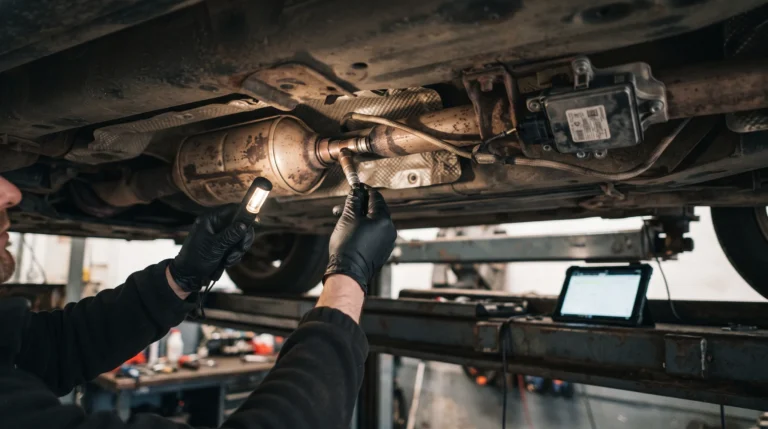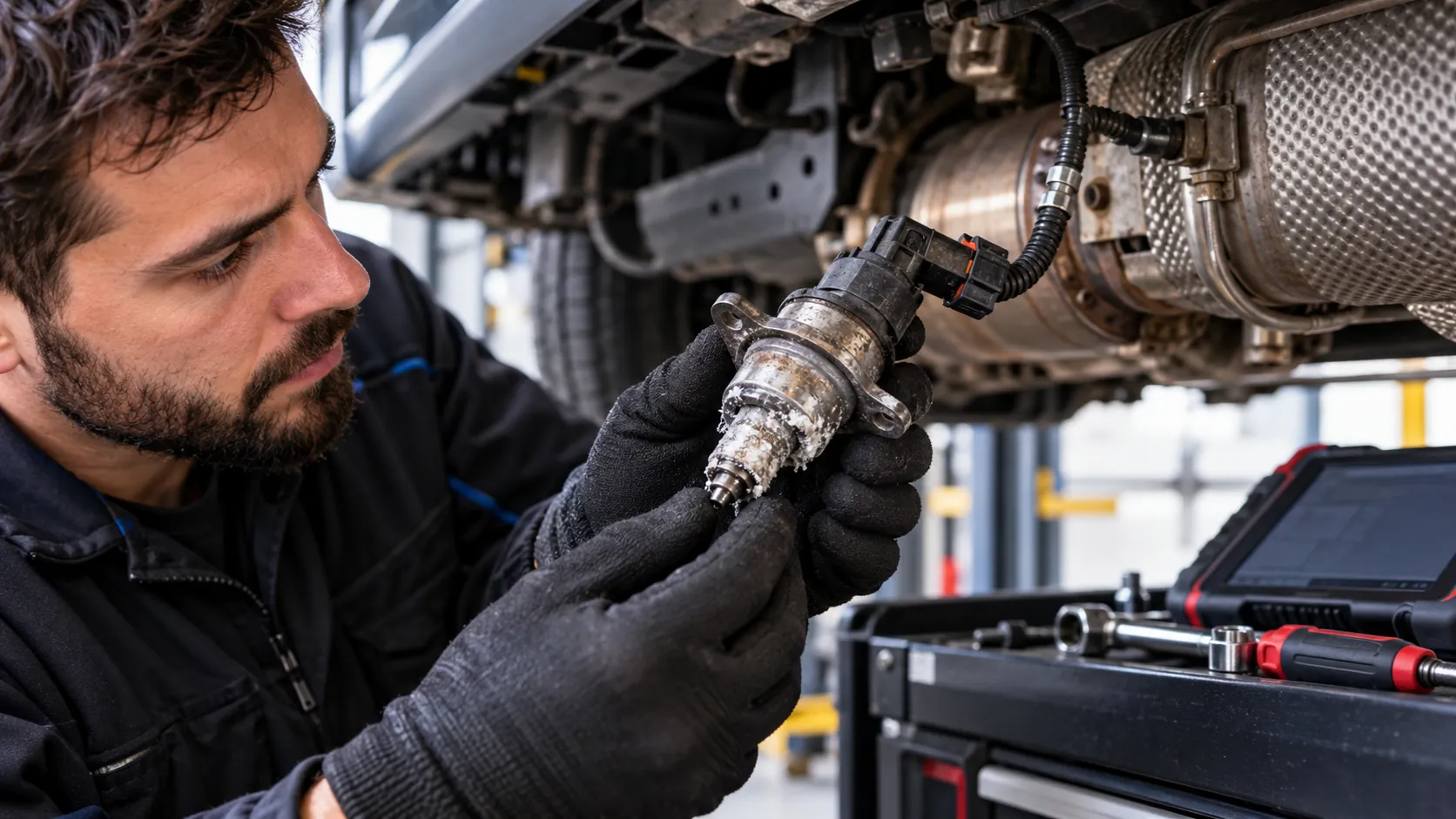

If your AdBlue injector has stopped opening, the SCR system can’t get urea into the exhaust stream, and your car will usually let you know about it within a few miles. A warning light comes on, a fault code gets stored, and eventually a countdown message shows up telling you the engine won’t restart after so many miles or starts. The injector itself, sometimes called the dosing valve or dosing module depending on who made your car, is a small solenoid sitting on or near the exhaust that fires short bursts of AdBlue on a schedule set by the ECU. When it won’t open, nothing gets dosed. Simple as that.
That’s different from a valve that’s leaking or dribbling AdBlue constantly, which is its own separate fault with its own causes. A valve that just refuses to open is almost always mechanical or electrical, and here in London, where so much driving is short hops and stop start traffic, it’s genuinely one of the most common reasons cars end up on our ramp for AdBlue diagnosis.
We’re going to go through what actually causes this, what to watch for before it gets worse, how we diagnose it properly, and what it tends to cost to put right.
What’s Actually Stopping the Valve From Opening
The dosing valve is built around a solenoid coil and a small pintle, or needle, that lifts off its seat the moment the coil gets energised. A handful of things can stop that movement from happening, and they’re not all equally common, so it’s worth knowing which one you’re more likely dealing with.
Crystallised urea is the big one, by far the most common cause we see. AdBlue is roughly 32.5% urea dissolved in deionised water. If it sits still in the lines or around the injector tip for too long, or picks up heat from a nearby exhaust component, the water evaporates and leaves solid urea crystals behind. Those crystals physically wedge the pintle shut. This shows up most on cars doing a lot of short journeys, cars that have sat unused for weeks at a time, or cars that had a slow AdBlue leak nobody noticed until residue built up around the valve.
Then there’s a seized pintle from plain inactivity, which is a slightly different thing from crystallisation, though the two often get lumped together. If a car’s been off the road for a stretch, whether that’s a fleet vehicle parked up or just someone’s car that hasn’t moved much, the valve can stick even without visible crystals, because the small amount of lubrication it relies on has simply dried out.
A failed solenoid coil is more of a straightforward electrical fault. The coil either has continuity or it doesn’t, and if it’s burnt out or shorted internally, no amount of voltage from the ECU is going to make that pintle lift. We usually confirm this with a resistance check across the connector pins, and it’s either clearly within spec or clearly not.
Corroded or damaged wiring catches a lot of people out, honestly. Injectors mounted close to the exhaust take a beating from heat cycling and road spray over the years, and a corroded pin or a cracked connector housing can interrupt the signal entirely, even when the valve itself is mechanically fine. We’ve seen more than one car where the whole “faulty injector” turned out to be nothing more than a corroded connector.
An ECU driver circuit fault is rarer, but it does happen. The ECU has a dedicated output stage that switches the injector on and off, and if that circuit has failed, the valve gets no signal at all no matter what condition it’s in. This is exactly why a proper diagnosis checks both ends of the circuit rather than assuming the injector is automatically the culprit.
Signs You’ll Notice Before It Fails Completely
The AdBlue warning light is usually the first thing you’ll see, sometimes weeks ahead of anything more serious. A few drivers mention a slightly rougher idle or a faint change in exhaust smell around the same time, though neither of those is something you can rely on by itself.
Once the system logs that dosing isn’t happening the way it’s supposed to, you’ll typically get a specific SCR or NOx related fault code, plus a dashboard message referencing AdBlue or the emissions system depending on your manufacturer. From there, most cars drop into a reduced performance mode, and eventually that countdown appears, warning you the engine won’t restart after a set number of miles or starts. That escalation isn’t about safety. It exists because manufacturers are legally required to stop a car running indefinitely without proper emissions control.
Is It Actually Safe to Keep Driving Like This?
In the early stage, before any countdown shows up, yes, generally speaking. The engine itself isn’t being damaged by a stuck dosing valve, and you won’t notice much difference in how the car drives until it hits that reduced power or countdown phase. That said, don’t just leave it and hope. Once the countdown starts, you’re working against a fixed number of miles or starts before the car won’t restart at all, and that timing is rarely convenient. Getting it looked at as soon as the light comes on, rather than waiting to see what happens, saves you from being stuck somewhere you don’t want to be.
How We Diagnose a Stuck Injector Properly
We start with a full scan for stored and pending fault codes, which narrows things down before anyone even touches the valve. From there we check the electrical side directly, measuring coil resistance and making sure the connector and wiring are carrying a clean signal from the ECU through to the valve.
If the electrical side checks out fine, we move on to the mechanical side, which generally means pulling the injector out to inspect it for crystallisation or physical seizure. A valve that’s crystallised shut can sometimes be cleaned and tested rather than replaced outright. It really depends how far the crystallisation has gone and whether the pintle’s been damaged from being forced against it repeatedly.
We also check system pressure and flow at the same time, because a valve that’s technically capable of opening but isn’t getting enough AdBlue pressure behind it can look almost identical from the driver’s seat. Treating this as a simple injector swap without checking pressure first is one of the more common reasons a repair doesn’t actually fix anything, and the car’s back with the same light on a few weeks later.
Common Fault Codes Linked to This Fault
| Fault code | What it typically points to |
| P204F | Reductant injector circuit malfunction |
| P2047 | Reductant injector circuit open |
| P2048 | Reductant injector circuit low |
| P2050 | Reductant injector circuit high |
| P229F | Reductant metering unit fault |
These codes shift slightly by manufacturer, and which one your car actually stores depends more on how the ECU has interpreted the fault than on the root cause alone. That’s really the whole point here. A code reader on its own won’t tell you whether you’re looking at electrical, mechanical, or a pressure problem, it just tells you something’s wrong in that area.
Why Crystallisation Keeps Coming Back to This Fault
It’s worth spending a bit more time on crystallisation specifically, because it’s the cause behind most of the calls we get about this exact issue. AdBlue doesn’t just sit inert in the system waiting to be used. It’s constantly exposed to heat from the exhaust and engine bay, and every time a car sits for a while, whatever’s left in the lines closest to the injector has a chance to start drying out.
On a car doing regular motorway miles, that’s rarely an issue, because the system’s cycling fluid often enough that nothing gets the chance to sit and evaporate. On a car doing mostly short urban trips, though, which describes an awful lot of London driving, the exhaust never really gets up to a consistent operating temperature, dosing happens less predictably, and the fluid closest to the tip of the injector is far more likely to sit there long enough to crystallise. We genuinely see this pattern again and again, and it’s a big part of why this fault turns up so often on cars that spend most of their life doing school runs, deliveries, or commuter journeys around town rather than longer trips out of the city.
Does This Happen the Same Way on Every Make?
Not exactly. The underlying principle’s the same across every SCR equipped diesel, but the injector’s location and how exposed it is to heat and road grime does vary by manufacturer. We see this fault regularly on Volkswagen, Audi, BMW, Mercedes, Ford, Vauxhall, Peugeot, Citroën, Jaguar and Land Rover models, and our vehicles page goes into more manufacturer specific detail if you’d rather check your particular model before booking anything in.
What Happens If You Just Leave It
Beyond the eventual no restart countdown, ignoring a stuck injector tends to make the repair more involved, not less. Crystallisation doesn’t reverse itself. It usually gets worse the longer AdBlue sits stagnant around the tip, and a valve that could’ve been cleaned and reused early on sometimes needs full replacement by the time it actually gets looked at, purely because the crystals have had longer to harden and the pintle’s been forced against them over and over.
There’s also a knock on cost consideration a lot of people don’t think about until it’s too late. A wiring fault left alone can spread if the corrosion causing it keeps progressing, and a valve that’s been repeatedly forced by the ECU trying to actuate it can end up mechanically damaged even if the original problem was something simpler, like a build up of crystals that could’ve been cleared out early on.
Repair Options and What It Costs
Diagnosis and repair for a dosing valve that won’t open starts from £249, a starting price rather than a fixed one, since what you actually pay depends on whether it’s a clean and test, a full injector replacement, a wiring repair, or something further upstream like pressure or pump related. We’ll always confirm the exact cause first and give you a firm price before any work goes ahead, rather than quoting blind and hoping it’s right. Our AdBlue repair and AdBlue diagnosis London pages set out what’s included, and if your dashboard’s already showing a restart countdown, our AdBlue countdown London page covers that specific stage and what to do about it.
AdBlue Injector Repair Across London
We cover this fault right across London, from the central boroughs out to the edges, and every area we work in has its own dedicated AdBlue repair page with local coverage details: Barnet, Barking and Dagenham, Bexley, Bromley, Brent, Camden, Ealing, Enfield, Greenwich, Hackney, Hammersmith and Fulham, Haringey, Harrow, Havering, Hillingdon, Hounslow, Islington, Kensington and Chelsea, Kingston upon Thames, Lambeth, Lewisham, Merton, Newham, Redbridge, Richmond upon Thames, Southwark, Sutton, Tower Hamlets, Waltham Forest, Wandsworth and Westminster.
Not sure which page covers your specific area? Our main AdBlue repair London page and the full locations directory both list everywhere we currently work.
Related AdBlue Problems Worth Reading
A few other guides cover faults that sit close to this one, worth a read if you’re not entirely sure yet what you’re dealing with. Our piece on an AdBlue injector stuck closed goes through the symptom side of this exact fault in more depth. If your warning light won’t clear even after a refill, our guide on an AdBlue warning light that won’t clear explains why that happens. If your dashboard’s already counting down miles or starts, our article on no engine restart within X miles covers that stage and what your options actually are. And for a wider look at what different fault codes mean beyond just this one, our AdBlue system fault codes explained guide is a useful companion read.
AdBlue Injector FAQs
Get clear answers about AdBlue injector faults, crystallisation, cleaning, diagnosis, repair, replacement and preventing repeat problems.
We wouldn’t recommend it, honestly. The injector needs to come out cleanly without damaging the pintle or the seal, and testing it afterward means confirming it’s actually firing correctly, not just that it looks clean. A botched attempt at home often costs more to fix afterward than just booking the job properly from the start.
There’s no fixed lifespan. It depends heavily on how the car’s driven. Cars doing mostly motorway miles tend to see far less crystallisation than cars doing short urban trips, which is exactly why this fault shows up more in city driving than on long distance cars.
Sometimes, if the cause is light crystallisation caught early on. It won’t do anything for a failed coil, damaged wiring, or a pintle that’s seized from mechanical wear rather than crystal build up though. That’s really why a proper diagnosis matters before spending money on an additive that might not even touch the actual problem.
It can be, depending on your vehicle’s age, mileage, and the manufacturer’s emissions component warranty terms. Worth checking with your dealer first, though plenty of drivers end up coming to us once a warranty’s already lapsed or a dealer quote came back higher than they expected.
No, not usually, and this is a common misconception. In most cases it’s isolated to the injector itself, the wiring feeding it, or the pressure supplying it. Replacing the entire SCR system is rarely necessary just because the injector’s failed.
Cold weather makes AdBlue more prone to sitting without moving properly through the lines, and short winter journeys, where the exhaust never fully reaches operating temperature, give crystallisation more of a chance to form. It’s not exclusively a winter fault, but we do see more of it once temperatures drop.
A general garage can read the fault code well enough, but confirming whether it’s the injector, the wiring, the ECU driver circuit, or system pressure usually takes equipment and experience specific to SCR systems. That’s exactly why a lot of these cars end up with a specialist after a general diagnosis hasn’t fully sorted things.
On most vehicles they’re the same component, just called different things depending on the manufacturer. A few platforms separate the dosing module, which meters the fluid, from the injector nozzle itself, but functionally they still work together as one unit.
Not directly, no. A low level triggers its own separate warning and eventually its own restriction, but it doesn’t stop the injector opening mechanically. If the tank’s topped up and the light still hasn’t cleared, that usually points to one of the faults covered above rather than fluid level.
Topping up won’t do any harm, but it also won’t fix a faulty injector, and if crystallisation is the cause, adding more fluid on top of a partially blocked system doesn’t resolve the blockage. Best to get it diagnosed properly rather than guessing and hoping it sorts itself out.
Once the actual cause is confirmed, most injector related repairs are the same day. That said, it does depend on whether a replacement part needs sourcing or is already in stock with us.
Yes, the same principle applies to any diesel vehicle running SCR emissions control, HGVs included. If you’re dealing with this on a commercial vehicle, our HGV remapping and NOx sensor pages cover related commercial vehicle emissions work.
To some extent, yes. Cars that get a longer run every so often, enough for the exhaust to properly reach operating temperature, tend to see far less crystallisation than cars that only ever do short stop start trips. It won’t guarantee you never see this fault, but it does genuinely reduce how often we see it on cars that get a mix of driving rather than purely short journeys.
Get It Diagnosed Properly
If your AdBlue warning light’s on and you suspect the injector isn’t opening the way it should, get in touch through our contact page and we’ll book a proper diagnosis before anything gets replaced unnecessarily. Catching it early, before that restart countdown appears, is almost always the easier and cheaper path.