
Sometimes. Sometimes not. Annoying answer, we know, but it’s the true one, and it’s the question we get asked almost every week here at AdBlue Fault, usually by someone who’s already been quoted a full pump replacement somewhere else and isn’t convinced that’s actually necessary.
A fair few of those people are right to be unsure. We regularly find a clogged filter or a corroded connector sitting behind what looked, on the surface, like a dead pump. Other times the pump really is finished, and no amount of cleaning or wiring work changes that. The only way to know which one you’re dealing with is to actually check, not guess from a dashboard warning.
What does the AdBlue pump even do?
It pulls fluid out of the tank and pushes it through to the injector at whatever pressure the system needs that moment, so the exhaust gets dosed accurately and NOx emissions stay where they’re supposed to be. Simple job on paper. Harder in practice, because it’s running almost the whole time the engine’s on, and the fluid it’s moving crystallises the second it dries out anywhere and corrodes a few metals it shouldn’t really touch for years on end.
That combination wears parts down in ways that aren’t always obvious from outside. A pump that sounds fine isn’t necessarily fine. One that sounds rough isn’t automatically dying either.
Which pump faults can actually be fixed?
More than people expect, honestly.
Clogged filters are the big one. The pump draws fluid through a filter before it ever reaches the line, and once that filter’s packed with crystallised urea or general gunk, the pump has to work way harder than it should just to pull anything through. From the dashboard, that looks exactly like a pressure fault. From under the vehicle, it’s usually just a filter that needs cleaning or swapping, and the pump itself turns out to be completely fine once that’s done.
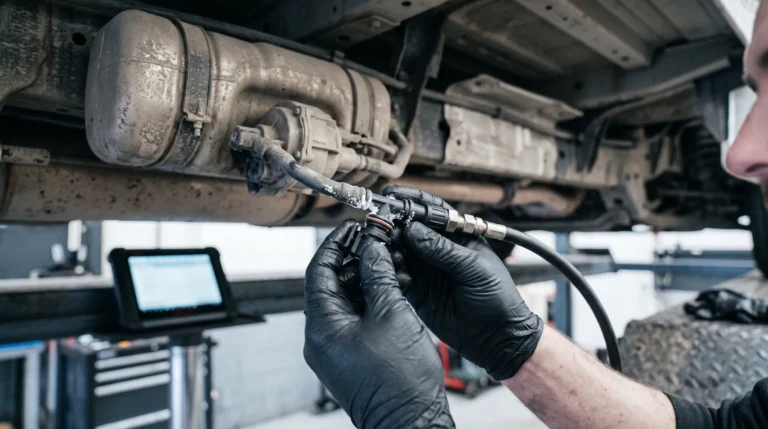
Wiring is the other one we see constantly, maybe even more than the filter issue if we’re being honest about it. The pump’s connector sits somewhere exposed, picking up damp and road grime for years, and a corroded pin inside it can produce a fault code that reads identically to a genuinely failed pump. We had a Transit come in a while back already quoted for a full pump by another garage. Took us about half an hour to trace it to the connector instead. Cleaned it up, reset the fault, van was back on the road that same afternoon for a lot less than a new pump would’ve cost.
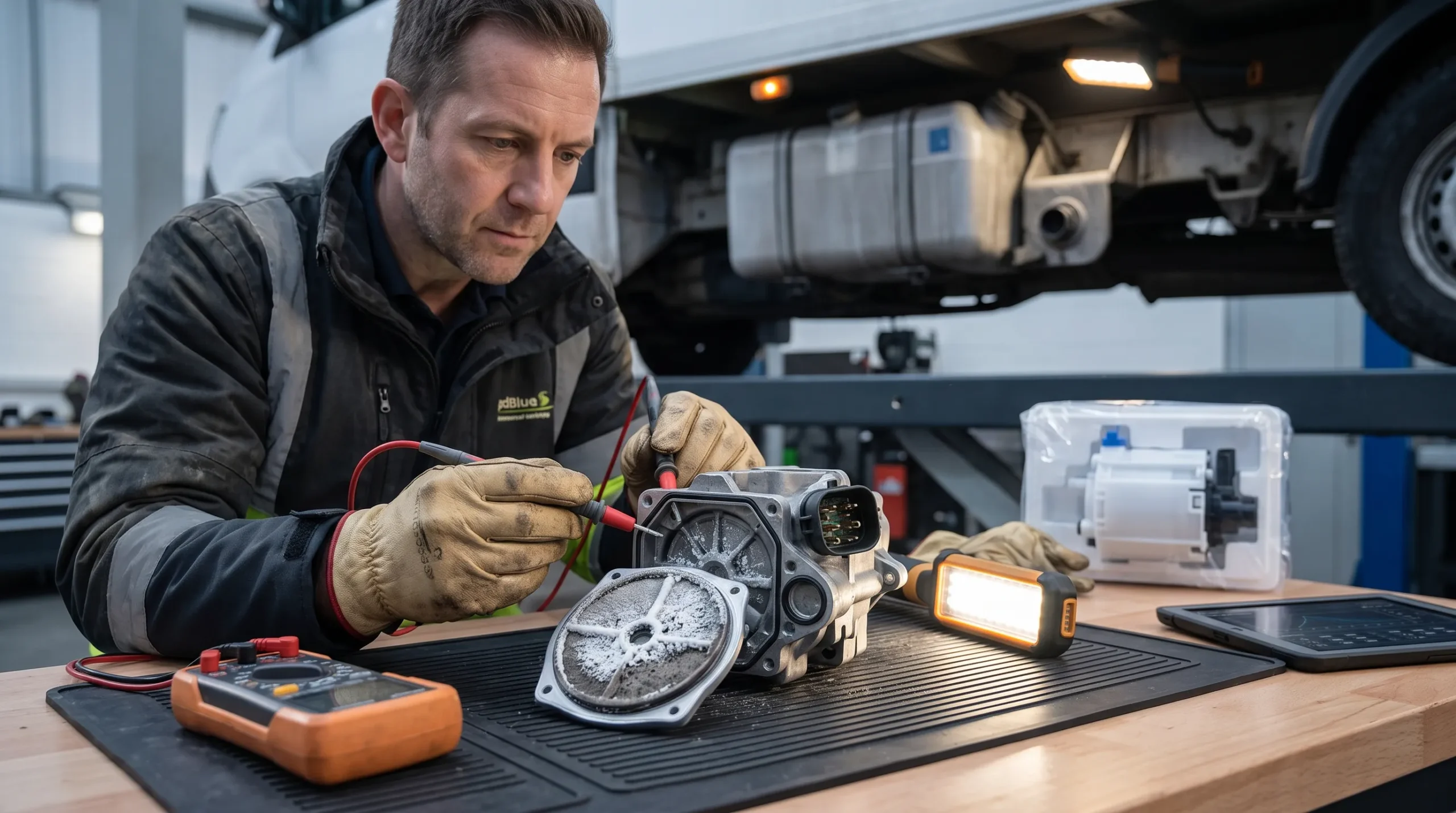
Crystallisation around the inlet is a third one worth knowing. AdBlue’s roughly a third urea in water, and if it sits still near the pump for too long, the water evaporates and leaves hard crystals behind that choke off flow. Clean that area out properly and the pump often goes right back to working normally.
Occasionally a stuck non return valve inside the pump housing can be freed up or swapped on its own too, depending on how that particular pump’s built.
“And which faults mean it has to be replaced?”
Some don’t leave any other option, and we’re not going to pretend otherwise just to make a smaller job sound more appealing.
If the motor’s burnt out internally, or it’s worn to a point where it physically can’t build pressure anymore no matter how clean everything around it is, that’s a replacement. These things are sealed units. There’s no rebuilding a burnt motor on a driveway.
Internal corrosion that’s actually eaten into the housing or the moving parts inside is the same story. AdBlue will corrode the wrong metals over a long enough stretch, especially if anything other than genuine fluid’s ever gone through the system, and once that damage is structural rather than electrical, cleaning won’t undo it.
A pump that’s seized solid, where the motor simply won’t turn even with power getting to it properly, is replacement territory too. Nothing left to free up at that point.
How do you actually tell the two apart?
Not by guessing, and definitely not by defaulting to whichever answer happens to be quicker to quote on the phone.
We start with a full fault code scan, since the exact pattern stored often tells us a lot before we’ve even opened the bonnet. Then we check real delivered pressure against what the pump’s supposed to be producing, because a dashboard warning alone doesn’t tell you much on its own.
If pressure’s low, the next step is checking that power and signal are actually reaching the pump properly, since a wiring fault can look exactly like a weak pump without the pump having a single thing wrong with it. After that we check the filter and inlet for crystallisation, because a pump straining against a half blocked filter looks a lot like a pump that’s simply wearing out, right up until the filter’s cleaned and the fault disappears entirely on its own.
Only once wiring, filtration, and crystallisation have all been ruled out do we treat the pump as the actual cause. At that stage, if it still won’t build proper pressure with everything else confirmed clean, replacing it is the honest call, not a repair that’s just going to fail again in a fortnight.
What should make you suspect the pump specifically?
The AdBlue warning light tends to show up first, usually with a dashboard message pointing at the AdBlue or emissions system rather than anything more specific. Worth mentioning if the pump sounds louder than usual too, or like it’s running almost constantly rather than cycling on and off the way it normally would. That detail alone, told to whoever’s diagnosing it, can save real time.
Leave it long enough and performance starts dropping, since the ECU limits how the engine runs once it can’t trust that dosing’s happening accurately. A restart countdown often follows that, same pattern most AdBlue faults eventually reach once nothing’s been done about them.
Two jobs, same symptoms, completely different outcomes
A Vivaro came to us not long ago with everything pointing at a dead pump. Pressure was low, the pump was running flat out almost nonstop, and the driver had already made peace with a big bill. Turned out the filter was so clogged with crystallised urea that the pump was basically fighting its own fuel supply the whole time. New filter, proper clean of the inlet, fault gone. The pump itself never needed touching.
A Sprinter we looked at not long after that one told a different story. Same starting symptoms almost exactly, loud pump, low pressure. This time though, cleaning the filter changed nothing. Pressure testing showed the motor genuinely couldn’t build the pressure it needed, even with every other part of the system checked and clean. That one needed a new pump, and we told the customer plainly rather than trying to patch something that wasn’t going to hold.
What does this actually cost?
Depends entirely on which of the above it turns out to be, and we always confirm that before quoting a firm figure rather than pricing blind over the phone. A filter clean or a connector repair sits well under the cost of a full pump, often by several hundred pounds.
Our guide on AdBlue pump replacement cost in the UK breaks that specific number down further, and our page on system repair cost in the UK and what to expect shows how pump work compares against other common AdBlue repairs we see.
Could this actually be a sensor fault instead?
Worth checking before anyone touches the pump. A pressure sensor reporting the wrong value can mimic a pump that’s failing to build pressure, even when the pump underneath is completely healthy. Our guide on AdBlue pressure sensor faults covers exactly that overlap, and it’s one of the first things we rule out before the pump gets blamed for anything.
There’s a broader version of this too, where the whole system’s struggling to hold pressure rather than just the pump. Our page on an AdBlue system not holding pressure covers that wider picture if your symptoms don’t line up neatly with a straightforward pump fault.
Does crystallisation only ever affect the pump?
No, not at all. It can build up anywhere fluid sits still for long enough, not just around the inlet. Our guide on whether AdBlue crystallisation can be repaired covers that issue on its own terms, beyond just how it affects the pump.
Is a weak pump the same thing as a quality sensor fault?
Easy to confuse from the dashboard, but they’re genuinely different problems underneath. A quality sensor fault is about what the ECU thinks of the fluid itself. A pump fault is about pressure in the delivery system. Our guide on NOx sensor versus AdBlue quality sensor untangles that properly if your symptoms don’t quite match what’s been described here.
Will the warning clear by itself once the pump’s sorted?
Usually not, not without a proper reset once the real fault’s genuinely fixed. Our guide on an AdBlue warning light that won’t clear explains why that light can hang around even after everything underneath is fine, and our AdBlue fault guide and AdBlue system fault codes explained pages give wider context if your scan tool’s thrown up something we haven’t covered here directly.
What we actually do about it
Fixing a pump fault properly usually pulls in more than one of our services, depending what’s actually found. AdBlue diagnosis is always where this starts, confirming what’s genuinely wrong before anything gets replaced for no reason. AdBlue repair covers the filter, wiring, or pump work itself, and AdBlue reset clears the fault properly once the real cause is actually dealt with.
If a pump issue turns out to connect to a wider sensor problem, our NOx sensor service picks that up. AdBlue bypass remains available as advice and support for suitable vehicles where that’s being considered, with legal requirements and intended use taken into account. For commercial vehicles, HGV remapping covers related emissions work on larger diesel fleets.
Does it matter what you drive?
A little. The mechanics are the same across any SCR diesel, but pump placement and how exposed it is to road grime differs by manufacturer. We see pump trouble regularly on Volkswagen, Audi, BMW, Mercedes, Ford, Vauxhall, Peugeot, Citroën, Jaguar and Land Rover models. Check our vehicles page if you want more detail on your specific one.
Where we cover this across London
North London
Barnet and Enfield see a lot of this, probably down to how much short, stop start driving feeds the crystallisation that sits behind plenty of these faults. We’re also out regularly in Haringey, Camden, Islington, Waltham Forest and Harrow, each with its own page covering what we offer locally.
East London
Hackney, Tower Hamlets, Newham and Redbridge make up a big chunk of our east London work. Further out we cover Barking and Dagenham, Havering and Greenwich too.
South London
South of the river we’re regularly in Lambeth, Southwark and Lewisham, along with Bromley, Bexley and Sutton out toward the edge. Merton, Wandsworth, Kingston upon Thames and Richmond upon Thames are covered too, each with their own local page.
West London
West London rounds things out, including Ealing, Hammersmith and Fulham and Hounslow. Hillingdon, Brent, Kensington and Chelsea and Westminster each have their own page too.
Not sure which page covers your postcode? Our AdBlue repair London page and the full locations directory list everywhere we currently reach.
AdBlue Pump FAQs
Clear answers about AdBlue pump faults, diagnosis, repair, replacement, pressure problems and common causes.
Not reliably. It needs an actual check of wiring, filtration and real delivered pressure before anyone can say which one applies.
Generally yes. A clogged filter or a corroded connector costs a fraction of a new pump. If the motor’s genuinely dead though, trying to repair around it just delays the inevitable.
Sometimes, unfortunately, more often than with a specialist. It’s part of why we check wiring and filtration before ever pricing up a new pump.
Only the ones actually caused by a clogged filter. If the real issue is a worn motor or a wiring fault, cleaning the filter won’t touch it, which is exactly why the cause needs confirming first.
There’s no set lifespan. It comes down to driving pattern, how often the tank’s run close to empty, and general upkeep. Some last years without a hint of trouble, others struggle sooner if crystallisation’s been allowed to build up.
Doing it repeatedly can contribute to wear, since the pump ends up drawing air instead of fluid in that moment. Keeping the tank reasonably topped up avoids adding unnecessary strain.
No. That fixes a level problem, not a pump one. If the pump’s genuinely struggling, the warning stays no matter how full the tank is.
Possibly, depending on your vehicle’s age and the manufacturer’s emissions warranty terms. Every repair we carry out also comes with its own workmanship warranty on top of that.
A filter clean or wiring fix is usually same day once the cause is confirmed. A full pump swap can take a little longer depending on parts availability for your particular vehicle.
Yes, the same mechanics apply to any SCR diesel. Our HGV remapping page covers related work on larger diesel fleets if that’s relevant to you.
It can add strain elsewhere over time, particularly if the ECU keeps compensating for low pressure for too long. Catching it earlier usually keeps the job smaller and cheaper.
Not dangerous to you directly, no. But leave it long enough and you’re looking at reduced performance, or eventually a restart countdown once the system decides it can’t guarantee proper dosing anymore.
Book Your AdBlue Pump Diagnosis
Think your pump’s behind a pressure fault or a warning that won’t go away? Get in touch through our contact page and we’ll book in a proper diagnosis before anything gets replaced that doesn’t need to be. Confirming the real cause first is almost always the cheaper route, and usually the quicker one too.