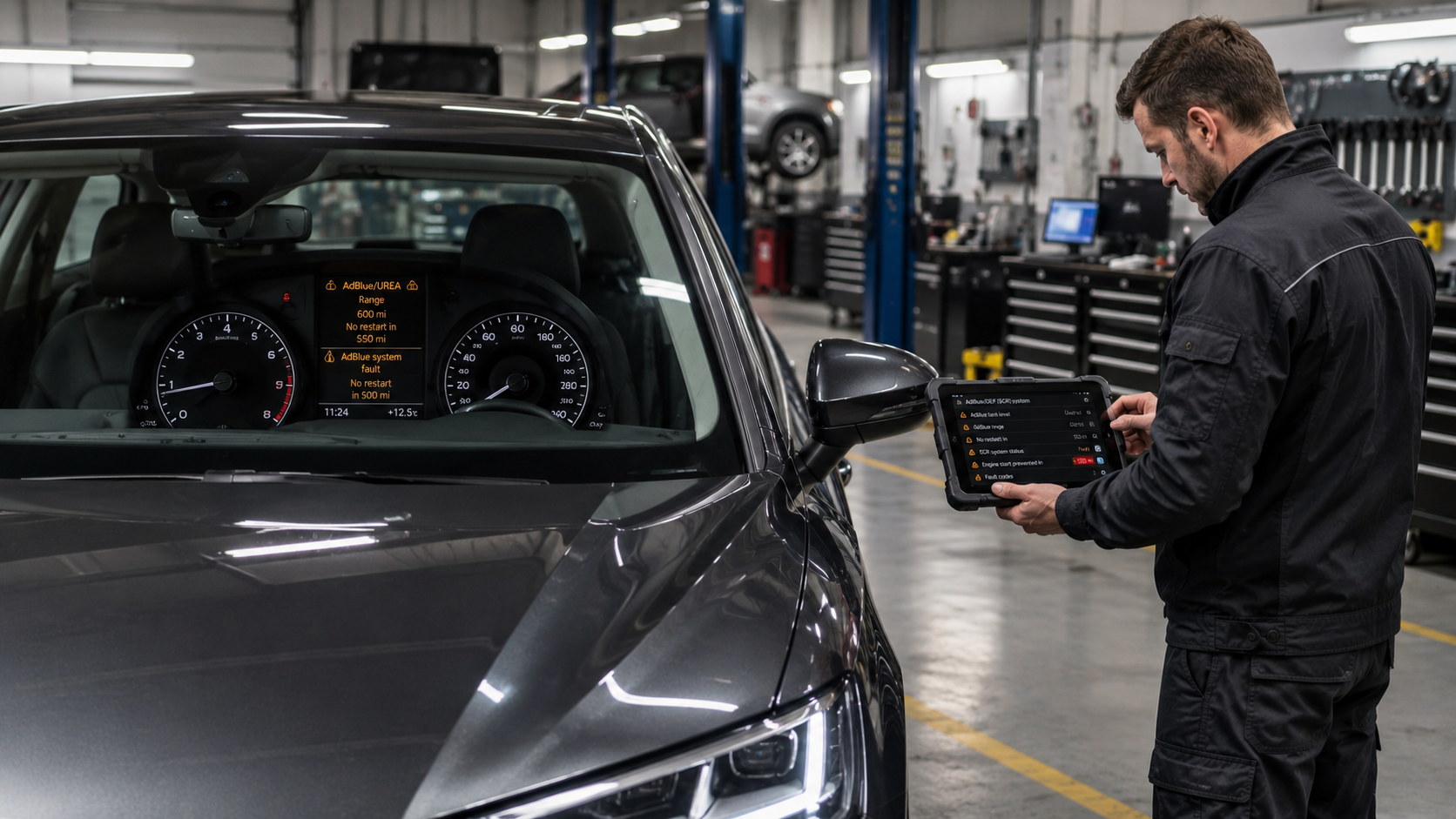

An AdBlue sign on your dashboard means either your AdBlue fluid level is low and needs topping up, or there is a fault with the SCR (Selective Catalytic Reduction) emissions system that requires professional diagnosis. The specific symbol, colour, and any accompanying message tell you which situation you are dealing with and whether topping up the fluid will resolve it or whether a component has failed. This guide explains every AdBlue dashboard sign you are likely to see, what each one means, and the correct response to each.
Why There Is More Than One AdBlue Dashboard Sign
Most drivers expect a single warning light, one symbol that means one thing. AdBlue systems do not work that way. Modern diesel vehicles with SCR systems display different dashboard signs depending on the severity and type of issue detected:
- A level warning tells you the tank is running low
- A system fault warning tells you a component has failed
- A countdown warning tells you how many miles remain before the engine will not restart
- A no-restart warning tells you the vehicle will not start again once switched off
Each of these requires a different response. Reading the symbol correctly rather than treating any AdBlue light as the same problem is what determines whether you top up and drive on, or arrange diagnosis before the situation becomes more serious.
The Most Common AdBlue Dashboard Signs Explained
The AdBlue Fluid Level Warning
What it looks like: On most vehicles, a blue or amber dashboard light with the text “AdBlue” or “DEF,” often accompanied by a fuel-gauge-style icon showing a low level. Some vehicles display the warning in the instrument cluster information panel rather than as a traditional dashboard light.
What it means: The AdBlue tank is running low. Most vehicles display this first warning when approximately 1,500 to 2,400 miles of AdBlue range remain. The vehicle drives completely normally at this stage.
What to do: Top up with AdBlue fluid before the countdown reaches zero. AdBlue is available from most petrol forecourts and motor factors. Check your vehicle handbook for the filler location. It is typically a blue cap near the diesel filler or in the boot and the tank capacity. Drive for 5 to 10 minutes after topping up to allow the system to confirm the new level. The warning should be clear.
Important: If the warning does not clear after topping up correctly, the issue is not the fluid level a fault code has been stored and diagnosis is required. Do not assume a second top-up will fix it.
The AdBlue Countdown Warning
What it looks like: A more prominent version of the level warning, often with a specific miles-remaining figure displayed for example, “AdBlue: 500 miles” or “Top up AdBlue range 300 miles.” This may appear as a pop-up message every time the vehicle is started.
What it means: The AdBlue tank is critically low. The vehicle is now counting down to a no-restart condition. Most vehicles display this second-stage warning when fewer than 500 miles of AdBlue range remain, though this varies by manufacturer.
What to do: Top up immediately, not at your next convenient opportunity. The countdown is a hard limit. Once it reaches zero, most modern diesel vehicles will display a warning that the engine will not restart after the next switch-off. Do not let it reach that point.
The AdBlue No-Restart Warning
What it looks like: A red warning light or a prominent message in the instrument cluster typically something like “AdBlue range 0 miles engine will not restart” or “Start not possible: refill AdBlue.” This usually appears at startup rather than mid-drive.
What it means: The AdBlue tank is empty or below the minimum detectable level. The vehicle’s ECU has activated the no-restart lockout, a legally mandated feature that prevents the vehicle from being driven without functional emissions control.
What to do:
- If the engine is still running do not switch it off until you have topped up. Top up with AdBlue immediately, then drive for at least 10 minutes to allow the system to confirm the new level.
- If the vehicle has already failed to start you need both an AdBlue top-up and, in most cases, a fault code reset from a diagnostic tool to clear the lockout. A top-up alone may not be sufficient to allow the engine to start.
If you are stranded with a no-restart lockout, our mobile team can attend your location to top up and perform a diagnostic reset. Contact us with your vehicle details and postcode.
The AdBlue System Fault Warning
What it looks like: This is where dashboard signs vary most significantly between manufacturers. Common presentations include:
- An amber or red warning light with “AdBlue” or “SCR” text
- A spanner or engine warning light appearing alongside an AdBlue message
- A specific fault message in the instrument cluster such as “AdBlue system fault workshop” or “SCR system faulty”
- On some vehicles, the check engine light illuminates alongside an AdBlue-specific message
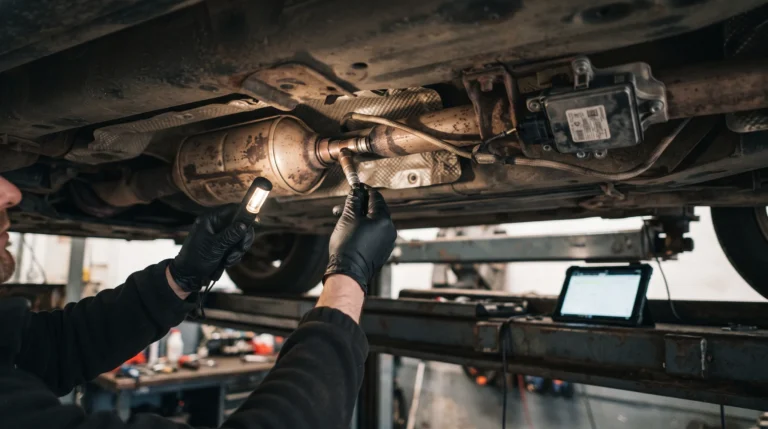
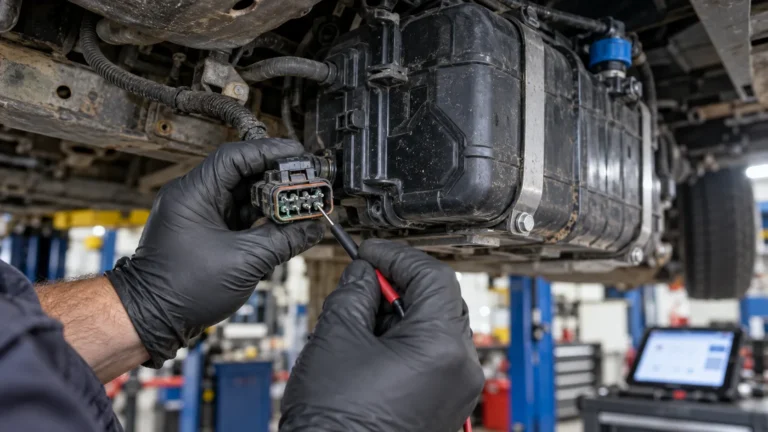
What it means: This is fundamentally different from a level warning. A system fault sign means a component within the AdBlue or SCR system has failed the pump, injector, NOx sensor, quality sensor, or SCR catalyst. Topping up the fluid will not clear this. The vehicle’s ECU has stored one or more fault codes that require a professional diagnostic scan to identify.
What to do: Do not ignore this sign and do not assume a top-up will resolve it. The vehicle may continue to drive normally for a period, but the fault code will remain stored and the countdown to limp mode or no-restart behaviour will continue in the background. Arrange a mobile diagnostic visit as soon as convenient. Our guide to common AdBlue system fault codes explains what each specific code means and what component it points to.
The Combined Warning Multiple Signs at Once
What it looks like: More than one dashboard sign appearing simultaneously — for example, an AdBlue level warning alongside a system fault message, or a check engine light alongside an AdBlue countdown.
What it means: Multiple issues are present simultaneously. This could be a genuine low level alongside a component fault, or it could be that a component fault is causing the level sensor to misread. The combination requires diagnosis to untangle topping up may address the level portion but leave the fault code active.
What to do: Top up the fluid first to eliminate the level issue as a variable. Then arrange a diagnostic scan to identify and address whatever fault codes remain. If the system fault sign persists after a correct top-up, the component fault is still present and needs professional attention.
How Different Manufacturers Display AdBlue Signs
The symbol, colour, and wording varies between makes. Here is how the most common vehicles present their AdBlue dashboard signs:
| Make | Typical AdBlue sign presentation | Notes |
| BMW | Blue “AdBlue” text with mileage countdown in instrument cluster | Three distinct warning stages before no-restart |
| Mercedes-Benz | Amber triangle with “AdBlue” message | Can escalate to red and lock ignition at zero |
| Volkswagen / Audi | “AdBlue range” displayed in MFD with miles remaining | Clear mileage countdown; fault codes appear as separate engine warning |
| Peugeot / Citroën | “AdBlue” or “Urea” warning same system, terminology varies by model | Some PSA models use “Urea” rather than “AdBlue” on the dashboard |
| Ford | Information display message “AdBlue range XXX miles” | Transit range shows message in central information display |
| Renault | “SCR system” warning on some van models rather than “AdBlue” | Trafic and Master sometimes show SCR rather than AdBlue in the message |
| Fiat / Iveco | “AdBlue” warning with countdown | Ducato commercial common presentation alongside fault codes |
If your vehicle displays “Urea” rather than “AdBlue” on the dashboard, it is the same fluid and the same system. The difference is terminology: some manufacturers use the chemical name (urea solution) rather than the trade name. Our urea repair and urea removal services cover these vehicles.
What the Colour of the Light Tells You
Dashboard warning light colour is a universal signal system that applies to AdBlue signs as it does to other warnings:
| Light colour | What it typically means |
| Blue | Informational AdBlue system is active and functioning |
| Amber / yellow | Warning action required, but not immediately critical |
| Red | Urgent immediate action required; may indicate imminent no-restart or serious fault |
An AdBlue sign that moves from amber to red is telling you that the situation has escalated either the countdown has reached a critical point, or a fault that was initially minor has progressed. Do not treat a red AdBlue sign the same way you treated an amber one.
When the AdBlue Sign Comes On After a Service
A specific and frustrating scenario: the AdBlue sign appears on the dashboard immediately after a routine service at a garage or dealership often within days or even the same day.
This happens because:
- The AdBlue system was not properly reset after other work was carried out
- A sensor or connector was disturbed during unrelated mechanical work
- The AdBlue fluid was not correctly refilled or was refilled with contaminated fluid during the service
This is a diagnostic issue rather than a component failure in most cases, and it can typically be resolved with a fault code reset and system recalibration. If the sign appeared within days of a service and you have not had AdBlue issues before, mention the service timing when you contact us it narrows the diagnosis significantly.
When to Arrange Mobile Diagnosis vs When to Top Up and Drive
The decision is straightforward once you know which sign you are dealing with:
| Dashboard sign | Top up and drive? | Diagnosis needed? |
| First level warning (amber, miles showing) | Yes top up when convenient | No, unless it doesn’t clear after top-up |
| Countdown warning (critically low) | Yes top up immediately | No, unless it doesn’t clear after top-up |
| No-restart warning | Yes top up before switching off | Possibly may need reset if engine won’t start |
| System fault warning | Top up will not help | Yes arrange diagnosis |
| Multiple warnings simultaneously | Top up first | Yes diagnosis after top-up |
| Check engine light + AdBlue message | Top up may not help | Yes fault codes need reading |
If you are unsure which category your dashboard sign falls into, contact us with a description of what you are seeing and your vehicle make and model we can advise before you travel.
Repair or Delete: The Decision After Diagnosis
Once the AdBlue sign has been diagnosed and the specific fault is identified, the next decision is whether AdBlue repair or an AdBlue delete is the right response.
Repair makes sense for first-time, isolated component failures a single failed sensor, a blocked injector, a contaminated fluid tank. An AdBlue fix resolves the specific fault and restores the system to its original function.
Delete makes more sense when the same fault has recurred after a previous repair, when multiple faults are active simultaneously, or when the repair cost is disproportionate to the vehicle’s value. An AdBlue bypass or urea delete is a permanent software solution that removes the SCR system requirement from the ECU; the dashboard sign is permanently cleared and the vehicle no longer requires AdBlue to function.
Our AdBlue delete vs repair guide covers this decision in full, including the cost comparison and the legal considerations for both options.
HGV and Commercial Vehicle Dashboard Signs
AdBlue dashboard signs on HGVs and commercial vehicles follow the same general logic as passenger car warnings, but the consequences of ignoring them are more significant. An HGV that reaches a no-restart condition can mean a full day off the road, a recovery call, and significant operational disruption.
Commercial vehicle AdBlue systems also tend to develop faults more frequently than passenger car systems due to higher mileage, more demanding operating conditions, and the larger fluid consumption of bigger engines. Our HGV remapping and AdBlue solutions page covers the specific options for commercial operators, including mobile diagnosis at depots and roadside locations.
Areas We Cover
We carry out mobile AdBlue dashboard sign diagnosis and resolution across:
- AdBlue diagnosis London
- AdBlue diagnosis Slough
- AdBlue diagnosis Esher
- AdBlue diagnosis Epsom
- AdBlue diagnosis Loughton
- AdBlue diagnosis St Albans
- AdBlue diagnosis Sevenoaks
- AdBlue diagnosis Dartford
- AdBlue diagnosis Bourne
- AdBlue diagnosis Grantham
- AdBlue diagnosis Peterborough
- AdBlue diagnosis Stamford
Not listed? Check our full locations page or contact us with your postcode. We cover a wide radius from each area and take enquiries from outside listed locations.
Frequently Asked Questions
An AdBlue dashboard sign means either the AdBlue fluid level is low and needs topping up, or there is a fault with the SCR emissions system. The specific symbol, colour, and any accompanying text or mileage countdown tell you which situation you are dealing with. A level warning clears after topping up. A system fault warning will not clear with fluid; it requires a professional diagnostic scan to identify the failed component.
Check what the sign is showing. If it displays a mileage countdown or a low level message, top up with AdBlue fluid and drive for 10 minutes; the sign should clear. If it shows a system fault message, a check engine light, or does not clear after topping up correctly, arrange a mobile diagnostic visit. Do not ignore a system fault sign; the fault code it represents will continue in the background even if the vehicle drives normally.
A level warning will clear once the tank is topped up and the system confirms the new level. A system fault warning will not go away on its own; it requires the specific failed component to be repaired or the system to be deleted from the ECU. Simply resetting the fault code without fixing the underlying cause will result in the sign returning within days.
A red AdBlue sign indicates a more urgent situation than an amber one: either the tank is at or near zero and a no-restart condition is imminent, or a serious system fault has escalated beyond an initial warning. A red AdBlue sign requires immediate attention; do not switch the vehicle off until you have assessed the situation and taken the appropriate action.
If the sign remains after correctly topping up with fresh AdBlue, a fault code may be stored in the system. This could be a quality fault, where the fluid was contaminated or incorrect, a sensor fault reading the level inaccurately, or a separate component fault that was already present. A top-up does not clear fault codes; a diagnostic scan is required to identify and address the stored fault.
If it is a first or second level warning with miles still showing, yes, until you can top up. If it is a system fault warning or a red warning, you should arrange a diagnosis promptly. If the sign shows a no-restart warning, do not switch the engine off until you have topped up and confirmed the warning has cleared.
Yes. Our mobile service covers cars, vans, and HGVs. For commercial vehicle operators, see our HGV remapping and AdBlue solutions page for the options specific to larger vehicles.
They refer to the same system. AdBlue is the trade name for the fluid; urea (or urea solution) is the chemical name. Some manufacturers, particularly Peugeot and Citroën, use “Urea” on the dashboard rather than “AdBlue.” If your dashboard shows a urea warning, the response is identical to an AdBlue warning. Our urea repair and urea removal services cover these vehicles.
Book Mobile AdBlue Dashboard Sign Diagnosis
If your AdBlue dashboard sign is on whether it is a level warning that has not cleared or a system fault you cannot identify we carry out same-day and next-day mobile diagnosis across London and the surrounding area. No recovery, no dealer wait.
Contact us today with your vehicle make, model, year, and a description of what the dashboard is showing, and we will confirm availability and advise on next steps before you travel anywhere.