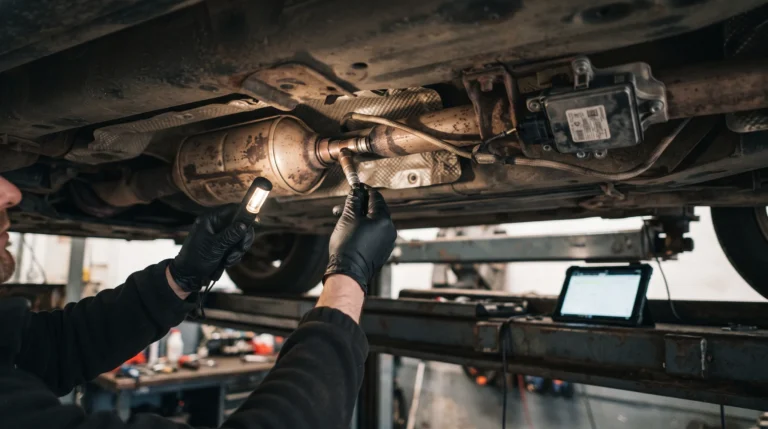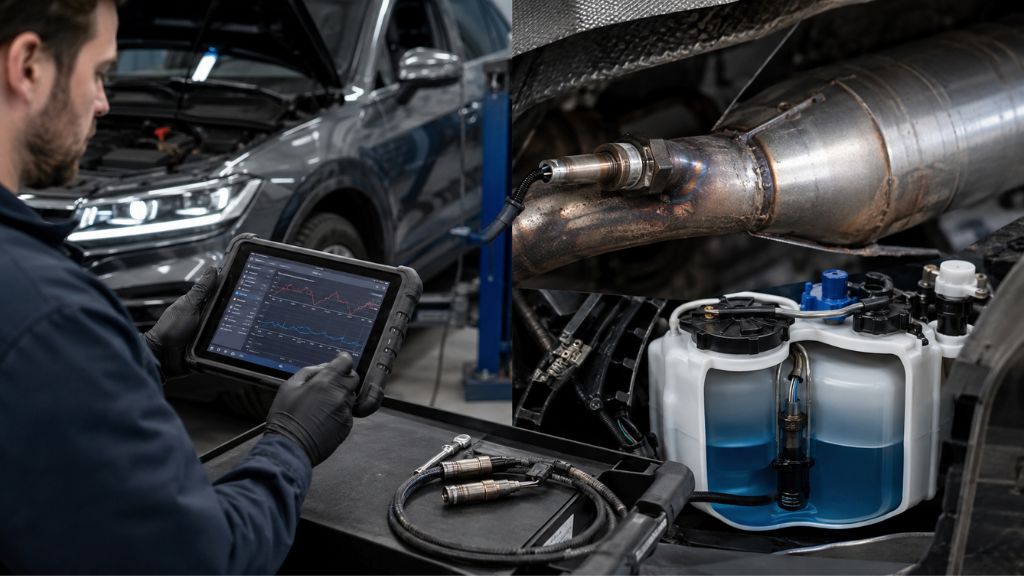

A NOx sensor measures nitrogen oxide levels in the exhaust before and after the SCR catalyst to confirm the AdBlue system is actually reducing emissions. An AdBlue quality sensor sits inside the AdBlue tank and measures whether the fluid in the tank is the correct concentration of urea. They are completely different components in completely different locations, measuring completely different things but they produce overlapping fault codes and dashboard warnings that make them easy to confuse. Conflating the two is one of the most common and most expensive diagnostic mistakes in AdBlue system repair: replacing a NOx sensor when the quality sensor has failed, or draining and refilling the AdBlue tank when the NOx sensor is the actual problem. This guide explains exactly what each sensor does, where it sits, what faults it produces, how to tell them apart, and why the distinction matters before any money is spent on parts.
Why Drivers Confuse These Two Sensors
The confusion is understandable. Both sensors are part of the AdBlue SCR system. Both produce fault codes that trigger AdBlue warning lights on the dashboard. Both can cause the no-restart countdown to begin. And neither produces a dashboard message that says “your NOx sensor has failed” or “your AdBlue quality sensor is reading incorrectly” in plain language; the message is almost always a generic AdBlue system fault or an emissions warning that gives no indication of which component is involved.
When a modern diesel starts showing SCR or emissions warnings, a lot of drivers end up asking the same question: is it the NOx sensor, or is it the AdBlue system itself? The problem is that the dash rarely makes that clear. You might see an engine warning light, an emissions message, an AdBlue countdown, limp mode, or a fault code like P20EE or P229F. Those signs can overlap, which is why people often replace the wrong part first.
The only way to distinguish between these two sensors as the cause of a fault is a proper diagnostic scan with live data not just reading fault codes, but evaluating what each sensor is actually reporting versus what the ECU expects. This is the exact diagnostic step most generic OBD scanners cannot complete, and the reason that replacing components based on fault codes alone produces the wrong answer a significant proportion of the time.
What a NOx Sensor Is
A NOx sensor short for nitrogen oxide sensor is an exhaust gas measurement device fitted in the exhaust system of Euro 5 and Euro 6 diesel vehicles.
The NOx sensor is part of the Selective Catalytic Reduction (SCR) system fitted to Euro 5 and Euro 6 diesel engines. Its job is to measure the level of nitrogen oxide in the exhaust gas both before and after the AdBlue dosing process to confirm that the SCR catalyst is reducing emissions to within legal limits.
Where it sits
Most vehicles have two NOx sensors: one upstream of the SCR catalyst and one downstream.
- Upstream NOx sensor positioned before the SCR catalyst in the exhaust flow. It measures the raw NOx output from the engine at the baseline nitrogen oxide level before any AdBlue has been added. The upstream NOx sensor measures raw engine-out NOx to help control EGR and fuelling.
- Downstream NOx sensor positioned after the SCR catalyst. It measures how much NOx remains in the exhaust after AdBlue has been injected and the catalytic reduction process has occurred. The downstream NOx sensor verifies SCR efficiency and governs AdBlue dosing.
What the ECU does with these readings
The ECU compares the readings from both sensors to calculate how effectively AdBlue is breaking down NOx into harmless nitrogen and water. If the upstream reading shows a high NOx level and the downstream reading shows a similarly high level meaning the SCR catalyst has not reduced the NOx the ECU concludes the system is underperforming. This triggers the P20EE fault code (SCR catalyst efficiency below threshold) and begins the fault escalation sequence.
A mismatch between upstream and downstream readings often triggers efficiency faults.
The critical point: the NOx sensor does not know whether the SCR system is underperforming because the AdBlue is wrong, because the injector is blocked, because the pump is failing, or because the catalyst has genuinely degraded. It only reports what it measures. The fault code the NOx sensor triggers is often the same regardless of what the underlying cause is which is why P20EE is one of the most misdiagnosed codes in the AdBlue system.
NOx sensor fault codes
| Fault code | Description |
| P2201 | NOx sensor circuit bank 1, sensor 1 (upstream) |
| P2202 | NOx sensor circuit bank 1, sensor 2 (downstream) |
| P20EE | SCR catalyst efficiency below threshold often triggered by a failing downstream NOx sensor |
| P229F | NOx sensor signal implausible |
What an AdBlue Quality Sensor Is
The AdBlue quality sensor is a completely different component in a completely different location inside the AdBlue tank itself, not in the exhaust.
Its job is to measure the concentration of urea in the AdBlue fluid. AdBlue must be 32.5% urea and 67.5% deionised water to work correctly. P207F often appears after a refill. That does not automatically mean the fluid is wrong, but it does mean the system believes quality is not within expected range.
Where it sits
The AdBlue quality sensor sits inside the AdBlue tank, typically as part of the tank module assembly that also includes the pump, heater, and level sensor. On most modern vehicles, these components are integrated into a single module rather than being individually replaceable in isolation.
What the ECU does with this reading
The ECU receives a continuous signal from the quality sensor indicating the urea concentration of the fluid in the tank. If the concentration falls outside the acceptable range either too dilute, too concentrated, or contaminated the ECU stores a quality fault code and triggers the same warning system as any other AdBlue fault.
The quality sensor does not know why the concentration is wrong. It only reports what it measures. Whether the fluid was contaminated during a top-up, has degraded from age or heat exposure, was the wrong product entirely, or whether the sensor itself has failed and is misreading correct fluid all of these produce the same fault code.
AdBlue quality sensor fault codes
| Fault code | Description |
| P203A | Reductant quality performance concentration outside acceptable range |
| P2BAD | Reductant quality below threshold concentration too low |
| P207F | Reductant quality sensor signal out of range |
| P203F | Reductant level sensor circuit often integrated with quality sensor in same module |
Side-by-Side: The Key Differences
| Feature | NOx Sensor | AdBlue Quality Sensor |
| Location | Exhaust system | Inside AdBlue tank |
| What it measures | Nitrogen oxide levels in exhaust gas | Urea concentration of AdBlue fluid |
| How many per vehicle | Usually two (upstream and downstream) | Usually one |
| Operating environment | High temperature exhaust gas | Room temperature AdBlue fluid |
| Primary fault codes | P2201, P2202, P20EE, P229F | P203A, P2BAD, P207F |
| Common cause of failure | Heat damage, connector corrosion, wiring faults | Contaminated fluid, degraded fluid, sensor failure |
| Can it be cleaned | No replacement only | Not typically tank drain and refill first, then sensor if fault persists |
| Replacement cost | £200–£550 fitted | Variable often part of module assembly |
| Coding required after replacement | Yes on most makes particularly Mercedes | Sometimes, depending on make and ECU |
How They Interact and Why That Creates Confusion
Because the NOx sensor is directly tied to the AdBlue system, a NOx fault and an AdBlue fault will often appear together. They can look identical on the dashboard which is exactly why correct diagnosis matters before spending money on parts.
Here is the specific scenario that produces the most confusion and the most expensive misdiagnoses:
Scenario A Quality sensor reads low concentration, triggers AdBlue fault. The driver tops up the tank with correct fluid. Quality fault clears. But a NOx sensor was also developing a fault independently. P20EE now appears. Driver assumes the P20EE is related to the fluid quality issue and assumes another quality problem. Drains and refills the tank again. P20EE is not clear. The actual cause of a failing downstream NOx sensor has not been addressed.
Scenario B Downstream NOx sensor begins to fail and reads implausible values. ECU cannot confirm SCR efficiency. P20EE stored. The driver is told “the catalyst may be failing.” The catalyst is replaced at significant cost. P20EE returns because the NOx sensor that was misreporting the catalyst performance was never replaced. The catalyst was intact throughout.
Scenario C AdBlue quality sensor fails internally and reads correct fluid as out-of-specification. P203A stored. Driver drains and refills with fresh AdBlue. P203A returns because the quality sensor is giving a false reading regardless of what fluid is in the tank. The actual cause of a failed quality sensor is not addressed by fluid replacement.
Each of these scenarios is common. Each involves money spent on the wrong intervention because the specific failed component was not identified before parts were changed.
How to Tell Which Has Failed
The only reliable way to distinguish between these two sensors as the cause of a fault is live data diagnosis, not just reading stored fault codes.
For a suspected NOx sensor fault:
Warm-up test: view NOx sensor heater status/current and PPM readings. If the heater won’t reach temperature or PPM is stuck or implausible, replacement is likely.
Live data should show:
- Upstream NOx reading responds to changes in engine load rising under acceleration, falling at idle. A sensor stuck at a fixed value or reading zero is almost certainly failed.
- Downstream NOx reading showing meaningful reduction compared to upstream confirming the SCR system is working. A downstream sensor showing values close to or equal to upstream suggests either genuine catalyst failure or a downstream sensor misreporting.
- A mismatch between upstream and downstream readings often triggers efficiency faults.
For a suspected quality sensor fault:
Live data should show the actual concentration reading the quality sensor is reporting. A sensor showing 0% or a wildly incorrect figure immediately after a fresh top-up with certified AdBlue is almost certainly a sensor failure rather than a genuine quality problem. A sensor showing a plausible but slightly off reading after a top-up warrants checking the fluid source and container before condemning the sensor.
The practical sequence for quality-related faults:
- Confirm fluid source was fresh, sealed, ISO 22241 certified AdBlue used?
- Check for contamination was a dirty funnel, incorrect container, or non-AdBlue fluid involved in the top-up?
- If fluid is confirmed correct and the fault persists, the quality sensor itself has likely failed
Common Vehicle-Specific Patterns
Different makes have characteristic failure patterns for these two sensors that are worth knowing:
Mercedes-Benz: The downstream NOx sensor is one of the most common causes of P20EE on the C-Class and E-Class diesel range. The fault presents identically to genuine catalyst failure, and the cost difference between replacing a NOx sensor (£200–£400) and replacing the SCR catalyst (£800–£1,500) makes correct diagnosis particularly consequential on Mercedes. Coding is required after sensor replacement.
BMW 3 and 5 Series diesel: Both NOx sensor faults and quality sensor faults appear regularly on high-mileage B47 and N47 engines. BMW’s integrated tank module means quality sensor faults often require module-level replacement rather than sensor-only intervention.
Peugeot Boxer / Citroën Relay: Quality sensor faults are common after quality-related fault history crystallised residue from previous contamination affects the sensor reading even after fresh fluid is added. The level sensor (often confused with the quality sensor) is also a common failure point on these commercial vans.
Volkswagen Group: Many vans have upstream and downstream NOx sensors. P20EE often shows when the ECU sees poor reduction between the two. Upstream reading should respond to engine load changes. On VW Group vehicles, software recalibration after NOx sensor replacement is standard rather than optional.
Ford Transit: NOx sensor faults are common on the diesel Transit range. The quality sensor is a less frequent failure point on these vehicles compared to the NOx sensors.
Replacing the Wrong Sensor: The Cost of Misdiagnosis
Swapping the wrong part costs £300 and doesn’t clear the lamp.
This is the real-world consequence of conflating these two sensors. A NOx sensor replacement on a Mercedes or BMW costs £200–£550 fitted. An AdBlue quality sensor replacement typically as part of a module costs significantly more. If the wrong component is replaced, the fault remains, the countdown continues, and the cost of the correct part must still be paid on top of the incorrect replacement.
The only protection against this is a live-data diagnostic scan before any part is ordered. Our diagnostic process reads both sensor outputs NOx sensor values upstream and downstream, quality sensor concentration reading alongside all stored fault codes, before making any recommendation. We do not recommend replacing components speculatively.
See our common AdBlue system fault codes guide for how each specific code is interpreted before reaching a diagnosis, and our AdBlue pump replacement cost guide for how the same diagnostic principle applies to pump-related faults.
Repair or Delete Once the Sensor Is Identified
Once the correct failed sensor is identified, the decision framework is the same as for any AdBlue component:
Repair makes sense when:
- A single sensor has failed in isolation first-time failure on an otherwise healthy system
- The rest of the AdBlue system is confirmed healthy by live data
- The vehicle has meaningful remaining life and repair cost is proportionate
Delete makes more sense when:
- The NOx sensor fault is recurring after a previous replacement
- Multiple faults are active simultaneously alongside the sensor fault
- The quality sensor fault is part of a broader pattern of AdBlue system deterioration on a high-mileage commercial vehicle
Our dedicated NOx sensor service covers both NOx sensor diagnosis and replacement. For quality sensor faults as part of a broader tank module issue, our AdBlue repair service covers module-level assessment and repair.
Our AdBlue delete vs repair guide covers the full decision framework including costs and legal considerations for both routes. Our pricing page sets out fixed costs for diagnosis, sensor repair, and delete services.
Our Mobile Diagnostic Service
We diagnose NOx sensor and AdBlue quality sensor faults as a mobile service at your home, workplace, or roadside. Every job begins with a live-data diagnostic scan that evaluates both sensor outputs before any component replacement is recommended.
All AdBlue repair and urea repair services, including NOx sensor replacement, are available mobile across our full coverage area. For the full range of AdBlue removal services and urea removal options, see the relevant service pages.
For HGV and commercial operators where sensor misdiagnosis means a day off the road and incorrect parts ordered in, our HGV remapping and AdBlue solutions page covers the commercial vehicle service specifically.
Areas We Cover
We carry out mobile AdBlue diagnosis, repair, and delete services across the UK at your home, workplace, or roadside, with same-day and next-day slots available across our core areas.
In London and the South East, we cover London, St Albans, Loughton, Dartford, Sevenoaks, Epsom, Esher, and Slough.
In Yorkshire we cover Leeds and Sheffield. In Scotland we cover Glasgow and Edinburgh. Across Shropshire we cover Telford, Shrewsbury, Oswestry, and Bridgnorth. In the West Midlands we cover Coventry, Dudley, Walsall, Solihull, and Wolverhampton. Across Staffordshire we cover Stoke-on-Trent, Stafford, Cannock, and Lichfield. In Warwickshire we cover Warwick, Leamington Spa, Stratford-upon-Avon, and Rugby.
Across the East Midlands and Lincolnshire we cover Peterborough, Grantham, Spalding, Stamford, Bourne, and Market Deeping.
Not listed? Check our full locations page or contact us with your postcode. We cover a wide radius from each area and take enquiries from outside listed locations.
Frequently Asked Questions
Get clear answers about NOx sensors, AdBlue quality sensors, common fault codes, sensor replacement and SCR system diagnosis.
A NOx sensor measures nitrogen oxide levels in the exhaust, before and after the SCR catalyst, to confirm the AdBlue dosing process is reducing emissions correctly. An AdBlue quality sensor sits inside the AdBlue tank and measures whether the fluid has the correct urea concentration. They are in different locations, measure different things, produce different fault codes, and require different fixes. Confusing the two can lead to replacing the wrong component and failing to clear the fault.
Yes. Because the NOx sensor is directly linked to the SCR emissions system, a NOx sensor fault and an AdBlue fault can appear together. They may look similar on the dashboard. A failing downstream NOx sensor can trigger P20EE, the SCR catalyst efficiency code, which may activate an AdBlue warning and no-restart countdown similar to those caused by other SCR or fluid-related faults. Learn more about NOx sensor faults.
No. A NOx sensor fault is a component fault in the exhaust system and is not caused by low AdBlue fluid level or fluid quality. Topping up the tank will not normally clear a NOx sensor fault code. If the warning remains after topping up with the correct AdBlue, a diagnostic scan is needed to identify the failed component.
Common fault codes associated with AdBlue or reductant quality problems include P203A, P2BAD and P207F. These are different from common NOx sensor-related codes such as P2201 and P2202, while P20EE is associated with SCR catalyst efficiency. Because several different faults can produce similar dashboard warnings, the fault code and vehicle-specific diagnostic data should be checked before replacing a component.
If the quality fault returns after the tank has been filled with the correct, fresh and certified AdBlue, the quality sensor may be incorrectly detecting the fluid as being out of specification. A faulty sensor can continue reporting an incorrect reading regardless of the actual fluid quality, meaning further refilling is unlikely to solve the underlying problem. Professional diagnosis can confirm whether the sensor or another part of the AdBlue system is responsible.
It depends on the vehicle make, model, year and ECU. Some vehicles require sensor coding, adaptation or a reset after NOx sensor replacement, while others may only require the fault memory and learned values to be reset using suitable diagnostic software. Generic OBD scanners may not support all manufacturer-specific procedures, so the correct replacement and reset procedure should be confirmed for the vehicle. Read the NOx sensor reset guide.
It depends on the vehicle. On many modern vehicles, the AdBlue quality sensor is integrated into the tank module alongside components such as the pump, heater and level sensor. Where the sensor is integrated, replacing the complete module may be the practical repair. On some vehicles, the quality sensor can be accessed or replaced separately. A diagnostic assessment of the specific vehicle should be carried out before ordering parts.
Book Mobile Diagnosis for NOx or Quality Sensor Faults
If you have an AdBlue warning with a fault code that could be either a NOx sensor or a quality sensor or if you have already replaced one component and the fault has not cleared we carry out same-day and next-day mobile diagnosis across London and the surrounding area.
Contact us today with your vehicle make, model, year, and the fault codes showing. We will confirm availability, carry out a live-data diagnostic scan to identify the actual failed component, and provide a fixed-price quote for repair or delete before any work begins.