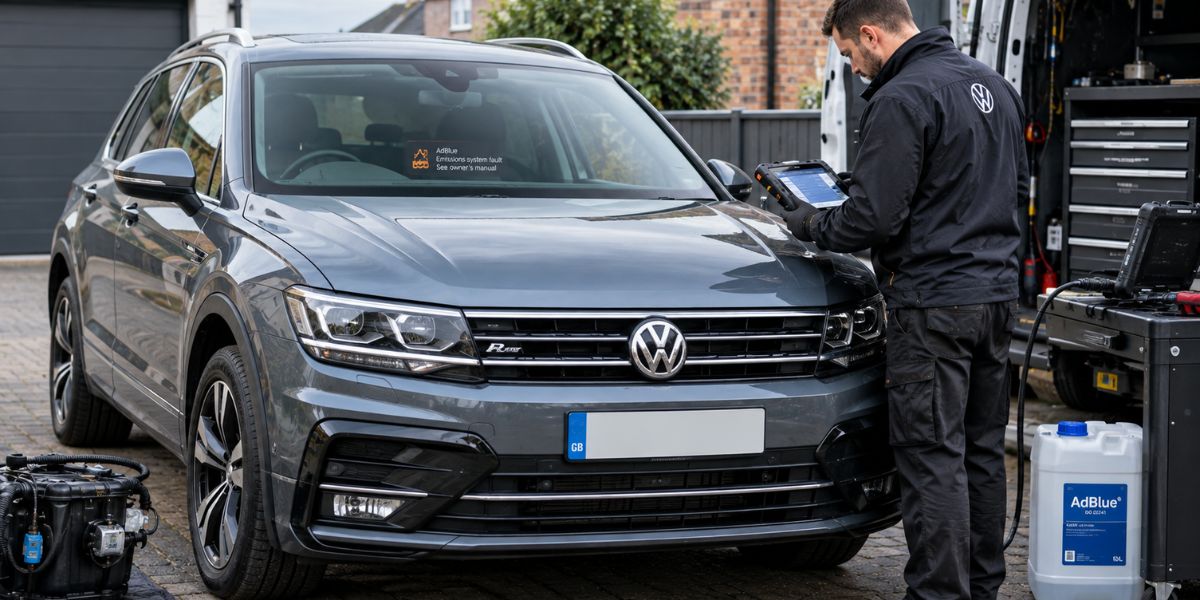

The pump clicked off. The dash shows a full tank. The warning is still there. If that’s where you are right now, the fault was never really about fluid, and no amount of extra AdBlue is going to change that. It’s one of the more frustrating faults a Volkswagen owner can run into, because everything you’d normally do about an AdBlue warning, checking the level, filling it up, watching the gauge settle, has already been done, and the light hasn’t moved. That leaves a lot of people assuming the car is being unreasonable, or wondering whether the dash is simply wrong.
It isn’t wrong, and the car isn’t being difficult for no reason. This particular warning almost always means the fault sits somewhere the fluid level can’t reach: a sensor giving a bad reading, a part not dosing accurately, or a connector telling the computer something false. This guide walks through why a refill doesn’t touch any of that, which parts are usually behind it on a VW specifically, how to narrow down which one you’re dealing with before you book anything, and what tends to make this fault turn up more often on Volkswagen‘s doing most of their miles around London.
First, work out which situation you’re actually in
Not every “light won’t clear” case is the same underneath, and the fix depends on which one you’re dealing with.
| What’s happening | What it tells you |
| Light cleared for a day or two, then came back | The system found a fault again after re checking itself, so something is genuinely wrong |
| Light never cleared at all, even briefly | The system hasn’t accepted the refill or the fault is being logged constantly |
| Level shown on the dash looks wrong compared with what you actually put in | The tank sender is likely misreporting, separate from the AdBlue warning itself |
| Warning appeared alongside reduced power or an emissions message | The fault is confirmed, not just suspected, and is affecting how the car runs |
| Warning only after a cold start, otherwise seems fine | Points toward a heater circuit rather than the tank or sensors |
If your situation matches the first three rows, keep reading. The last two point toward faults covered in more depth on our AdBlue system fault and AdBlue malfunction warning guides.
Two checks, not one
A Volkswagen‘s AdBlue system runs two separate checks, and a refill only ever answers one of them.
The first check is simple: is there enough fluid in the tank? Filling it up answers that question directly, and if this was the actual fault, the warning clears within a short drive.
The second check is harder to see from the driver’s seat: can the system trust the readings it’s getting about that fluid, and is the fluid actually being used correctly? This check has nothing to do with quantity. A full tank can still fail it if the part reporting the level, or the part spraying the fluid, is giving the computer bad information.
That’s the whole explanation in one sentence: a refill only fixes a low fluid fault, and if the warning survives a refill, you were never dealing with a low fluid fault.
The part most often responsible
Inside the tank sits a sender unit, and on most VW Group vehicles it’s doing more than one job. Depending on the model, it reports fluid level, tank temperature, and sometimes contributes to how the car judges fluid quality.
When this sender starts drifting or giving implausible readings, something odd happens: the dash gauge can still show a sensible level while the car logs a fault saying it can’t confirm the level or quality it’s seeing. Topping up doesn’t touch this, because the sender was never short of fluid to measure. It’s the reading itself that’s untrustworthy, at any fill level.
This is common enough on higher mileage VWs that it’s usually the first thing checked when a refill hasn’t worked.
The other usual suspects
| Cause | Why it survives a refill |
| Tank sender giving false readings | Reports bad data regardless of how much fluid is actually present |
| NOx sensor drifting | Checks exhaust cleaning, not fluid level, so a full tank changes nothing |
| Injector narrowed by crystallised AdBlue | Under doses even with plenty of fluid available to spray |
| Weak pump or partially blocked line | Can’t reach dosing pressure no matter how full the tank is |
| Old, diluted or contaminated fluid | Fails quality checks the car runs independently of quantity |
| Loose or corroded connector at the tank unit | Produces the same false readings as a failed sender |
None of these get better with more AdBlue in the tank. Each one needs identifying on its own terms.
How we actually find it
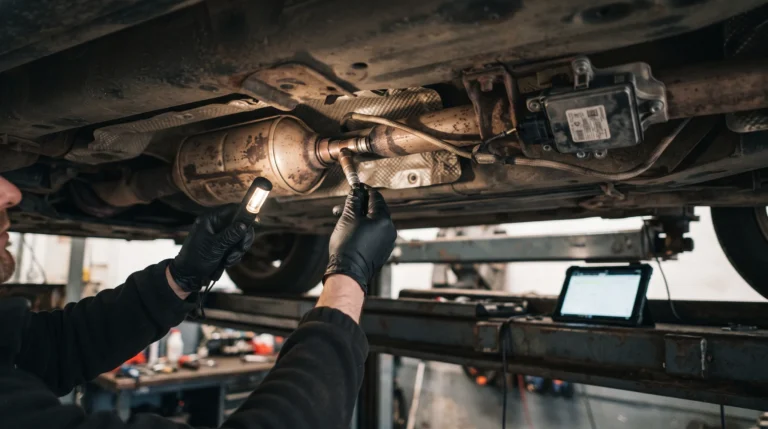
Because a refill has already failed to help, we don’t start by looking at fluid level at all. We connect diagnostic equipment, read every stored code, then watch live data while the system runs: what the tank sender is reporting, what pressure the pump is achieving, and what both NOx sensors are seeing before and after the catalyst. We also test the physical connector at the tank unit directly, since a wiring fault there can look identical to a failed sender until it’s actually checked.
Skipping that last step is how people end up paying for a new sender when the real fault was a corroded pin in the connector behind it.
Fault codes that tend to show up with this exact symptom
| Code | What it points to |
| P203B | Reductant level sensor range or performance |
| P204C | Reductant tank sensor circuit low |
| P2059 | Reductant heater performance, tank sensor circuit |
| P229F | NOx sensor signal stuck |
| P20EE | SCR efficiency below threshold |
| P20E8 | Reductant pressure too low |
A code mentioning level, sensor or circuit is the strongest sign that you’re dealing with exactly the kind of fault a refill can’t reach.
Why clearing the code isn’t the same as fixing it
A basic reset wipes the message from the dash, and for a short while it looks like the problem has gone. It hasn’t. The car reruns its full set of checks on the next drive, and if the sender, a sensor, or the injector is still sending bad information, the fault gets logged again and the light comes straight back. This is exactly why refilling and resetting together so often feels like it should have worked, right up until it doesn’t.
Which VWs this shows up on
Any diesel VW Group vehicle with an AdBlue system can develop this fault, and it isn’t limited to one model. We see it on the Golf, Passat, Tiguan and Touran regularly, along with the equivalent Audi, Škoda and SEAT models built on the same platform with the same SCR components underneath.
What to do while you’re waiting to get it checked
There’s a short list of things worth doing, and a shorter list worth avoiding, in the gap between noticing the fault and getting it looked at properly.
Do keep an eye on whether the warning is joined by anything else, such as reduced power, an emissions message, or a mileage countdown appearing on the dash. That changes how urgently it needs attention. Do note down exactly when the light first came on, and whether it’s been constant or intermittent since, because that detail genuinely speeds up a diagnosis. Do avoid adding more AdBlue once the tank is already showing full, since it won’t help and risks overfilling.
Don’t reset the fault repeatedly hoping it eventually sticks. Each reset without a repair just delays finding the actual cause while the underlying part keeps sending bad information. And don’t assume the car is fine to ignore simply because it’s still driving normally, since a confirmed fault can progress toward a mileage countdown over time even while everything otherwise feels normal behind the wheel.
Sorting it out
Repair and diagnosis costs vary depending on what’s actually found, since a corroded connector, a tank sender and a NOx sensor are three very different jobs with different parts and labour involved. We confirm a price once we know what’s actually wrong with your VW rather than quoting blind, so there’s nothing to guess at before we’ve had a proper look.
Why this fault turns up so often on London VWs
The tank sender and the sensors behind this fault don’t fail any faster just because a car is in London, but London driving gives them plenty of reasons to misbehave in the first place. Stop start traffic, short hops between drops or school runs, and long queues rarely let the exhaust reach a proper working temperature, and that’s exactly the condition that speeds up sensor wear and lets AdBlue crystallise around the injector. A VW doing most of its miles across the North or South Circular, or sitting in traffic through the congestion zone, is under a different kind of strain to one doing steady motorway runs, and it shows up in how often these faults appear.
If your VW is mostly a London car, that’s worth mentioning when you book, since it often explains why a fault has developed even on a car that isn’t especially old or high mileage.
Where we help VW owners
London. Start with AdBlue repair London, or go straight to your borough: Barking and Dagenham, Barnet, Bexley, Brent, Bromley, Camden, Ealing, Enfield, Greenwich, Hackney, Hammersmith and Fulham, Haringey, Harrow, Havering, Hillingdon, Hounslow, Islington, Kensington and Chelsea, Kingston upon Thames, Lambeth, Lewisham, Merton, Newham, Redbridge, Richmond upon Thames, Southwark, Sutton, Tower Hamlets, Waltham Forest, Wandsworth and Westminster.
South East England. The South East hub, plus St Albans, Loughton, Dartford, Sevenoaks, Epsom, Esher and Slough.
West Midlands. The West Midlands hub, Coventry, Dudley, Solihull, Walsall and Wolverhampton.
Staffordshire. The Staffordshire hub, Stoke-on-Trent, Stafford, Cannock and Lichfield.
Warwickshire. The Warwickshire hub, Nuneaton, Rugby, Warwick, Leamington Spa and Stratford-upon-Avon.
Shropshire. The Shropshire hub, Shrewsbury, Telford, Oswestry and Bridgnorth.
East Midlands and Lincolnshire. The regional hub, Bourne, Peterborough, Grantham, Spalding, Stamford and Market Deeping.
Yorkshire and Scotland. Leeds, Sheffield, Glasgow and Edinburgh.
Not on the list? Send us your postcode. The full locations hub has everything in one place.
VW AdBlue Warning Light FAQs
Get clear answers about VW AdBlue warning lights, refills, tank senders, NOx sensors, wiring faults, countdowns and AdBlue diagnosis.
Because a refill only answers the question of whether there’s enough fluid. If the warning remains after a refill, the fault may involve a sensor, tank sender, injector or pump giving incorrect information, none of which is fixed by adding more fluid.
Overfilling can create separate problems and will not fix a fault that was never caused by low fluid. If the AdBlue warning is already on with a full tank, adding more fluid is unlikely to solve the underlying issue.
They are related but not identical. The sender is the physical component inside the tank that measures the fluid level and sends information to the vehicle. The dashboard gauge displays what the sender reports, so a faulty sender can cause an inaccurate reading.
It might clear the message briefly, but the vehicle can detect the same fault again when it carries out its checks on the next drive. Disconnecting the battery does not repair the underlying component or system fault.
You generally can’t tell reliably from the driver’s seat. Both faults can produce warnings that remain after a refill, and distinguishing between them requires live data and system checks while the vehicle is running rather than relying on the fault code alone.
Yes. Old, diluted or contaminated AdBlue can cause the system to fail its quality checks regardless of how much fluid is in the tank. Using sealed, in-date AdBlue helps rule out fluid quality as a possible cause.
Many VWs can progress from a persistent warning to a mileage countdown if the fault remains confirmed. Once the countdown reaches zero, the vehicle may not restart after being switched off. Diagnosing the problem earlier gives you more options.
AdBlue faults can occur across VW models equipped with an SCR AdBlue system, including applicable diesel versions of the Golf, Passat, Tiguan and Touran. Similar systems are also used across related Audi, Škoda and SEAT models.
Wiring can be a genuine cause. A loose, damaged or corroded connector around the tank unit can interrupt the signal or power supply and trigger an AdBlue warning. It can be missed if the sender or another component is replaced without checking the wiring first.
It depends entirely on what is found during diagnosis. A wiring repair, tank sender replacement and NOx sensor repair involve different parts and labour, so the final price is confirmed once the actual cause has been identified.
If no countdown has started, the vehicle will usually continue to drive normally. However, an unresolved fault can progress to a countdown, so it is better to arrange a diagnosis rather than waiting for the warning to become more serious.
Not reliably. Confirming a tank sender fault generally requires live data to be checked against the diagnostic equipment used to assess the wider AdBlue system, rather than relying only on a basic fault-code readout.
The underlying diagnostic approach is similar: reading fault codes, checking live data and identifying the actual cause. What can differ is the equipment used, availability, repair options and overall cost.
A connector fault or a sensor that is degrading gradually can sometimes pass the vehicle’s checks and fail them under different conditions. This can cause an AdBlue warning that disappears temporarily before returning.
Mention that you’ve already topped up the AdBlue and the warning stayed on or returned. If you have a fault code from your own scanner, provide that too, and explain whether the warning is constant or intermittent. This information can help speed up the diagnosis.
Talk to us about it
If topping up hasn’t worked, the fluid was never the actual problem, so the next step is finding what is. Get in touch through our contact page with your VW’s model, year, postcode and what you’ve already tried, and we’ll take it from there.