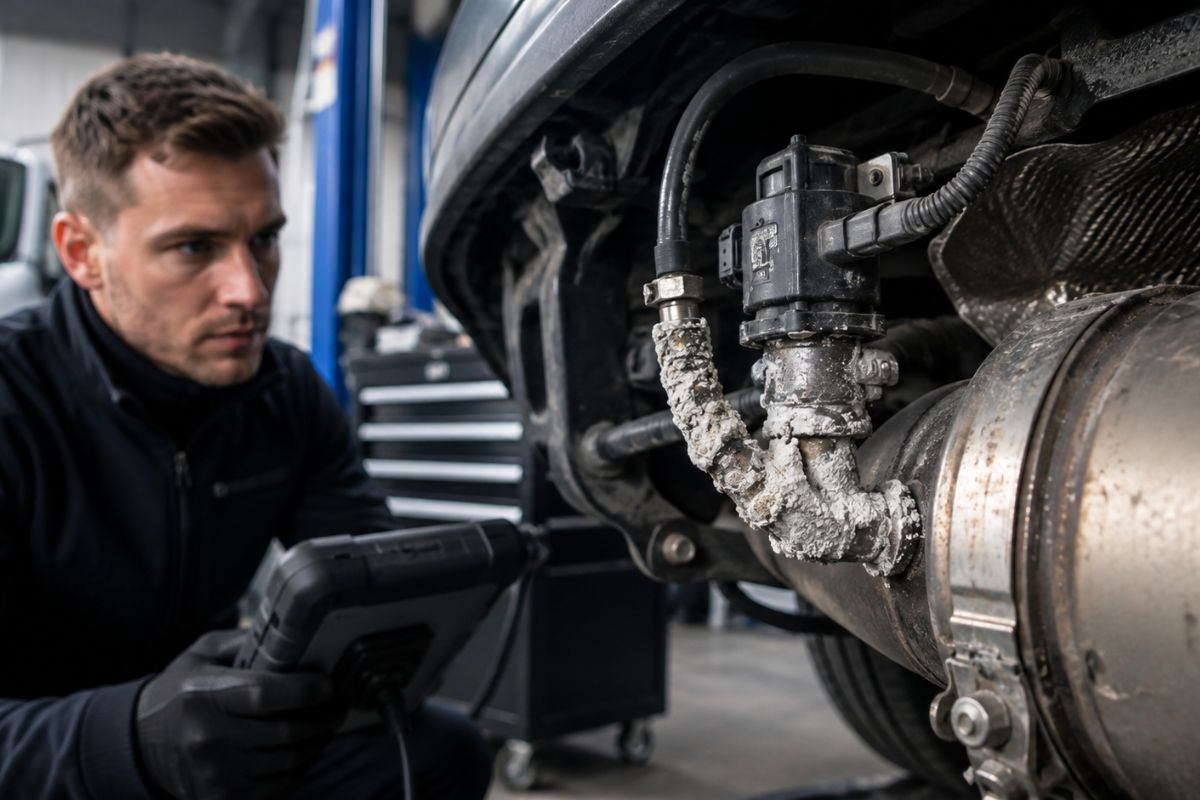

Yes, AdBlue crystallisation can be repaired in most cases, and in many situations it is the cause of fault codes that were assumed to indicate component failure. When AdBlue fluid evaporates or is exposed to heat, it leaves behind solid urea deposits white, chalky crystals that accumulate at the injector nozzle, around the SCR system pipework, at the filler cap, and within the tank module. These deposits block fluid delivery, trigger fault codes, and produce warning lights that look identical to pump or injector failure. Identifying crystallisation as the cause rather than immediately replacing expensive components saves significant cost in many cases. Here is what AdBlue crystallisation is, where it forms, what it causes, and how it is resolved.
What AdBlue Crystallisation Actually Is
AdBlue is a solution of 32.5% urea and 67.5% deionised water. The water component evaporates when exposed to heat or air, leaving behind solid urea crystals. This is not a defect in the fluid or the system, it is a straightforward chemical property of the solution.
The problem is where those crystals form and accumulate. In normal operation, the AdBlue system is a closed loop fluid drawn from the tank, delivered to the injector, and sprayed into the exhaust stream in controlled quantities. The system is designed to minimise fluid contact with surfaces that would allow evaporation and crystallisation. When the system is working correctly and maintenance is consistent, crystallisation is manageable.
When the system develops a small leak, when the injector is partially blocked and fluid drips rather than sprays cleanly, when the vehicle does mostly short urban runs that do not allow the system to fully warm up and self-clean, or when a previous repair left residue in the system crystallisation accumulates faster than the system can manage, and the deposits begin to cause problems.
Where AdBlue Crystallisation Forms
At the injector nozzle
The AdBlue injector is the component most consistently affected by crystallisation. It is positioned in the exhaust stream and exposed to significant heat which accelerates urea evaporation from any residual fluid that drips or accumulates at the nozzle after each injection cycle.
A partially blocked injector nozzle from crystallisation restricts fluid delivery, which triggers a catalyst efficiency fault code (most commonly P20EE) because the SCR system is not receiving enough AdBlue to reduce NOx to the required level. The ECU sees insufficient NOx reduction and concludes the system is underperforming which it is, but the cause is crystallisation at the nozzle rather than injector failure or catalyst degradation.
This distinction matters enormously. Replacing an injector that has a crystallised nozzle without cleaning the nozzle and addressing the cause of the crystallisation sometimes resolves the fault code, but it is a more expensive solution than cleaning a component that is otherwise intact. In some cases, the replacement injector develops the same crystallisation issue if the root cause is not addressed.
In the injector pipework and delivery lines
Crystallisation is not always limited to the injector itself. The pipework between the pump and injector can accumulate deposits over time, particularly at joints and connectors where small amounts of fluid can seep and evaporate. Partial blockage in the delivery line restricts flow in a way that can mimic pump under-delivery producing the same fault codes as a failing pump without the pump being the actual problem.
Around the filler cap and filler neck
The AdBlue filler cap area is one of the most visible crystallisation sites. White, chalky deposits around the filler cap and filler neck are common; they form from spillage during top-up, from residual fluid on the cap seal, and from the evaporation of fluid that contacts the filler neck surface.
Crystallisation around the filler cap is mostly cosmetic and does not typically cause fault codes on its own. However, heavy crystallisation can contaminate fresh fluid during top-up if deposits fall into the tank which then produces a quality fault code (P203A, P2BAD) because the contaminated fluid reads as incorrect concentration to the quality sensor.
In the tank module
The tank module which incorporates the pump, heater, level sensor, and quality sensor as a combined unit on most vehicles can develop crystallisation internally if the tank has been run very low repeatedly, if fluid has been allowed to degrade over time, or if contaminated fluid was used. Internal crystallisation in the tank module affects the pump’s ability to draw and deliver fluid, and can cause the quality sensor to misread correct fluid as out-of-specification.
This is one of the more difficult crystallisation situations to address without removing the module, and on some vehicles it tips the cost comparison toward an AdBlue delete rather than a repair particularly where the module is expensive to replace and the vehicle is high-mileage.
Around the SCR catalyst inlet
Severe or long-standing crystallisation can extend beyond the injector and delivery system into the SCR catalyst inlet area. Solid urea deposits that accumulate here restrict exhaust flow and affect catalyst performance in a way that persists even after the injector has been cleaned and the delivery system restored. This is less common than nozzle or pipework crystallisation but more serious and it is another situation where the fault code presentation (P20EE, P204F) looks identical to catalyst failure even when the catalyst itself is intact.
What Fault Codes Crystallisation Causes
AdBlue crystallisation is one of the most frequently misdiagnosed causes of AdBlue fault codes, precisely because the codes it generates are identical to those produced by component failure. The most common fault codes associated with crystallisation:
| Fault code | Typical cause description | How crystallisation produces it |
| P20EE | SCR catalyst efficiency below threshold | Blocked injector nozzle restricts AdBlue delivery; insufficient NOx reduction |
| P2047 / P204B | Reductant injector circuit fault | Crystallised nozzle causes injector to operate outside expected parameters |
| P204F | Reductant system performance | Combined delivery restriction from crystallisation across multiple points |
| P203A | Reductant quality performance | Contamination from crystallised deposits falling into the tank during top-up |
| P2BAD | Reductant quality below threshold | Same contamination mechanism as P203A |
| P20BA / P20B9 | Reductant pump control circuit | Internal crystallisation in tank module affecting pump operation |
Seeing any of these codes particularly P20EE and P2047 does not confirm that the injector or catalyst has failed. It confirms that the system is underperforming. The cause needs to be established through physical inspection and live data before any component is replaced.
Our guide to common AdBlue system fault codes covers what each code means and how diagnosis should be approached before any repair decision is made.
Which Vehicles Are Most Prone to AdBlue Crystallisation
Crystallisation affects all vehicles with AdBlue systems to some degree, but certain patterns make it significantly more likely:
Urban and short-run driving: Vehicles that predominantly do short journeys stop-start urban driving, short commutes, delivery routes do not allow the SCR system to fully warm up and complete its self-cleaning cycle. The injector runs partial cycles and residual fluid accumulates and crystallises faster than the system clears it.
Vehicles that have run the tank very low repeatedly: Running the AdBlue tank to empty or near-empty multiple times stresses the pump and allows air into the delivery system. Residual fluid at the injector crystallises more aggressively when the system runs dry and then restarts.
High-mileage commercial vans: Peugeot Boxer, Citroën Relay, Renault Trafic, and Mercedes Sprinter diesel vans on high mileage are among the most common vehicles we see with injector crystallisation particularly where the maintenance schedule has not included regular AdBlue system checks.
Vehicles where a previous repair left residue: Incomplete flushing after a quality fault, or a previous injector replacement that did not address residual crystallisation in the delivery line, creates conditions for rapid re-crystallisation at the same points.
How AdBlue Crystallisation Is Repaired
Injector nozzle cleaning
For crystallisation confined to the injector nozzle and immediately surrounding area, professional cleaning is often the most cost-effective first step. The injector is removed, the nozzle is treated with an appropriate cleaning solution to dissolve the urea deposits, and the delivery performance is tested before reinstallation.
This is not a DIY repair. The injector is a precision component and the cleaning process requires the right chemical approach and the ability to test injector delivery rate after cleaning to confirm it has been restored to specification. An injector that has been cleaned without delivery testing may appear resolved but continue to underperform.
Delivery line flush
Where crystallisation has extended into the pipework between the pump and injector, a flush of the delivery system with clean deionised water dissolves soluble urea deposits and clears the line. This is carried out alongside injector cleaning rather than as a standalone procedure.
Tank drain, flush, and refill
Where crystallisation contamination has reached the tank either from internal deposits or from contaminated top-up the tank needs to be drained, flushed, and refilled with fresh, correctly concentrated AdBlue. A fault code reset follows, and the system is monitored to confirm the quality sensor reads the fresh fluid correctly.
Component replacement where cleaning is insufficient
If the injector nozzle is damaged rather than simply crystallised the nozzle itself corroded or mechanically compromised from extended blockage cleaning will not restore it to correct function and replacement is necessary. Similarly, if the tank module’s internal crystallisation has damaged the pump’s internal seals or the quality sensor’s measurement capability, module replacement is the appropriate repair.
Our AdBlue repair service assesses the extent of crystallisation before recommending cleaning versus replacement the two are not always interchangeable, and recommending replacement when cleaning would suffice costs money unnecessarily. Our pricing page sets out fixed costs for both approaches.
When an AdBlue Delete Is Worth Considering Instead
For most vehicles with a first crystallisation issue particularly where the crystallisation is at the injector nozzle and the rest of the system is intact repair is the right starting point. Cleaning is less expensive than deletion and restores the system to original function.
However, there are situations where an AdBlue bypass or urea delete is worth considering alongside or instead of repair:
The same crystallisation fault has recurred after a previous cleaning. If the injector was cleaned six months ago and the same fault code has returned, the root cause typically the vehicle’s short-run duty cycle has not changed, and the crystallisation will continue to recur. A delete removes the cycle permanently rather than repeating the repair every few months.
The crystallisation has caused secondary damage. If extended crystallisation has damaged the injector beyond cleaning, caused SCR catalyst inlet restriction, or damaged the pump module internally, the combined repair cost may approach or exceed the cost of deletion. At that point, the economics shift.
The vehicle is commercial and downtime is the primary concern. For fleet operators or sole traders who cannot afford recurring downtime for the same fault, deletion is a permanent solution that eliminates the crystallisation risk entirely. Our HGV remapping and AdBlue solutions page covers this specifically for commercial vehicles.
Our AdBlue delete vs repair guide covers the full decision framework, including the legal considerations for both options.
Preventing AdBlue Crystallisation
While crystallisation cannot be entirely eliminated in all operating conditions, the risk is significantly reduced by:
Using only fresh, correctly concentrated AdBlue. Fluid that has been stored incorrectly, left in an open container, or is past its shelf life has a higher tendency to crystallise. Use sealed, purpose-packaged AdBlue from reputable sources.
Not running the tank empty. Consistently topping up before the tank reaches very low levels reduces the conditions that accelerate injector crystallisation. A tank that is always at a reasonable level keeps the delivery system functioning consistently rather than cycling through dry periods.
Regular longer runs if the vehicle primarily does short journeys. If the vehicle is used predominantly for short urban trips, a longer motorway run periodically allows the SCR system to reach operating temperature and complete its self-cleaning cycle. This is not always practical for every vehicle, but it makes a measurable difference to crystallisation rates.
Keeping the filler cap area clean. Wiping the filler neck and cap after topping up prevents crystallised residue from the cap area from entering the tank during subsequent top-ups.
Regular professional AdBlue system checks. Catching early-stage crystallisation at a service before it has progressed to a blocked nozzle or fault code is significantly cheaper than addressing it once it has produced a drivability issue.
Our Mobile AdBlue Crystallisation Service
We diagnose and treat AdBlue crystallisation as a mobile service at your home, workplace, or roadside. We do not require you to recover the vehicle or wait for a dealer appointment.
Our mobile service includes full AdBlue system diagnosis, fault code reading with live data assessment, injector and delivery line inspection, professional cleaning where appropriate, and a clear recommendation on whether cleaning or repair is the right approach with fixed pricing for both before any work begins.
All AdBlue removal services and urea removal and urea repair options are available as mobile services across our full coverage area.
Our mobile AdBlue crystallisation repair service covers customers across several major regions of the UK, including Warwickshire, Staffordshire, Shropshire, the West Midlands, the East Midlands and Lincolnshire, and South East England. We also provide mobile support in major cities including Glasgow, Leeds, Edinburgh, Sheffield, and London. Whether crystallisation is affecting the injector, delivery lines, or another part of the AdBlue system, the same diagnostic-first approach is used to identify the actual cause before recommending cleaning, repair, or component replacement.
“`htmlFrequently Asked Questions
Answers to the most common questions about AdBlue crystallisation, diagnosis, cleaning, repair and system faults.
Yes, in most cases. Crystallisation at the injector nozzle and in the delivery pipework is typically resolved through professional cleaning rather than component replacement. Where crystallisation has caused secondary component damage, replacement of the affected part is necessary. A diagnostic assessment before any repair work establishes whether cleaning or replacement is appropriate, which matters because the two have significantly different costs.
Visible crystallisation appears as white or yellowish chalky deposits, most commonly around the AdBlue filler cap, filler neck, and at any point in the system where fluid has leaked or evaporated. Crystallisation inside the injector nozzle or delivery pipework is not visible without removing the component but produces characteristic fault codes that indicate restricted fluid delivery.
The most common are P20EE (SCR catalyst efficiency below threshold), P2047 and P204B (injector circuit faults), and P203A or P2BAD (reductant quality faults from contamination). These codes are identical to those produced by genuine component failure, which is why accurate diagnosis before component replacement is essential.
The most common cause of recurring crystallisation is short-run driving that does not allow the SCR system to reach full operating temperature and complete its self-cleaning cycle. Other causes include running the tank very low repeatedly, using degraded or incorrectly stored AdBlue, and incomplete cleaning after a previous crystallisation repair. If crystallisation has recurred after a repair, the root cause has not been addressed.
Crystallisation is one specific cause of AdBlue system faults; it is not the only cause. The fault codes it produces are the same as those from pump failure, injector failure, NOx sensor failure, and SCR catalyst degradation. Identifying crystallisation as the cause rather than a component failure requires physical inspection alongside the fault code reading.
For a first crystallisation issue on an otherwise healthy system, repair is almost always the right starting point; it is less expensive and restores the system to original function. Delete becomes worth considering if the same fault recurs after a previous repair, if secondary component damage has made repair uneconomical, or if the vehicle’s operating conditions make recurring crystallisation inevitable. Our AdBlue delete vs repair guide covers the full comparison.
Surface crystallisation around the filler cap can be cleaned carefully with warm water and a cloth. Injector nozzle crystallisation requires the injector to be removed and treated with the correct cleaning solution, followed by delivery rate testing before reinstallation; this is not a DIY repair. Attempting to clean the injector in place, or using the wrong cleaning product, risks damaging the nozzle or forcing crystallised debris further into the delivery system.
Yes. Our mobile service covers cars, vans, and HGVs. Commercial vehicles, particularly those on short urban duty cycles, are among the most common presentations for injector crystallisation. For HGV operators, see our HGV remapping and AdBlue solutions page for the specific options available for larger vehicles.
Book Mobile AdBlue Crystallisation Diagnosis and Repair
If your AdBlue warning light is on, a fault code has been stored, or a previous repair has not held and crystallisation may be involved we carry out same-day and next-day mobile diagnosis across London and the surrounding area.
Contact us today with your vehicle make, model, year, and the fault codes showing if known. We will confirm availability, advise on the likely cause based on your vehicle and symptom description, and provide a fixed-price quote before any work begins.