

If your dashboard has just lit up with an AdBlue warning, a UREA message, or a mileage countdown you’ve never seen before, you’re not alone and you don’t need to panic. AdBlue and NOx sensor faults are among the most common reasons modern diesel cars and vans end up in a garage, and in the vast majority of cases they’re entirely fixable without a dealer bill running into thousands of pounds.
This guide brings together everything our technicians see day to day, out on driveways and at roadsides across London and the South East: what the warning lights actually mean, which fault codes turn up most often, what causes them, what your options are, what they cost, and what UK law actually says about each one. Nothing here is guesswork; it’s drawn from the diagnostics we run and the vehicles we fix every week.
What is AdBlue, and why does your car need it?
AdBlue is a colourless, non-toxic fluid a 32.5% solution of automotive-grade urea in deionised water carried in a dedicated tank alongside your diesel tank. It’s injected into the exhaust stream ahead of a catalyst, where it triggers a chemical reaction that converts harmful nitrogen oxides (NOx) into harmless nitrogen and water vapour before they leave the tailpipe. It’s what allows modern diesel engines to meet Euro 6 emissions standards while still delivering the power and economy diesel is known for.
AdBlue, DEF and UREA the same system, different names
This trips a lot of owners up, so it’s worth clearing up early. AdBlue is a registered trade name. The same fluid is also called Diesel Exhaust Fluid (DEF) in international standards, and on many Stellantis-group vehicles Peugeot, Citroën, Vauxhall, DS the dashboard and workshop manuals simply call it “UREA.” If your Peugeot Boxer or Vauxhall Combo is flashing up a “UREA” warning rather than “AdBlue,” it’s the same fault, on the same type of system, and it’s fixed the same way. Our UREA Removal service covers exactly this, with dedicated UREA Delete and UREA Repair options depending on what your vehicle needs.

How the SCR system actually works
The technology behind all of this is called Selective Catalytic Reduction, or SCR. In simple terms:
- A tank stores the AdBlue fluid, usually with a filler neck next to (or near) your diesel filler.
- A pump draws fluid from the tank and sends it to a dosing module.
- The dosing module injects a precise, temperature- and load-dependent amount of AdBlue into the exhaust, just before the SCR catalyst.
- NOx sensors usually one before and one after the catalyst measure how effectively the system is converting NOx, feeding that data back to the ECU (Engine Control Unit) in real time.
- A heater keeps the fluid from freezing in cold weather, since AdBlue crystallises below around -11°C.
Every part of that chain tank, pump, dosing module, heater, sensors, wiring is a potential failure point, which is why AdBlue systems have a reputation for being troublesome even though the underlying chemistry is simple.
How to recognise an AdBlue fault
Manufacturers design AdBlue warnings to escalate in stages, precisely so you get fair warning before you’re left stranded. Recognising which stage you’re in tells you how urgently you need to act.
The three warning stages
Stage one informational. A dashboard message tells you AdBlue is low, or that a fault has been detected, alongside a rough mileage or range figure (sometimes several thousand miles). At this stage the car drives completely normally. This is the best time to get a proper diagnostic check. Waiting rarely makes things easier or cheaper.
Stage two countdown. The message becomes more insistent and a mileage countdown appears commonly with phrases like “engine will not restart in [X] miles.” The vehicle still drives, but every mile you cover brings you closer to being unable to restart it. If you’re in this stage, it’s worth booking a mobile visit rather than hoping it resolves itself.
Stage three no-start. The countdown reaches zero. The engine will not restart until the underlying AdBlue fault is properly addressed. This is the scenario people usually call us about in a genuine panic, and it’s completely recoverable but it does need a technician, not a top-up.
Symptoms beyond the dashboard light
The warning light is the obvious clue, but AdBlue and related emissions faults often show up in other ways first:
- Engine management light (MIL) illuminated alongside or instead of the AdBlue symbol
- Reduced power or “limp mode” the car feels sluggish, revs are capped, or acceleration is noticeably dulled
- A “AdBlue quality” or “AdBlue system fault” message even when the tank is topped up
- Rougher idle or a slight increase in fuel consumption
- On some vehicles, a specific “UREA” or “SCR system” warning rather than the AdBlue symbol
If you’re seeing any of these without a clear AdBlue light, it’s still worth a proper scan the underlying fault is often the same, just presented differently by the manufacturer’s software.
Common AdBlue and NOx sensor fault codes
When a technician plugs in a diagnostic tool, the codes stored in the ECU point towards the likely cause. Here are the ones we see most often on UK diesel cars and vans:
| Fault code | What it relates to | Typically points to |
| P204F | Reductant (AdBlue) system performance | Contaminated fluid, blocked injector, dosing fault |
| P20EE | SCR NOx catalyst efficiency below threshold | Faulty NOx sensor, degraded catalyst, incorrect dosing |
| P20E8 | Reductant pressure too low | Weak or failing pump, frozen fluid, blocked filter |
| P20E9 | Reductant pressure too high | Blocked injector, faulty pressure sensor |
| P207F | Reductant quality performance | Contaminated or incorrect-strength AdBlue |
| P2200 / P229F | NOx sensor circuit fault / signal stuck | Failing NOx sensor, wiring or connector issue |
| P203B–P203D | Reductant level sensor circuit fault | Faulty level sensor, wiring fault, genuinely low fluid |
| P20BD | Reductant heater control circuit | Faulty AdBlue heater, common in winter |
A couple of things worth understanding about these codes. First, they rarely appear alone a failing NOx sensor (P2200) will often trigger a catalyst efficiency code (P20EE) too, because the ECU is reading incorrect data and assumes the SCR system itself isn’t working. Second, clearing a code without fixing the underlying cause almost always brings it straight back within a few drive cycles. This is the single biggest reason AdBlue “repairs” fail the code gets reset, not diagnosed.
If your scan has thrown up any of the codes above, our AdBlue Repair team can read live data not just the stored code to confirm the actual root cause before recommending a fix, and our NOx Sensor service covers sensor-specific faults like P2200 and P229F directly.
What causes AdBlue system faults?
Most AdBlue faults trace back to one of a handful of causes:
- Winter crystallisation. AdBlue freezes below roughly -11°C. If the heater element that’s meant to prevent this fails, or the fluid sits in freezing temperatures for extended periods, crystals can form in lines, the pump, or the injector, causing blockages and pressure faults.
- Pump wear. AdBlue pumps typically start showing wear from around 80,000–120,000 miles. As they weaken, dosing pressure drops, triggering codes like P20E8.
- Injector blockage. The dosing injector sits in a hot, harsh environment and can clog with crystallised deposits or carbon over time, disrupting the precise dosing the system relies on.
- NOx sensor drift or failure. These are precision components exposed to extreme heat and vibration. They’re one of the most failure-prone parts of the whole system.
- Contamination. Water, diesel, or poor-quality AdBlue in the tank (from unreliable suppliers or old, degraded stock) will trigger quality-related codes and can damage the pump.
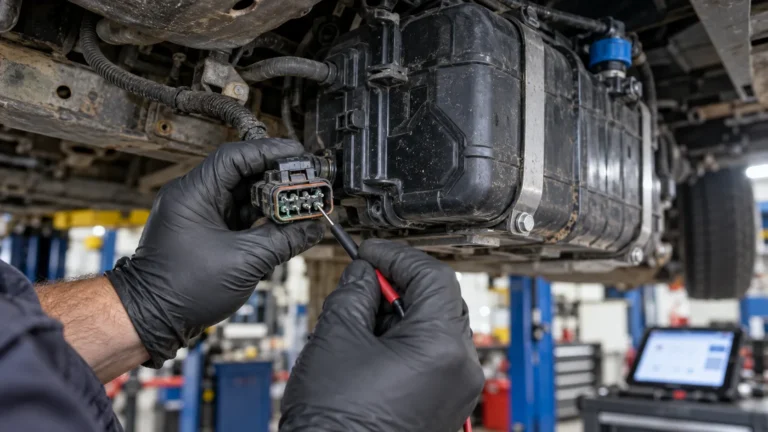
- Wiring and connector corrosion. Especially relevant on vehicles that see a lot of wet, salted UK roads a corroded connector can produce fault codes that look identical to a failed sensor.
Understanding the cause matters because it determines whether you’re looking at a straightforward repair or something more involved which brings us to diagnosis.
Proper diagnosis: why guesswork costs you money
The single most common mistake we see usually from owners who’ve already had one unsuccessful repair attempt is replacing a part based on the fault code alone, without confirming the cause with live data. A P20EE code, for example, could mean a failed catalyst, a failed sensor, or simply a dosing calibration issue. Replace the wrong part and the code returns, and now you’ve spent money for nothing.
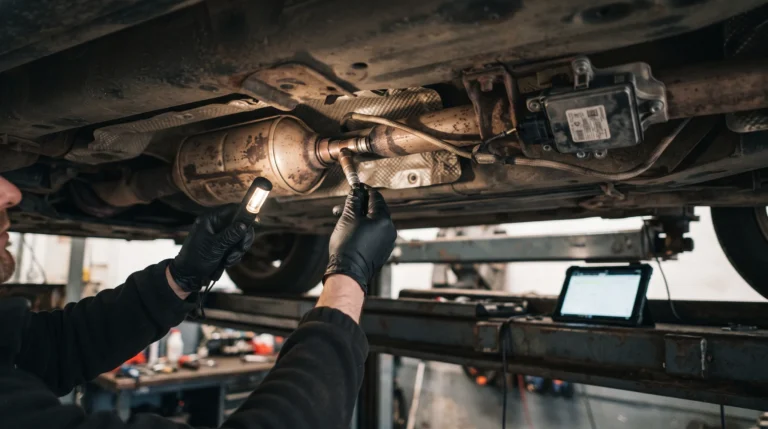
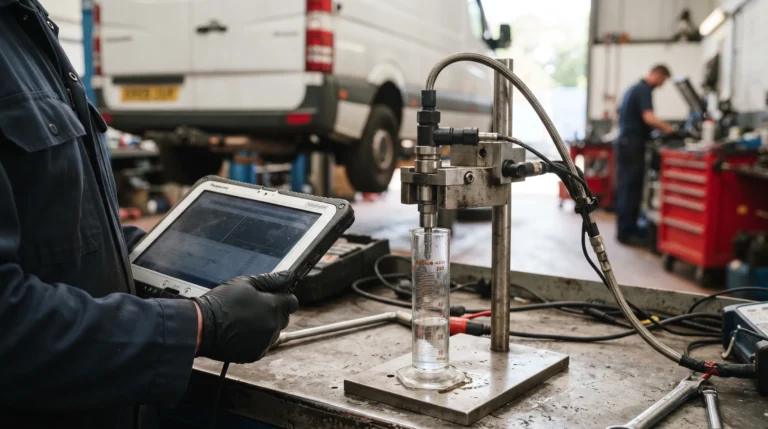
A proper diagnostic process reads live sensor data pressure, temperature, NOx readings before and after the catalyst while the engine is running, not just the stored trouble codes. This is exactly the approach our AdBlue Fix technicians take on every visit, whether the outcome ends up being a repair, a delete, or something else entirely. It’s a mobile service, so the diagnostic happens at your home, workplace, or roadside no need to arrange recovery to a garage first.
Your options: repair, removal, delete or bypass
Once you know what’s actually wrong, you generally have four routes forward. They’re related but distinct, and which one makes sense depends on your vehicle, your budget, and how you use it.
AdBlue Repair fixing the fault at its source
This means replacing or repairing the specific failed component pump, injector, heater, sensor, or wiring so the AdBlue system continues to function exactly as the manufacturer intended. It’s the right call when a vehicle is relatively young, still under warranty considerations, or when you simply want to keep the emissions system fully intact and road-legal without any grey areas. Our AdBlue Repair service covers full diagnostics through to component-level fixes.
AdBlue Removal what it actually involves
“AdBlue removal” is often used interchangeably with “AdBlue delete,” but strictly it can mean two different things: a software-based removal (see below) or, in rare cases, physically removing hardware something reputable technicians avoid on road vehicles, since it invites automatic MOT failure and is a far blunter approach than a clean software solution. Our AdBlue Removal page explains the distinction in full and confirms exactly what’s involved before any work is carried out.
AdBlue Delete the permanent software solution
An AdBlue delete is a specialist ECU remap that instructs the engine management system to stop monitoring and requiring the AdBlue system altogether. No physical parts are removed it’s a digital change to the software the ECU runs from. Warning lights, countdowns, and dosing-related fault codes are permanently cleared. It’s the option most owners consider once they’re facing a second or third repeat failure, particularly on higher-mileage vans where the cost of chasing repeat AdBlue faults starts to outweigh the vehicle’s value. Full detail is on our AdBlue Delete page including the legal position, which we cover in full further down this guide.
AdBlue Bypass how it differs from a full delete
A bypass is a narrower software intervention rather than deleting the AdBlue requirement entirely, it addresses a specific fault (commonly a failing sensor or dosing irregularity) by instructing the ECU to ignore that one input, while leaving the rest of the system’s logic intact. It’s sometimes used as an interim or lower-cost solution where a full delete isn’t necessary or desired. Our AdBlue Bypass page explains which situations it suits and how it differs from a complete delete.
Repair vs delete which is right for your vehicle?
| Factor | Favours repair | Favours delete |
| Vehicle age / mileage | Newer, lower mileage | Older, high mileage |
| Fault history | First-time fault | Repeat failures (2nd, 3rd occurrence) |
| Vehicle use | Daily road use, resale planned soon | Long-term keeper, fleet/commercial use |
| Budget | Prefer factory-standard system | Prefer a one-off, permanent fix |
| Legal position | No complications, fully road-legal | Requires understanding the road-use restrictions below |
There’s no universally “right” answer here it genuinely depends on your circumstances, and it’s exactly the kind of decision worth talking through with a technician who can see your specific fault history rather than guessing from a forum thread.
When it’s called UREA instead of AdBlue
As mentioned earlier, a meaningful share of the vans we work on particularly Peugeot Boxer, Citroën Relay, Vauxhall Movano and similar Stellantis-platform vehicles display “UREA” rather than “AdBlue” on the dashboard and in diagnostic software. It’s the identical SCR technology underneath; only the manufacturer’s naming differs. If you’re seeing a UREA warning light, a UREA quality fault, or a UREA-specific countdown, our UREA Removal hub covers both UREA Delete for a permanent software solution and UREA Repair for fixing the fault at component level the same decision framework above applies.
NOx sensor problems
The NOx sensor deserves its own section because it’s arguably the single most failure-prone part of the entire emissions system. Positioned directly in the hot, corrosive exhaust stream, these sensors take a genuine beating from heat cycling, vibration, and moisture and unlike a pump or injector, a NOx sensor’s failure is often intermittent before it’s constant, which makes it a frustrating one to chase down from the driver’s seat.
Typical symptoms of a failing NOx sensor:
- AdBlue or emissions warning light with no obvious pattern
- Limp mode that comes and goes, sometimes clearing itself on restart
- P2200-series or P229F fault codes on a scan
- Poorer fuel economy that develops gradually
You generally have two paths once a NOx sensor is confirmed faulty: replace it with an OEM-spec part (keeping the system fully factory-standard) or have it deleted at ECU level so the vehicle stops relying on that sensor’s data entirely. Given that many vehicles run two NOx sensors one either side of the catalyst and that replacement parts aren’t cheap, a lot of owners specifically ask about deletion once a sensor has already failed once. Our NOx Sensor page covers bypass, delete and replacement, so you can weigh up which suits your situation once we’ve confirmed exactly which sensor and which fault you’re dealing with.
EGR faults: the other common culprit
Not every dashboard warning that looks like an AdBlue fault actually is one. The Exhaust Gas Recirculation (EGR) valve which recirculates a portion of exhaust gas back into the intake to lower combustion temperatures and reduce NOx formation in the first place is another extremely common source of diesel warning lights, limp mode, and poor running, and its symptoms overlap heavily with AdBlue faults.
EGR valves are prone to carbon build-up, particularly on vehicles doing a lot of short journeys or motorway-light driving, where the valve rarely gets hot enough to self-clean. Once carbon builds up enough to stick the valve open or closed, you’ll typically see rough idling, hesitant acceleration, and on many modern vans the same kind of limp mode and warning light behaviour that AdBlue faults produce, which is exactly why a proper diagnostic that distinguishes between the two systems matters so much.
It’s also worth understanding that EGR and DPF systems interact directly: a disabled or malfunctioning EGR valve increases the soot load reaching the DPF, since more raw exhaust gas is passing through rather than being recirculated and partially cleaned. If you’re dealing with repeat EGR faults, it’s worth having the DPF checked in the same visit rather than treating them as unrelated problems.
Our EGR Delete hub covers this system in full, with EGR Solutions for cleaning, repair and diagnostic work, and EGR Removal for a permanent software-based fix on vehicles with repeat, unresolvable faults.
DPF and AdBlue: why they often fail together
The Diesel Particulate Filter (DPF) traps soot from the exhaust and periodically burns it off in a process called regeneration, which needs sustained higher engine temperatures typically motorway-speed driving to complete properly. Vans and cars doing predominantly short, low-speed urban journeys (a very common pattern across our London and South East coverage area) often struggle to complete regeneration cycles naturally, leading to a gradually clogging filter.
The connection to AdBlue is more direct than most owners realise: a struggling or blocked DPF changes the exhaust conditions the SCR system is designed around, which can itself trigger AdBlue-related fault codes even when the AdBlue system’s own components are working perfectly. If you’re chasing an AdBlue fault that keeps returning despite repairs, it’s genuinely worth having the DPF assessed at the same time. Our DPF Solutions page covers both DPF cleaning and regeneration support.
What does it cost?
Costs vary meaningfully by vehicle, fault, and how far the problem has been left to develop, so treat the figures below as typical UK market ranges rather than a quote get in touch for a price specific to your vehicle and fault.
| Repair / service | Typical UK range |
| Diagnostic reset (no underlying fault) | £80–£150 |
| AdBlue injector replacement | £100–£250 |
| NOx sensor replacement (per sensor) | £250–£650 |
| AdBlue pump repair/replacement | £400–£1,200+ |
| AdBlue heater repair | £150–£400 |
| AdBlue tank replacement (rare) | £800–£2,000+ |
| AdBlue delete (software) | £150–£300 |
| NOx sensor delete (software) | £150–£300 |
| EGR delete/solutions | £120–£300 |
A general pattern worth knowing: dealer quotes for AdBlue faults often start at £1,000+ because dealers tend to replace whole assemblies (a combined pump/tank/heater unit, for instance) rather than diagnosing down to the individual failed part. A proper independent diagnostic frequently identifies a single failed component, which is a large part of why mobile specialist repairs typically come in well under dealer pricing for the same fault.
Is AdBlue delete legal in the UK?
This is a question we get asked honestly and directly, and it deserves a straight answer rather than a vague one.
For vehicles used on public roads, the position is clear: it is not legal. Under the Road Vehicles (Construction and Use) Regulations 1986, a vehicle must not be used on the road if any device fitted to control emissions has been removed or rendered inoperative. An AdBlue, NOx sensor, EGR or DPF delete falls squarely within that. Consequences of being caught can include:
- Automatic MOT failure, or a failure to comply once detected
- Fines up to £1,000 for private cars, and up to £2,500 for goods vehicles over 3.5 tonnes
- Potential insurance complications, since an undisclosed emissions modification can affect a claim
- DVSA and roadside enforcement checks, which have become increasingly capable of detecting these modifications
The exceptions are narrow. Vehicles used exclusively off-road agricultural machinery, plant, motorsport used only on private circuits, or vehicles being exported and never registered for UK road use sit outside these road-use regulations. The critical detail is that the vehicle must never touch a public road once modified, not even briefly, for the off-road exception to apply.
We’re transparent about this with every customer, and we’d rather you go into a decision with the full legal picture than a half-explained one. For a great many vehicles, particularly those with repeat AdBlue faults on higher mileage, repair remains a viable and fully compliant route see our AdBlue Repair and UREA Repair services. Where a delete is being considered, we’ll always talk through how the vehicle is actually used before any work goes ahead. The same legal position applies equally to EGR Removal and DPF removal; none of these are treated any differently under the regulations.
Our mobile service and where we cover
Every service on this page repair, removal, delete or bypass, across AdBlue, UREA, NOx sensor, EGR and DPF systems is carried out by our mobile technicians at your home, workplace, or roadside. There’s no need to arrange recovery to a garage or lose a day waiting around; in most cases the full diagnostic and fix is completed in a single visit, often within a couple of hours.
We cover a wide stretch of London and the South East, with dedicated local coverage in London, Dartford, Esher, Slough, St Albans, Sevenoaks, Loughton and Epsom each with a technician who knows the local driving patterns (a lot of short, stop-start journeys across these areas, which is exactly the kind of driving that accelerates DPF and EGR issues, as covered above).
Ready to get your AdBlue fault diagnosed properly? Get a free quote and we’ll talk through your symptoms, fault codes if you have them, and the most sensible next step for your vehicle.
Preventing AdBlue and NOx sensor faults
A handful of habits meaningfully reduce the odds of an AdBlue fault reaching the countdown stage:
- Top up with quality AdBlue only, ideally ISO 22241-certified, and avoid decanting from unsealed or long-opened containers, which is a common source of contamination.
- Don’t let the tank run dry. Low-level warnings exist for a reason running genuinely empty forces the pump to draw air, which can damage it.
- In winter, park undercover where possible if your vehicle has a history of heater faults, and don’t ignore any “AdBlue crystallised” style message to get it looked at before it progresses.
- Give diesel vans a regular motorway run where practical, to help the DPF complete natural regeneration cycles and reduce the knock-on load on the SCR system.
- Act on the first warning, not the countdown. Every stage-one warning we’ve discussed above gives you real lead time using it saves money and avoids the stress of a no-start situation.
Real-world scenarios
The van that “fixed itself” twice. A common pattern with fleet vans: an AdBlue warning appears, the driver tops up the fluid, the light goes out, and everyone assumes it’s resolved until it returns a few weeks later. In most of these cases, the fluid was never actually the issue; a marginal sensor or dosing fault was intermittently clearing itself on restart. By the third occurrence, the underlying component has usually failed properly, and proper diagnostics at that point confirm what a top-up never could.
The no-start on a Friday afternoon. A countdown ignored for a couple of weeks reaches zero at the worst possible time. This is fully recoverable with a mobile visit but it does mean waiting for a technician rather than driving away, which is exactly why acting at stage one or two, rather than stage three, makes life easier.
The repeat NOx sensor replacement. A vehicle has one NOx sensor replaced, only for the fault to reappear eight months later often because the first fault was actually a wiring or connector issue that damaged the new sensor too, or because the second sensor in a paired setup was already borderline and hadn’t yet thrown a code. This is the scenario that most often leads owners to weigh up a sensor delete against a second full-price replacement.
Frequently asked questions
Can I still drive with an AdBlue warning light on?
Will an AdBlue delete affect my MOT?
Is AdBlue delete reversible?
What happens if I run out of AdBlue completely?
How do I know if it’s an AdBlue fault or an EGR fault?
Is it cheaper to repair or delete an AdBlue system?
Do you cover vans as well as cars?
How long does a mobile AdBlue repair or delete take?
Do you offer a warranty on AdBlue work?
The bottom line
Whether you’re seeing an early warning, a mileage countdown, or you’re already at a no-start, the fault is almost always fixable; the key is getting it properly diagnosed rather than guessed at. If you’re not sure which of our services applies to your situation, that’s exactly what our team is for: start with a call or a quote request, and we’ll point you towards AdBlue Repair, AdBlue Delete, NOx Sensor work, EGR Solutions, or DPF Solutions based on what your vehicle actually needs not before.