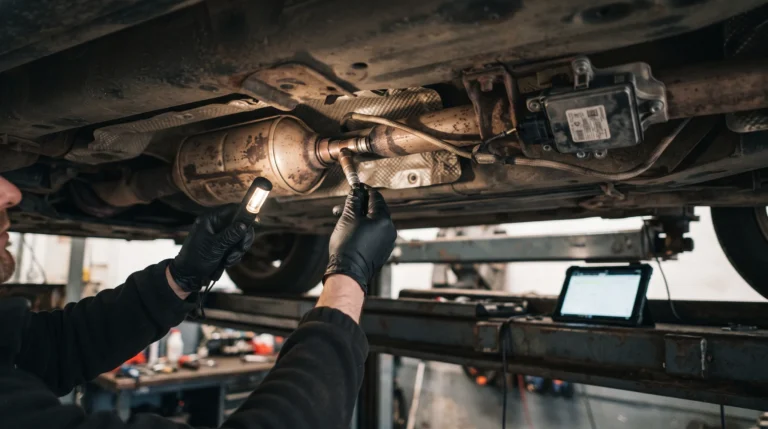

Usually, yes. We say that a lot in this workshop, mostly because the pump gets blamed first almost every single time someone rings up about low pressure, and it’s rarely the actual culprit. It’s the obvious suspect. The moving part makes noise, easy to point at. But a pump is just one link in a chain that also includes a filter, a delivery line, a few seals, a connector or two, and a sensor watching pressure the whole way through. Any one of those can drop the number enough to trip a fault.
We’ve lost count of how many “the pump’s definitely gone” calls turned into a £40 seal instead of a £400 part. Not every time. But often enough that we won’t quote a pump without actually testing for one first.
How Pressure Is Even Meant to Build in the First Place
AdBlue sits in the tank, gets drawn through a filter, travels along a line, builds up under the pump, then gets injected in a tiny, precise dose. Most systems want somewhere around 5 to 9 bar at the injector, though that number shifts a bit by manufacturer. Every joint on that route is a place pressure can quietly leak away. The pump makes the pressure. It doesn’t get exclusive blame for losing it.
Here’s the annoying part. The ECU just sees a number. It can’t tell you if that number’s low because the pump’s knackered or because a rubber seal three inches away finally gave up. Same fault code either way. Which is exactly why guessing from the dashboard gets people nowhere.
What’s Actually Behind It, Pump Aside
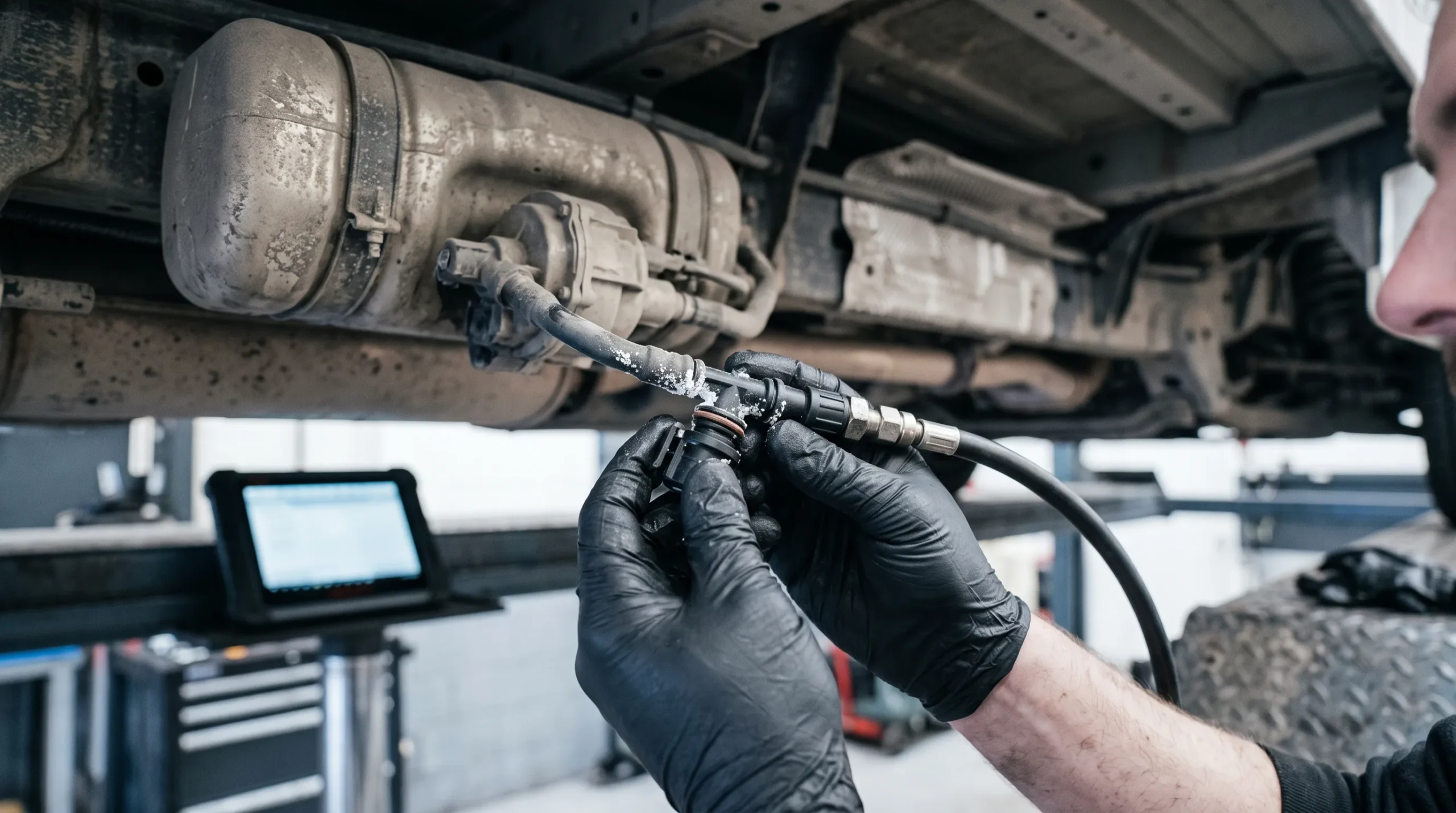
Perished seals top the list by a long way. They sit somewhere genuinely unpleasant, hot one minute, cold the next, constantly wet with AdBlue, picking up road filth for years. Rubber doesn’t last forever. Swap it, pressure’s back, and the pump never gets touched.
A clogged filter causes the opposite problem but ends up looking identical on a scan tool. Fluid can’t push through fast enough, so the system reads it as low pressure, when really it’s crystallised urea sitting in the filter doing the damage, not anything mechanical failing underneath.
Loose fittings are the sneaky one. A connector that’s worked itself open just a fraction over months of vibration can bleed off enough pressure to set a fault with zero visible leak anywhere. We’ve found these on the second or third check, not the first, because nothing’s dripping and nothing looks obviously wrong.
A tired non return valve is maybe the biggest pump impersonator on this whole list. It lets pressure drain backward the second the pump switches off, so every cold start is the pump playing catch up from zero. Looks exactly like a weak pump from where the driver’s sitting.
And then the sensor itself. Nothing wrong with pressure at all in this case, it’s just lying about what it’s reading. Our guide on AdBlue pressure sensor faults goes into that one properly.
And Sometimes, Yeah, It Really Is the Pump
Won’t pretend otherwise. A motor that’s worn down inside to the point it can’t physically build the pressure needed, no matter how spotless everything upstream is, that’s a replacement. Our page on whether an AdBlue pump can be repaired or needs replacing covers that call properly if it comes to it.
Corrosion inside the housing, usually from the wrong fluid running through it at some point, finishes the job too. Cleaning doesn’t bring that back.
The Order We Actually Check Things In
Fault code scan first, always. Then a real pressure test rather than trusting what the dash says, because a dashboard warning alone can’t tell a genuine pressure loss apart from a sensor that’s simply wrong.
If pressure’s confirmed low, seals and connections get checked next. They’re cheap and they’re common. Filter after that. Only once all of that’s clean do we isolate the pump and test it on its own. Only then, if it still won’t hold proper pressure by itself, do we call it a new pump.
Skip that order and go straight for the pump and you’re risking two things at once. Paying for a part that was fine. And leaving the real problem, some tired seal sitting right there the whole time, completely untouched under a brand new pump that still won’t hold pressure.
The Sprinter in Lewisham That Kept Its Original Pump
Came to us already quoted for a full pump by another garage. Low pressure reading, nothing else checked. We tested before agreeing to anything, and the pump was putting out close to what it should. The real leak was an O ring further up the line, dried out, cracked, the kind of thing you’d walk straight past on a quick look.
New seal. Pressure held. Fault stayed cleared on the follow up a week later. Van was back out that same afternoon for a fraction of the original quote, and the pump that nearly got binned for nothing is still in there doing its job.
A Transit a few weeks later told a completely different story. Same complaint almost word for word, low pressure, warning light. This time every seal checked out, every connection was tight, and the filter was clean. The pump on its own just couldn’t hold pressure. That one got a new pump, properly earned, no shortcuts taken to avoid it.
Where This Sits Next to Our Other Pressure Guide
Our page on an AdBlue system not holding pressure covers the broader symptom. This one picks up from there, specifically on whether the pump’s actually to blame once low pressure’s confirmed, or whether something smaller’s hiding underneath it.
Could It Be the Injector Instead of Pressure?
Possibly. A poorly spraying injector can sometimes produce a reading that looks pressure related even when the delivery system’s fine throughout. Our guide on AdBlue injector repair versus replacement is worth checking if dosing accuracy’s the actual concern rather than raw pressure.
Things Worth Mentioning When You Call to Book
AdBlue light first, nearly always, often with a dashboard message that doesn’t actually say much. If the pump’s louder than it used to be, or running for longer stretches, say so. That one detail changes what we check first.
Ignore it long enough and performance starts dropping, same as most AdBlue faults, and eventually a restart countdown turns up once the ECU gives up trusting its own dosing.
What Does This Cost?
Depends entirely what’s found, which is the whole argument for testing properly before quoting. A seal or a filter clean sits well under what a pump costs, often by a few hundred pounds. Our page on system repair cost in the UK and what to expect covers the wider picture, and AdBlue pump replacement cost is worth a read if the pump does end up being the actual cause.
What We Actually Do
AdBlue diagnosis comes first, always, confirming where pressure’s going before anything gets swapped. AdBlue repair covers the seal, filter, or pump itself, whichever it turns out to be. AdBlue reset clears the fault once the real cause is actually dealt with, not just papered over.
HGV remapping covers related emissions work for commercial fleets.
Does Your Vehicle Change Any of This?
A bit. Seal and connector placement differs by manufacturer, which affects how exposed they are to heat and grime over the years. We see this regularly on Volkswagen, Audi, BMW, Mercedes, Ford, Vauxhall, Peugeot, Citroën, Jaguar and Land Rover models. Check our vehicles page for yours specifically.
Where We Cover This Across London
North London
Barnet, Enfield, Haringey, Camden, Islington, Waltham Forest and Harrow.
East London
Hackney, Tower Hamlets, Newham, Redbridge, Barking and Dagenham, Havering and Greenwich.
South London
Lambeth, Southwark, Lewisham, Bromley, Bexley, Sutton, Merton, Wandsworth, Kingston upon Thames and Richmond upon Thames.
West London
Ealing, Hammersmith and Fulham, Hounslow, Hillingdon, Brent, Kensington and Chelsea and Westminster.
Not sure which page covers your postcode? Our AdBlue repair London page and full locations directory list everywhere we reach.
Quick Answers
01Does low pressure mean the pump’s on its way out?
Not necessarily, and it’s actually one of the less likely causes once everything’s been checked properly. Seals and loose connectors cause more of these faults than a genuinely dying pump does.
02Can a tiny seal leak really set off a full fault code?
Yes. The ECU can’t tell a small leak apart from a weak pump. Both just read as low pressure.
03Is fixing a seal actually cheaper than a new pump?
By a long way, usually a few hundred pounds difference. That gap is the whole reason for testing properly before quoting matters.
04How do you actually tell a leak apart from a weak pump?
Pressure tests the whole system first. Isolate and test the pump on its own only once everything upstream’s confirmed clean. You can’t tell the two apart by eye or by dashboard alone.
05Would a normal garage catch a small seal leak?
Not always. Take a proper pressure testing kit and the patience to check each connection, rather than jumping straight to the pump because it’s the obvious part.
06Is crystallisation the same kind of problem as a leak?
Different mechanism, same result on a scan tool. One restricts flow, the other lets it escape, but both read as a pressure fault to the ECU.
07Is there a warranty on this work?
Yes, every job we do carries its own workmanship warranty, whatever the actual cause turns out to be.
08How long does a seal or filter job take?
Usually the same day once we know the cause. A pump, if it genuinely comes to that, can take a bit longer depending on parts.
09Could I end up paying for a pump that wasn’t actually needed?
That’s exactly what checking in the right order is meant to stop, seals and connections before the pump ever gets isolated and tested.
10Does this happen on vans and HGVs too, not just cars?
Yes, same principles across any SCR diesel. HGV remapping covers related work for fleets.
Already Quoted a New Pump? Get a Second Opinion First
Get in touch through our contact page and we’ll find out exactly where pressure’s actually being lost before anything gets replaced that doesn’t need to be.