

The AdBlue warning light means your vehicle’s AdBlue (diesel exhaust fluid) level is low, or there is a fault with the AdBlue system. A low-level warning gives you time to top up before further warnings appear. A system fault warning, often an amber or red icon accompanied by a fault message, means a component in your SCR (Selective Catalytic Reduction) system has failed and topping up the fluid will not clear it. Ignoring it can result in the engine entering a reduced-power mode or refusing to restart. Here is what each warning stage means, why it comes on, and what your options are.
Quick Reference: AdBlue Warning Light Stages
| Warning stage | What it looks like | What it means | Action required |
| First warning | Amber light, mileage countdown | AdBlue level low | Top up within the displayed range |
| Second warning | Amber light, shorter countdown | AdBlue critically low | Top up immediately |
| Final warning | Red light or startup message | Near-empty engine may not restart | Top up before switching off |
| System fault | Amber/red light + fault code | Component failure, not a level issue | Professional diagnosis required |
| Won’t clear after refill | Persists after topping up | Fault code stored, sensor issue, or contamination | Professional diagnosis required |
What Is AdBlue and Why Does the Warning Light Exist?
AdBlue is a non-toxic fluid made from 32.5% urea and 67.5% deionised water. It is injected into the exhaust stream of diesel vehicles fitted with SCR (Selective Catalytic Reduction) systems, where it reacts with nitrogen oxide (NOx) emissions to convert them into harmless nitrogen and water vapour.
The AdBlue warning light exists because SCR systems are legally required to function correctly; your vehicle is designed to prevent the engine from restarting once the AdBlue tank is empty, specifically to prevent vehicles from operating outside their emissions compliance parameters. This is not a suggestion. It is a hard limit built into the vehicle’s ECU.
What Does the AdBlue Warning Light Actually Mean?
The meaning of the AdBlue warning light depends on whether it is a level warning or a system fault warning and the difference is significant.
A level warning means the tank is running low. Every diesel vehicle with an SCR system consumes AdBlue at roughly 1–1.5 litres per 1,000 miles, though this varies by engine size, driving style, and vehicle age. Most vehicles give a first warning between 1,500 and 2,400 miles remaining. Top up the fluid and the light clears.
A system fault warning means a component of the AdBlue pump, injector, NOx sensor, SCR catalyst, or the AdBlue quality sensor has failed or is reading incorrectly. Topping up the fluid will not clear this. The fault code must be diagnosed and either the component repaired or an AdBlue repair carried out.
AdBlue Warning Light Stages Explained
Stage 1 — First warning: low level
Most vehicles display the first AdBlue warning between 1,500 and 2,400 miles remaining. It typically appears as an amber dashboard light accompanied by a message showing the approximate miles left. At this stage, the vehicle drives normally and there is no urgency beyond planning a top-up.
AdBlue is available from most petrol stations, motor factors, and online retailers in 5-litre or 10-litre containers. Check your vehicle handbook for the correct filler location and the tank capacity overfilling can cause contamination of the filler neck, which triggers its own fault code.
Stage 2 — Second warning: critically low
The second warning appears when the remaining range is shorter, typically under 500 miles depending on the manufacturer. The warning may become more prominent, appearing at every startup. The vehicle still drives normally but the countdown to a no-restart condition is now serious.
Top up immediately. Do not top up with tap water, incorrect concentration, or AdBlue that has been stored in a contaminated container contaminated fluid causes AdBlue quality fault codes that persist even after the correct fluid is added.
Stage 3 — Final warning: engine will not restart
Once the AdBlue tank is empty (or below the minimum detectable level), most modern vehicles display a startup warning stating that the engine will not restart once it has been switched off. Some vehicles enter reduced-power (limp) mode at this stage.
If the engine is running, top up before switching off. If the vehicle has already failed to start, it needs a top-up and in some cases a fault code reset from a diagnostic tool before the restart lockout will clear.
Stage 4 — System fault warning
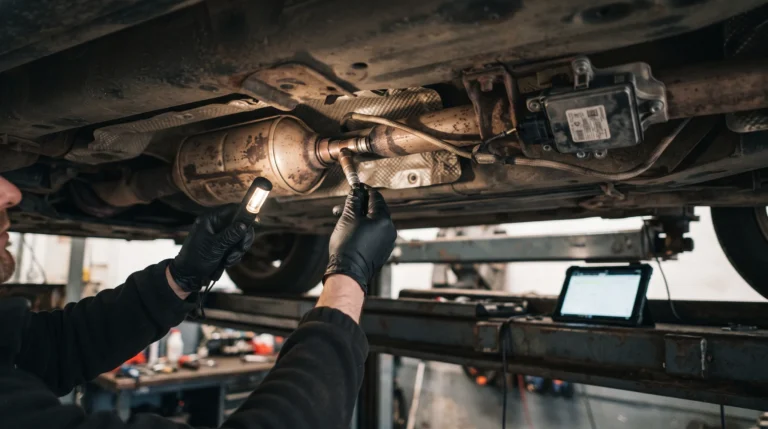
A system fault warning is distinct from a level warning. It is typically accompanied by a specific fault code (visible via an OBD diagnostic tool) and may or may not coincide with a low level warning. Common causes include:
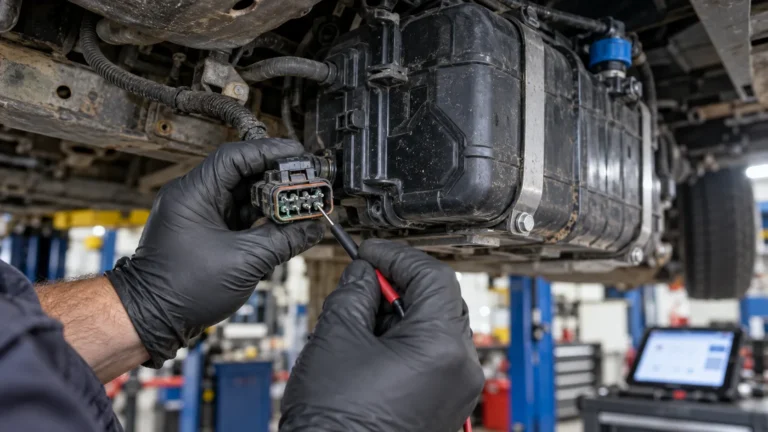
- AdBlue pump failure — the pump that draws fluid from the tank and delivers it to the injector has failed electrically or mechanically
- AdBlue injector fault — the injector nozzle is blocked or has failed
- AdBlue quality fault — the system has detected that the fluid is the wrong concentration, contaminated, or has degraded
- NOx sensor fault — the upstream or downstream NOx sensor has failed or is reading incorrectly (see our dedicated NOx sensor page for full diagnosis information)
- SCR catalyst fault — the catalyst itself has degraded or been damaged
- Temperature sensor fault — the SCR system’s temperature management has a fault
Each of these requires a different repair. A professional AdBlue fix involves diagnosing the specific fault code, identifying the failed component, and repairing or replacing it. An AdBlue delete or AdBlue bypass is a software-based alternative for vehicles where ongoing system failures make repair uneconomical; this is covered in detail below.
Why Is My AdBlue Warning Light On? Common Causes
Low AdBlue level
The most straightforward cause. Top up with the correct fluid and the light clears within a short drive once the system confirms the new level. If the light does not clear after topping up, the issue is a fault code or sensor problem not the level itself.
AdBlue quality fault
This occurs when the system detects that the fluid in the tank is not the correct concentration (32.5% urea), has been contaminated, or has degraded due to overheating or age. Contamination is more common than people expect using a funnel previously used for oil or coolant, topping up with water-diluted fluid, or leaving fluid in an open container can all trigger a quality fault.
A quality fault will not be clear by itself. The tank typically needs draining, flushing, and refilling with correct fluid. If the fault code remains after this, the quality sensor itself may need replacement.
AdBlue pump fault
The AdBlue pump sits inside or adjacent to the tank and delivers fluid to the SCR injector. Pumps fail more commonly on high-mileage vehicles and those where the tank has been run completely dry repeatedly running the pump dry accelerates wear on its internal seals. Pump failure presents as a fault code alongside either a system fault warning or a warning that does not clear after refilling.
NOx sensor fault
The NOx sensors (typically one upstream and one downstream of the SCR catalyst) monitor the effectiveness of the SCR system. A failed or contaminated NOx sensor can trigger an AdBlue system fault even when the fluid level and pump are functioning correctly. Our NOx sensor service covers diagnosis and replacement across a wide range of diesel vehicles.
AdBlue system fault after a service
A specific and frustrating variant of the AdBlue warning light appears, or a fault code is stored, immediately after a routine service. This usually occurs because the AdBlue system was not properly reset after the service, or because a sensor was disturbed during other work. This is a diagnostic issue, not a component failure, and can typically be resolved with a fault code reset and system recalibration.
What to Do When the AdBlue Warning Light Comes On
If it’s a level warning:
- Check how many miles remain on the countdown (if displayed)
- Top up with the correct AdBlue fluid check your handbook for filler location and capacity
- Use only fresh, sealed fluid from a reputable source
- Drive for 5–10 minutes the system needs to confirm the new level before the warning clears
- If the warning does not clear after topping up, a fault code is stored and you need diagnosis
If it’s a fault warning:
- Do not ignore it the vehicle is flagging a component failure, not just a level issue
- Check whether the vehicle is still driving normally or has entered reduced-power mode
- If normal driving is possible, book a diagnostic appointment soon
- If the vehicle is in limp mode or is displaying a no-restart warning, arrange mobile diagnosis as a priority
- Contact us for same-day or next-day mobile AdBlue diagnostics
AdBlue Warning Light by Vehicle Make
Different manufacturers use different warning icons, messages, and stage intervals. Here is how the most common makes present AdBlue warnings:
| Make | Warning terminology | Specific behaviour |
| BMW | “AdBlue” + countdown miles | Three-stage warning; engine no-restart lockout at empty |
| Mercedes | “AdBlue” warning triangle | Often accompanied by specific fault codes; can lock out ignition at zero |
| Peugeot/Citroën | “AdBlue” or “Urea” | PSA group vehicles show urea warning same system, different name |
| Volkswagen Group (VW, Audi, SEAT, Skoda) | “AdBlue range” + miles | Prominent instrument cluster display; clear mileage countdown |
| Ford | AdBlue range message | Appears in information display; countdown from first warning |
| Renault | SCR or AdBlue warning | Van range (Trafic, Master) shows SCR warning rather than AdBlue in some models |
| Fiat/Iveco | “AdBlue” or “DEF” | Commercial van range; Ducato commonly presents AdBlue warnings |
If the warning light on your specific vehicle is behaving unexpectedly persisting after a refill, appearing with a fault code, or accompanied by a no-restart message the vehicle-specific behaviour is covered in our dedicated make-specific guides linked from the blog.
Is My AdBlue Problem a Repair Job or a Delete?
This is the most common decision point for drivers whose AdBlue system has developed a recurring or expensive fault.
Repair is the right approach when the fault is isolated: a single failed sensor, a pump replacement, or a one-off quality fault. Our AdBlue repair and urea repair services diagnose the specific fault code and replace only the failed component.
Delete or bypass is worth considering when the system has multiple faults, when the repair cost is disproportionate to the vehicle’s value, or when the same fault is recurring despite previous repairs. An AdBlue delete, AdBlue bypass, or urea delete is a software-based solution that removes the SCR system’s requirement from the ECU the vehicle no longer monitors or requires AdBlue to function, and the warning lights are permanently cleared.
There are legal considerations to understand before choosing either option. The legal implications are explained in full on our delete page read this before making a decision. The pricing page covers costs for both repair and delete options across our service range.
Repair vs delete at a glance
| Factor | AdBlue repair | AdBlue delete |
| Cost | Lower for isolated faults | Fixed cost regardless of fault complexity |
| Outcome | System restored to OEM function | SCR system permanently bypassed |
| MOT implications | System must function for MOT | Legal and MOT implications apply see our delete page |
| Best suited for | Single component failures | Recurring faults, uneconomical repairs |
| Timeframe | Same-day mobile in most cases | Same-day mobile in most cases |
Does an AdBlue Fault Affect DPF or EGR Systems?
An AdBlue fault is specific to the SCR system and does not directly cause DPF or EGR faults. However, the three systems are related in the broader emissions management architecture, and a vehicle with a long-running AdBlue fault that has been driven in reduced-power mode can develop secondary issues.
DPF faults present separately if your vehicle also has a DPF warning, our DPF solutions page covers diagnosis and options. EGR faults present differently again see EGR solutions, EGR removal, or EGR delete depending on what you’ve been quoted.
Our Mobile AdBlue Warning Light Service
AdBlue Fault is a mobile diagnostic and repair specialist. We come to you at your home, workplace, or roadside across London and the surrounding area. There is no need to recover the vehicle to a garage or wait for a dealer appointment.
Our mobile service covers:
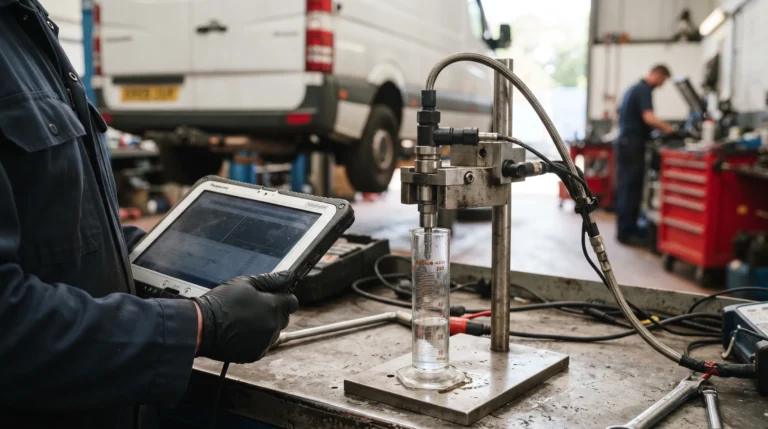
- Full AdBlue system diagnosis with professional diagnostic equipment
- Fault code reading and interpretation
- AdBlue pump, injector, and sensor replacement where required
- AdBlue fluid supply, drain, and refill for quality fault case
- AdBlue delete and bypass where repair is not the right option
- All AdBlue removal services including urea removal
For HGV and commercial vehicle operators, see our HGV remapping and AdBlue solutions our mobile capability extends to trucks, vans, and agricultural vehicles across our service areas.
Areas We Cover
We carry out mobile AdBlue warning light diagnosis and repair across:
- AdBlue repair London
- AdBlue repair Slough
- AdBlue repair Esher
- AdBlue repair Epsom
- AdBlue repair Loughton
- AdBlue repair St Albans
- AdBlue repair Sevenoaks
- AdBlue repair Dartford
Not in one of these locations? See our full service area we cover a wide radius from each of our base locations and take enquiries from outside listed areas.
Frequently Asked Questions
What does the AdBlue warning light mean?
The AdBlue warning light means either your AdBlue fluid level is low and needs topping up, or there is a fault with the SCR system such as a pump, injector, or NOx sensor failure. A low-level warning clears after topping up. A system fault warning requires professional diagnosis and will not clear with fluid alone.
What happens if I ignore the AdBlue warning light?
If the AdBlue tank runs empty, most modern diesel vehicles are programmed to prevent the engine from restarting once it has been switched off. Before that point, the vehicle may enter a reduced-power (limp) mode. Ignoring a system fault warning causes the fault code to remain stored in some cases the vehicle deteriorates further, and secondary faults can develop.
Why is my AdBlue warning light still on after I topped it up?
If the light remains on after topping up correctly, a fault code has been stored in the system. This happens when the fluid was contaminated, when the level sensor is reading incorrectly, or when a separate system fault (pump, injector, NOx sensor) was already present. Top-up alone does not clear fault codes; a diagnostic scan is required.
Can I drive with the AdBlue warning light on?
If it is a first or second level warning, yes but only until you can top up. If the warning is a system fault warning, or if the countdown has reached zero, you should arrange diagnosis promptly. If the vehicle has already entered limp mode, driving it further risks additional faults and potential engine protection activation.
How much does AdBlue warning light diagnosis and repair cost?
Diagnosis costs and repair costs vary by fault type and vehicle. Our pricing page sets out our fixed-price options for common repairs and delete services. For a specific quote based on your fault codes and vehicle, contact us.
What is the difference between an AdBlue repair and an AdBlue delete?
An AdBlue repair fixes the specific failed component pump, injector, sensor and restores the SCR system to its original function. An AdBlue delete is a software-based solution that removes the SCR system requirement from the vehicle’s ECU, permanently clearing the warning light without repairing the hardware. Both are available as mobile services. The right choice depends on the fault type, repair cost, and vehicle value see our AdBlue delete page for the full explanation.
Do you carry out a mobile AdBlue diagnosis near me?
We cover London, Slough, Esher, Epsom, Loughton, St Albans, Sevenoaks, Dartford, and the surrounding areas. See our locations page for full coverage detail, or contact us with your postcode and we’ll confirm availability.
Does an AdBlue fault affect my DPF or EGR?
Not directly AdBlue faults are specific to the SCR system. However, vehicles driven in limp mode for extended periods can develop secondary issues. If you have both an AdBlue warning and a DPF or EGR fault, see our DPF solutions and EGR solutions pages or contact us for a combined diagnosis.
Can you fix an AdBlue fault on a van or HGV?
Yes. Our mobile service covers light commercial vehicles, vans, and HGVs. For larger commercial vehicles, see our dedicated HGV remapping and AdBlue service.
Book Mobile AdBlue Warning Light Diagnosis
If your AdBlue warning light is on whether it’s a low-level warning that won’t clear or a system fault you can’t diagnose, we carry out same-day and next-day mobile diagnosis across London and the Home Counties. No recovery, no dealer wait, no guesswork.
Contact us today with your vehicle make, model, and postcode and we’ll get back to you with availability and a fixed-price quote.