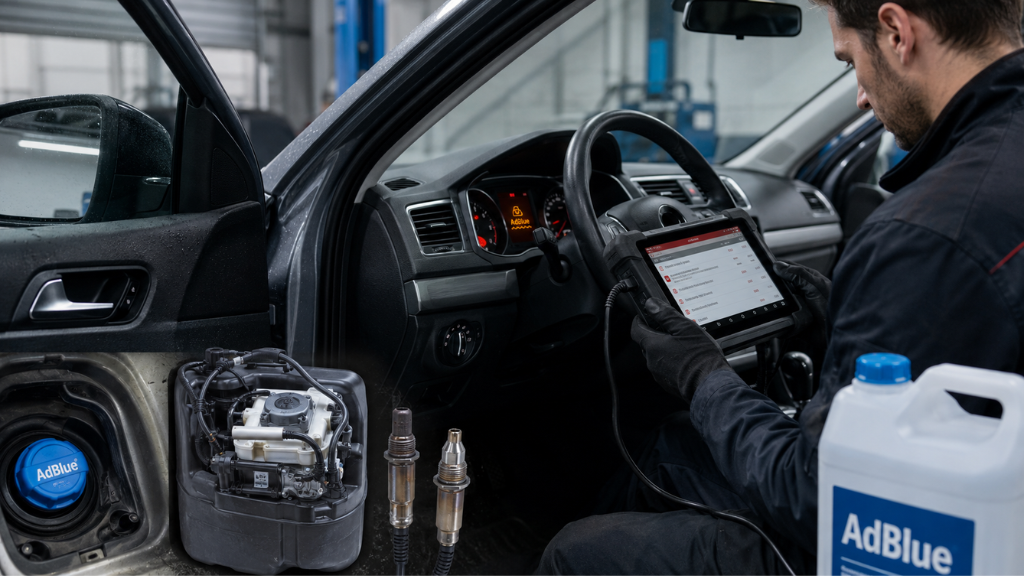

Quick answer: An AdBlue warning light usually stays on after a refill because the ECU hasn’t finished verifying the fix, not because the fix has failed. The system needs three things to confirm before it clears the fault: a completed drive cycle (typically 20–30 minutes at steady motorway speed), a fluid quality reading it trusts, and dosing behaviour that matches what it expects from the NOx sensors either side of the SCR catalyst. If any one of those three doesn’t check out, the light stays lit even with a full tank. In roughly a third of the vehicles we’re called out to for this exact complaint, there’s no fault at all, just an incomplete drive cycle. In the rest, it’s a sensor, pump, or wiring fault that a refill was never going to fix.
That distinction matters, because it changes what you should do next. Drive it properly before assuming it’s broken. If it’s still on after that, keep reading, because which specific fault you’ve got determines whether this is a £40 fix or a £600 one.
Why Refilling Doesn’t Always Clear the Light
Quick answer: Because the ECU isn’t just checking tank level, it’s checking whether the whole SCR chain (level, quality, dosing, and NOx correction) agrees with itself, and that agreement can only be confirmed through a monitored drive, not a static top-up.
Here’s the bit most explanations skip: the AdBlue light isn’t wired to the tank float. It’s the output of a diagnostic monitor that runs continuously in the background, comparing what the dosing module is injecting against what the downstream NOx sensor reports. When you refill an empty tank, you’ve fixed the level, but the ECU has no way of knowing that yet. It has to watch the system behave correctly over a defined drive cycle before it downgrades the fault from “active” to “cleared.”
This is the single most common reason we get called to a vehicle, do a full scan, and find nothing wrong. The customer refilled, drove five minutes to the shops, and assumed the light staying on meant something had failed. In most cases, it just hadn’t had the chance to pass its own test yet.
Where it gets genuinely confusing for owners is when the vehicle had already dropped into a countdown or derate state before the refill. Once that’s happened, most manufacturers require the drive cycle to be completed after the tank is full and after any stored fault has been addressed, not before. Refilling a tank that’s already in derate doesn’t automatically pull the vehicle back out of it. You’ll often see the light stay solid, or the countdown persist, until that drive cycle is completed properly.
The Diagnostic Logic We Actually Use
Quick answer: Start with drive cycle completion, then fluid quality, then wiring/connectors, then sensors, then pump/dosing hardware, in that order, because that’s the order of likelihood, not the order of expense.
Most guides list AdBlue faults by category (sensor, pump, wiring) without saying which to suspect first. On a vehicle in front of us, we don’t start with the most expensive possibility, we start with the most common one and rule it out cheaply before moving to the next.
1. Has the drive cycle actually been completed? Not “has it been driven,” but has it done 20+ minutes at a steady 50mph+ without the fault re-triggering. Stop-start town driving essentially never satisfies this.
2. Is the fluid actually correct? We check for crystallisation at the filler neck (a strong sign of historic low-level running or spillage), and if there’s any doubt, we test concentration. Genuine AdBlue is a precise 32.5% urea solution; anything diluted, contaminated, or out of spec will trigger a quality fault that no amount of driving clears.
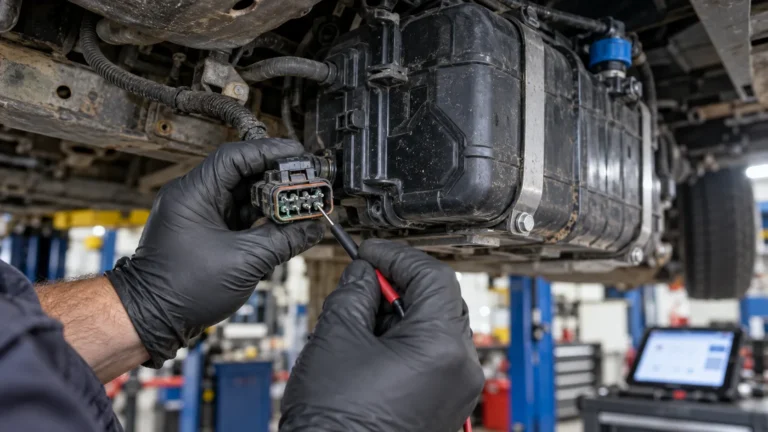
3. Is it actually the sensor, or the connector? This is where a lot of unnecessary parts get replaced. We frequently see NOx sensor and AdBlue quality sensor faults that are actually corrosion inside the connector, not sensor failure. A sensor that tests fine on the bench but throws a fault on the car is a connector problem nine times out of ten, and it’s a five-minute fix instead of a £200-plus sensor replacement.
4. Is the sensor itself failing? Once wiring is ruled out, live data during a test drive tells us whether the sensor reading is plausible. A NOx sensor reporting a static, unchanging value regardless of engine load is a strong sign of genuine sensor failure rather than a wiring fault.
5. Is the pump or dosing module actually delivering AdBlue accurately? This is usually the most expensive fault on the list, and also the one people jump to first because “the pump’s gone” sounds like a plausible explanation. We check this last, not because it’s rare, but because ruling out the cheaper causes first avoids replacing a pump that was never faulty.
Misdiagnosis We See Most Often
The most expensive mistake we see isn’t a wrong repair, it’s the right repair done in the wrong order. Owners (and, to be fair, some fast-fit garages working to a fixed labour slot) replace the AdBlue pump because it’s the “big” component associated with dosing faults, when the actual cause was a corroded connector at the NOx sensor costing a fraction of the price to fix. The fault code that triggers on both problems can look identical to a basic code reader; it takes live data monitoring during a drive to tell them apart.
Troubleshooting Table: Matching Your Symptoms to the Likely Cause
| What You’re Seeing | Most Likely Cause | Fix Difficulty |
| Light stays on immediately after refill, clears after 20+ miles motorway driving | Drive cycle not yet completed | Low — resolves on its own |
| Light stays on despite full tank and a proper long drive | Quality sensor or level sensor fault | Medium — needs diagnostic scan |
| Light on with reduced power / limp mode | NOx sensor fault or dosing fault triggering derate | Medium to high |
| Light clears, then returns within days | Pump or dosing module fault | Medium to high |
| Light on after using cheap, old, or opened AdBlue | Contaminated or out-of-spec fluid | Low to medium — may need tank flush |
| Light won’t clear after a garage repair | Fault code not cleared with correct reset procedure | Low — needs correct diagnostic tool |
| Light on with strong ammonia smell from exhaust | Dosing overdose fault | Medium — needs diagnostic scan |
| Countdown ignored, vehicle now in reduced power/won’t restart | AdBlue ran dry, system in forced derate | Medium — refill plus manufacturer reset usually required |
| Fault clears on scanner but returns within a mile of driving | Wiring/connector corrosion mimicking sensor fault | Low to medium once located |
| Light comes on only in cold weather | AdBlue crystallisation or heater element fault in tank | Medium |
Decision Tree: What To Do Right Now
Quick answer: If the tank was genuinely empty, refill and drive 20–30 minutes at motorway speed before doing anything else. If that doesn’t clear it, or the vehicle is already in reduced power, it needs a diagnostic scan rather than another refill.
- Was the tank actually empty, or just low? → Empty: refill fully, then complete a 20–30 minute motorway drive before judging the result. → Already had fluid: this isn’t a level issue, skip to step 3.
- Did the light clear after that drive? → Yes: done, no further action needed. → No: continue.
- Is the vehicle in reduced power, or was there a countdown you ignored? → Yes: this needs a manufacturer-appropriate reset alongside any repair, a refill alone won’t pull it out of derate. Book a diagnostic. → No: continue.
- Has the light come back after previously clearing, within a week or two? → Yes: strongly suggests a pump, dosing module, or sensor fault rather than a fluid issue. Book a diagnostic. → No: continue.
- Is there an ammonia smell, unusual fluid consumption, or crystallisation visible around the filler neck? → Yes: dosing accuracy or quality fault. Worth a scan before it worsens. → No: the fault may still be present but not yet obvious. If the light remains after a proper drive cycle, it’s not going to self-resolve, book a scan rather than continuing to guess.
Vehicle-Specific Reset Behaviour
Quick answer: VAG group vehicles are generally the most forgiving of a simple refill-and-drive approach; Mercedes and BMW are the most likely to need a manufacturer-specific diagnostic reset even after the underlying fault is fixed.
Mercedes-Benz (BlueTEC / BlueEFFICIENCY): Mercedes systems are strict about drive cycle completion and, once a fault has genuinely been stored (rather than just a level warning), they typically won’t self-clear even after the repair is done. We almost always need to clear the stored fault with dealer-level or manufacturer-specific software after the physical repair, a battery disconnect or basic reset tool usually isn’t enough.
BMW: Similar picture to Mercedes. BMW’s SCR systems (branded differently depending on model year) frequently retain historic fault codes in memory that keep the warning active until they’re cleared with proper diagnostic software, even once the cause has been physically fixed.
VAG Group (VW, Audi, Skoda, SEAT): Generally more forgiving. A straightforward refill and drive cycle clears the majority of level-related warnings without further intervention. Where we do see recurring issues on this group, it’s NOx sensor faults on higher-mileage EA288 engines specifically, worth checking first if the light keeps returning on one of these.
Ford Transit / Ranger: Dosing module faults are common on higher-mileage vans, usually from crystallised urea inside the pump or injector. This tends to affect vehicles doing a lot of short, low-revving urban runs where the system doesn’t get up to a consistent operating temperature.
Vauxhall / Peugeot / Citroën (shared platforms): We see level sensor faults reported more often on this group than others, typically on vehicles that have previously been allowed to run completely dry at least once. Once the sensor’s been through that, false readings become more likely even after a refill.
This isn’t exhaustive, and behaviour varies by exact model year and engine variant even within a manufacturer. If your vehicle isn’t listed, the underlying diagnostic logic above still applies, it’s the reset procedure that differs, not the fault-finding approach.
Common Fault Codes Linked to This Problem
Quick answer: P204F (reductant quality), P20EE (SCR NOx efficiency), and P2201 (NOx sensor circuit) are the three codes we see most often attached to a warning light that won’t clear after refilling.
A fault code reader will tell you the code. It won’t tell you whether that code is caused by a genuinely failed sensor, a corroded connector, or a dosing fault upstream of it, that’s the part that needs live data and physical inspection, not just a code lookup.
| Fault Code | General Meaning | What We’d Check First |
| P20EE | SCR NOx catalyst efficiency below threshold | Dosing accuracy, catalyst condition, sensor plausibility |
| P204F | Reductant (AdBlue) quality performance fault | Fluid concentration, tank crystallisation, quality sensor |
| P2049 | Reductant temperature sensor circuit fault | Sensor wiring and connector first, sensor second |
| P2201 | NOx sensor circuit fault (bank 1) | Connector corrosion before assuming sensor failure |
| P229F | Reductant level sensor circuit fault | Sensor mounting, tank contamination |
| P203E | Reductant pressure too low | Pump condition, line blockage, crystallisation |
| P203F | Reductant pressure too high | Dosing valve fault, line blockage |
| P20BA | Reductant heater performance fault | Heater element, especially after cold weather symptoms |
Codes and their exact descriptions vary slightly by manufacturer and generation, so treat this as a general reference point rather than a definitive answer for your specific vehicle.
Repair vs Delete: What Actually Makes Sense
Quick answer: Repair is the right call for any vehicle used on public roads, since an AdBlue delete isn’t legal for road use in the UK and will fail an MOT. Delete is only appropriate for genuinely off-road or plant equipment.
We get asked about this constantly once a repair quote comes in higher than expected, so it’s worth addressing directly rather than dancing around it.
| Consideration | AdBlue Repair | AdBlue Delete |
| Legality on public roads | Fully legal | Not legal for road use in the UK |
| MOT impact | No impact once repaired correctly | Will fail on emissions-related checks |
| Typical cost | Varies by fault; sensor and wiring repairs are often the cheapest fix | Can be cheaper than a full pump or module replacement upfront |
| Insurance implications | None | Can affect claim validity if system is disabled |
| Long-term outcome | Restores factory operation and resale value | Affects resale and warranty; not appropriate for most owners |
| Where it’s genuinely appropriate | Any road-used vehicle | Off-road, plant, or agricultural applications only |
If you’re weighing this up properly rather than just wanting the cheapest immediate fix, our full breakdown at AdBlue repair vs AdBlue delete goes through the legal and practical detail in more depth than makes sense to repeat here. For most owners reading this because a warning light won’t clear on a daily-driven vehicle, AdBlue repair is the option that keeps you legal, insured, and MOT-compliant.
The Legal Side, Briefly
Disabling or removing the AdBlue/SCR system on a vehicle used on public roads in the UK is illegal, and it’s not a grey area. It will cause an MOT failure under emissions checks, and running a vehicle on the road with a disabled emissions system can also affect insurance validity if you need to make a claim. This applies whether the delete was done to cut cost or because a repair looked complicated, the reason doesn’t change the legal position.
If your vehicle is genuinely off-road only, agricultural or plant equipment for example, different rules can apply. That’s a conversation worth having directly with us rather than assuming based on general advice, since the details depend on how the vehicle is actually used and registered.
What a Mobile Diagnostic Visit Actually Involves
Quick answer: A proper diagnostic goes beyond reading the stored code, it includes live data monitoring during a test drive, because two different faults can trigger the identical code on a basic scanner.
- Full system scan across SCR, engine, and emissions systems, not just the AdBlue-specific code.
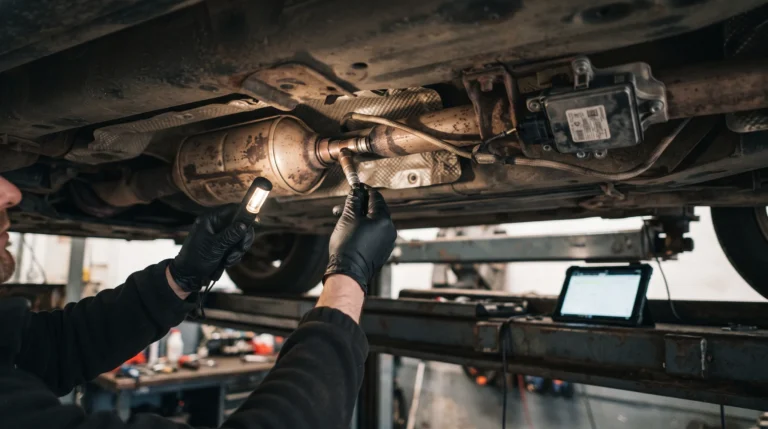
- Physical inspection of the tank, sensor, pump, and dosing module for visible crystallisation or corrosion, this alone resolves a surprising number of cases.
- Wiring and connector check, since corrosion here gets misdiagnosed as sensor failure more often than any other fault on this list.
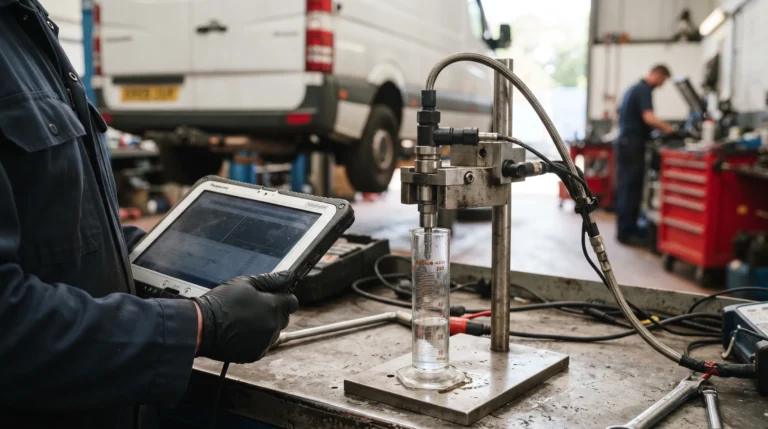
- AdBlue quality test, checking concentration and contamination rather than assuming the fluid is fine because it’s genuine AdBlue.
- Live data monitoring during a test drive, watching NOx sensor readings and dosing behaviour in real time. This is the step a basic code read skips, and it’s usually what separates a correct diagnosis from an expensive guess.
- Fault code clearance using the correct manufacturer procedure, since a generic reset doesn’t clear a stored fault on every platform, particularly Mercedes and BMW.
This is generally the fastest route from “the light won’t clear” to knowing exactly why, without paying for a pump or sensor that was never the actual problem.
Frequently Asked Questions
The questions we’re actually asked on the phone before a diagnostic booking, no jargon, no sales pitch.
Most often because the drive cycle needed to confirm the fix hasn’t been completed yet, not because the refill failed. Give it a proper motorway drive before assuming there’s a fault.
Typically 20 to 30 minutes of continuous driving at higher speed. Short, stop start journeys are unlikely to trigger the self check the ECU needs to complete.
On some vehicles, yes, a dashboard reset combined with a completed drive cycle clears it. On Mercedes and BMW models with a genuinely stored fault, a manufacturer specific diagnostic tool is usually required.
In the early stages, yes, most vehicles give a mileage countdown before restricting performance. Once that countdown reaches zero, expect reduced power and, eventually, the vehicle may not restart, so it’s not worth ignoring long term.
This points to a genuine mechanical fault, most often the pump, dosing module, or a sensor, rather than a drive cycle or fluid issue. A fault that returns within days of clearing is one of the clearer signs it needs a diagnostic rather than another reset.
It can, if it isn’t to the correct ISO 22241 specification or has been stored incorrectly, particularly if it’s been opened and exposed to air for a long period. Correctly stored, genuine AdBlue is unlikely to trigger a quality fault on its own.
It removes the warning by disabling the system, but this isn’t legal for road going vehicles in the UK and will fail an MOT. It’s only appropriate for specific off road applications.
Yes, and it’s more common than you’d think. A fault code that points to the NOx sensor or dosing system can be caused by wiring corrosion rather than the component itself, and without live data monitoring during a drive, it’s easy to replace a working part.
It can. Crystallisation and heater element faults inside the tank are more likely to show up in cold conditions, and a light that only appears in winter is worth mentioning specifically when booking a diagnostic.
Because the light isn’t purely a level warning, it reflects the ECU’s confidence in the whole SCR system. A full tank with a quality, sensor, or dosing fault will still trigger the light.
If the Light Still Won’t Clear
If you’ve refilled it, driven it properly, and it’s still on, or it keeps coming back, it’s worth having it looked at rather than continuing to guess and potentially replacing parts that were never at fault. We run mobile diagnostics across London, Birmingham, Yorkshire and the surrounding areas, so we come to the vehicle rather than the other way round.
Book a mobile diagnostic visit and we’ll identify exactly what’s triggering the fault before recommending any repair. If you’d rather talk through your fault code or symptoms first, you can contact us for fault code advice, or check current AdBlue repair pricing for the most common fixes.