
“Communication fault” is one of those messages that sounds worse than it usually is, and also more confusing. Your car isn’t telling you the tank is empty or the fluid is bad. It’s telling you something much stranger: that one part of the AdBlue system has stopped talking to the rest of it.
If you’ve seen this on a scan tool, or your dash is showing an AdBlue warning that nobody can explain, you’ve probably already had the “have you tried topping it up?” conversation. Topping up won’t help here. The fluid isn’t the problem. The conversation between the tank module and the engine computer is.
So here’s what that actually means, what tends to cause it, and how a proper diagnosis gets to the bottom of it without replacing half the system.
What the Tank Module Actually Does
Think of the tank module as a small control centre bolted into your AdBlue tank. On most vehicles it bundles several jobs together: it measures how much fluid is left, it heats the fluid so it doesn’t freeze, it houses or controls the pump that sends AdBlue forward, and on some cars it carries a quality or temperature sensor too.
All of that information has to reach the engine control unit (ECU), and the ECU has to be able to send instructions back. The two talk constantly over a data link. When that link works, you never think about it. When it drops out, the ECU effectively goes blind on that side of the system. It can’t confirm the level, can’t trust the pump, can’t run the heater properly, and it flags a communication fault.
The important thing to understand is that the module itself might be perfectly healthy. A communication fault doesn’t automatically mean a dead part. It means the message isn’t getting through, and the reason could be anywhere along the route.
Why Communication Faults Happen
There’s no single cause, but the same handful of culprits come up again and again.
Wiring and connector problems. This is the most common finding by a long way. The tank module sits low in the vehicle, often under the boot floor or near the rear axle, where it’s exposed to water, road salt and grit. A loose pin, a split in the loom, or a connector that’s taken on moisture can interrupt the signal. We’ve written about this in more detail in our guide to AdBlue connector corrosion, though on this site the fault code reference is the best place to start if you’ve got a code in hand.
Corrosion at the pins. Even if the connector looks fine from the outside, green or white deposits on the contacts can raise resistance enough to corrupt the data. It tends to be intermittent first, which is why so many of these faults come and go.
Power or earth supply problems. The module needs a clean power feed and a solid ground. A corroded earth point, a weak connection, or a fuse that’s on the edge of failing can leave it half-working, which produces exactly this kind of fault.
Low or unstable battery voltage. A tired battery, a recent battery replacement that wasn’t done carefully, or a charging fault can upset modules across the whole car. AdBlue systems are sensitive to it, and a communication fault is sometimes the first thing to appear.
Water ingress into the module. If moisture has got inside the module housing or the connector seal, electronics can misbehave in strange ways. It often shows up after heavy rain or a wash.
Damage from outside. Stone strikes, rodent damage, or a repair that disturbed the loom can all break the data link. We’ve also seen cases where aftermarket electrical work, such as a tow bar kit, has pinched or tapped into the wrong wire.
A genuinely failed module. Sometimes the module’s own electronics have given up. It’s a real possibility, but it should be the conclusion of a proper diagnosis, not the starting assumption.
Software or coding issues. After a module replacement or a software update, the new part may not have been coded or adapted to the vehicle correctly, which leaves it unable to communicate properly.
What You’ll Notice as a Driver
A communication fault doesn’t always look the same, but a few patterns come up often.
The warning light appears with no clear reason, and often with a full tank. If that sounds familiar, our guide on the AdBlue warning light explains what the different warnings generally mean, and our piece on the AdBlue sign on the dashboard helps you work out which symbol you’re looking at.
The fault is intermittent. It appears for a few days, vanishes, then returns. That’s the classic fingerprint of a wiring or connector problem rather than a failed part. If you’re stuck in that cycle, our article on an AdBlue warning light that won’t clear covers it from another angle.
The warning flashes or behaves oddly. Our guide to an AdBlue light flashing and one on the AdBlue warning symbol explain what those different patterns suggest.
The fault appears soon after starting. We’ve covered a related pattern in our guide to an AdBlue fault after 10 to 20 miles, where the system seems fine until the car has been driven for a short while.
And if the fault is left alone, the countdown starts. Our articles on the no engine restart in X miles countdown and the AdBlue countdown in London explain how that clock works and why it matters.
Why It’s Easy to Misdiagnose
This is a fault that fools people, and it’s worth being honest about why.
It looks like a failed pump, because the pump doesn’t respond. It looks like a level sensor fault, because the level can’t be read. It looks like a heater fault, because the heater won’t operate. In every case, the real issue is that the ECU can’t talk to the module, so it can’t confirm any of those things. We’ve seen vehicles leave a garage with a new pump fitted, and the fault still there, because the pump was never the problem. If you want to see how those other faults differ, our guides on an AdBlue heater not working, an AdBlue quality fault and NOx sensor versus AdBlue quality sensor are useful companions. And if a pump replacement is being quoted, our AdBlue pump replacement cost guide is worth reading first, so you know what you’re being asked to pay for.
How We Diagnose It
Communication faults reward patience. The quickest way to waste money is to start swapping parts, so we work through the system in a sensible order.
We begin with a full scan. We read live and stored codes, and we pay attention to the pattern. Codes that mention lost communication or missing signals point us towards the data link, while codes about specific components point elsewhere. Our guide on AdBlue system fault codes explained and our fault codes reference show how those messages are read.
Next we check the basics: battery condition, charging voltage, and the relevant fuses and relays. It sounds simple, but power problems cause more communication faults than people expect.
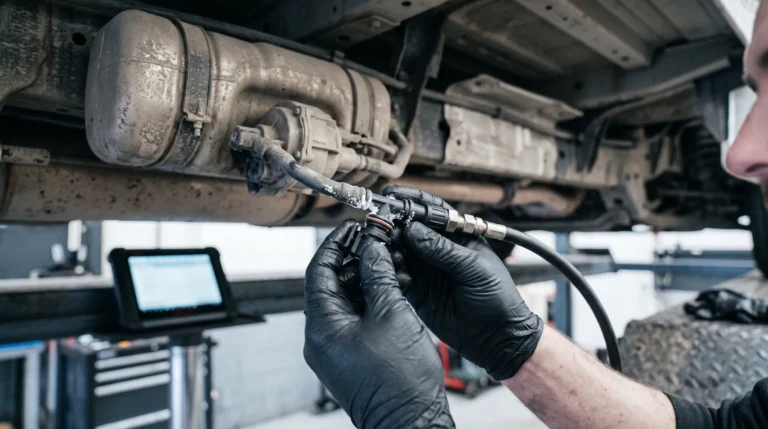
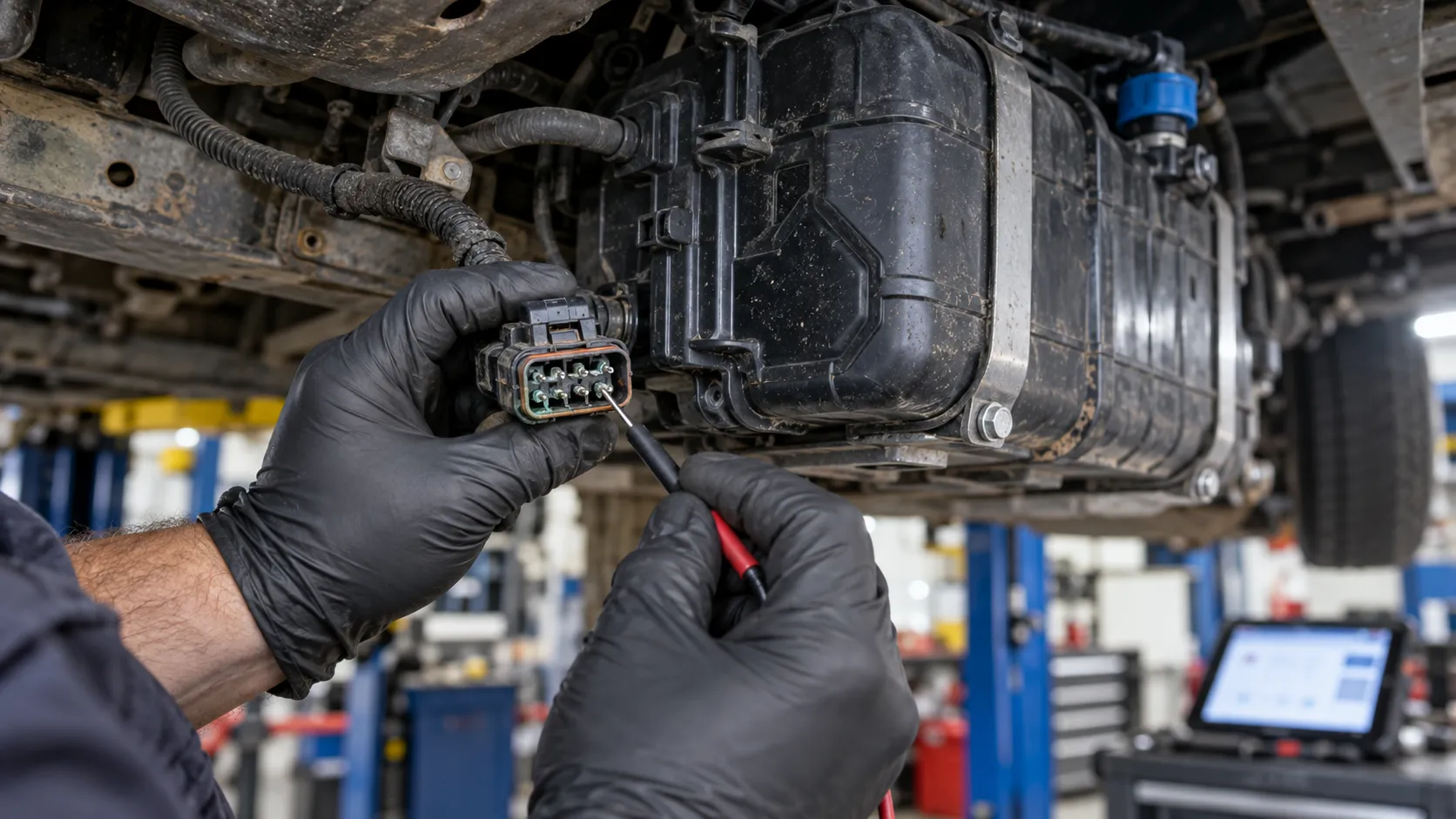
Then we move to the physical route. We trace the wiring to the module and inspect the connector carefully, looking for moisture, corrosion, bent pins, and loom damage. A connector that looks clean can still have a poor contact, so we test it electrically rather than trusting our eyes.
After that, we measure. We check supply voltage, earth quality, and the data lines themselves at the module. This tells us whether the module is getting what it needs and whether the signal is making it along the wire.
Only when the wiring and supply are proven good do we look at the module itself. If it’s genuinely failed, replacement is straightforward. If it’s been replaced recently, we check whether it’s been coded and adapted correctly.
Fixing It Properly
What the repair involves depends entirely on what we find.
If it’s a wiring or connector fault, the fix is usually to repair the loom, replace the damaged connector or pins, clean and protect the contacts, and restore proper sealing. That’s often a smaller job than people fear.
If it’s a power or earth problem, we repair the supply side and then confirm the module behaves normally.
If it’s a failed module, we replace it and make sure it’s coded and adapted so it communicates properly with the ECU. A new part that isn’t set up correctly can leave you with the same fault.
If crystals or contamination are part of the picture, we deal with those too. Our guide on whether AdBlue crystallisation can be repaired explains the background. And for a general sense of what to expect on cost, our system repair cost guide gives a realistic picture.
You can read about the services involved on our AdBlue repair and AdBlue fix pages, and if a related fault involves the urea system more broadly, our urea repair page covers that. For Londoners who simply want the warning cleared after a repair, our AdBlue reset London page explains how that works. If NOx readings are part of the problem, see our NOx sensor page, and if the issue has spread further into the exhaust, our DPF solutions are there as well. Commercial operators can also look at our HGV remapping page.
Make-Specific Notes
Some manufacturers are more prone to this than others, usually because of where the module or loom is routed. If you drive one of these, we have a page for you: Volkswagen, Audi, BMW, Mercedes, Ford, Vauxhall, Peugeot, Citroën, Jaguar or Land Rover. We also have make-specific articles for Audi system faults, Mercedes lights that keep coming back, Volkswagen warnings after a refill, Ford Transit P20EE faults and Peugeot faults. Our vehicles page lists everything we cover, and our AdBlue fault guide gives the broader overview.
What You Can Do Before You Book In
You can’t diagnose a data fault from the driver’s seat, but you can make the technician’s life easier.
Note when it happens. After rain? After a wash? On cold starts? Those details point towards moisture and connector problems.
Tell us what’s been done recently. A new battery, a tow bar fitted, a rear-end repair, or a previous module replacement are all useful clues.
Don’t keep clearing the fault and hoping. It might disappear for a while, but an intermittent communication fault is almost always a physical problem that will return.
And don’t ignore the warning for too long. If the ECU can’t confirm the system is working, the countdown can start, and that makes things a lot less relaxed.
Want to know more about us? Our about page has the background, and our blog has more guides like this one.
Areas We Cover
We diagnose and repair AdBlue communication faults across a wide area, so if you’re near one of the places below, your local page has more detail on how we work there.
In London, our main London page and our AdBlue diagnosis London page cover the capital, and we work across every borough. In central and inner London, that includes Westminster, Camden, Islington, Hackney, Tower Hamlets, Lambeth, Southwark, Lewisham, Greenwich, Wandsworth, Hammersmith and Fulham and Kensington and Chelsea. In south and south-west London, we cover Merton, Sutton, Kingston upon Thames, Richmond upon Thames and Bromley. In west and north-west London, we work across Hounslow (with a separate Hounslow page), Ealing, Hillingdon, Harrow and Brent. In north London, there’s Barnet, Enfield (also on our Enfield page) and Haringey. And in east and south-east London, we cover Waltham Forest, Redbridge, Newham, Barking and Dagenham, Havering and Bexley. Wiring and connector faults are especially common on vehicles that spend their lives in wet, salted, stop-start city conditions, so London is where we see a lot of them.
Across the South East, we cover St Albans, Slough, Sevenoaks, Dartford, Epsom, Esher and Loughton, along with the wider South East England region.
In the Midlands, we cover the West Midlands as a whole, including Solihull, Dudley, Wolverhampton, Walsall and Coventry. Further out, Staffordshire is covered through Stoke-on-Trent, Stafford, Cannock and Lichfield. Warwickshire includes Nuneaton, Rugby, Warwick, Leamington Spa and Stratford-upon-Avon. And Shropshire covers Shrewsbury, Telford, Oswestry and Bridgnorth.
Heading east, our East Midlands and Lincolnshire coverage includes Grantham, Peterborough, Stamford, Spalding, Market Deeping and Bourne. In Yorkshire, we cover Leeds and Sheffield.
And in Scotland, we cover both Edinburgh and Glasgow.
If your area isn’t named above, our full locations page has the complete list.
Quick Answers
01What does a tank module communication fault mean?
It means the engine computer has lost contact with the AdBlue tank module, so it can’t read the level, run the heater, or confirm the pump is working. The module itself may be fine.
02Will topping up the AdBlue fix it?
No. This fault is about the data link between the module and the ECU, not the fluid level.
03What usually causes it?
Wiring and connector faults are the most common cause, followed by corrosion, power or earth problems, low battery voltage, water ingress and, less often, a failed module.
04Is the tank module always faulty?
No. In many cases the module is healthy and the problem is a damaged wire, a corroded connector or a poor earth. Replacing it without diagnosis can waste money.
05Why does the fault come and go?
Intermittent faults usually mean a loose or corroded connection that makes contact sometimes and not others, often affected by moisture, temperature or vibration.
06Can a weak battery cause it?
Yes. Low or unstable voltage can disrupt modules across the vehicle, and AdBlue components are sensitive to it.
07Can I keep driving with this fault?
For a short while, usually, but the system can eventually start a countdown to a restricted restart if the fault isn’t resolved.
08How is it diagnosed?
With a full scan, power and earth checks, a physical inspection of the wiring and connector, and measurements at the module to confirm what it’s actually receiving.
09Does a new module need coding?
Often, yes. A replacement module may need to be coded or adapted to the vehicle before it communicates properly.
10Could aftermarket electrical work cause this?
It can. Tow bar wiring, alarm installs and other additions have been known to interfere with data lines if they’re connected incorrectly.
11How much will it cost to fix?
It depends on whether it’s a wiring repair, a connector replacement or a new module. We confirm the cause first and quote before any work begins.
12How do I stop it coming back?
Keep connectors protected from moisture, deal with early intermittent warnings promptly, look after the battery, and make sure any previous repairs were done and sealed properly.
Get the Real Fault Found
A communication fault is one of the most misdiagnosed AdBlue problems, and one of the easiest to fix once the true cause is clear. If your warning keeps returning, or someone has already replaced a part without success, it’s worth having the data link checked properly. Get in touch through our contact page to book a diagnostic check, wherever you’re based in London, the Midlands, Scotland or the wider UK.