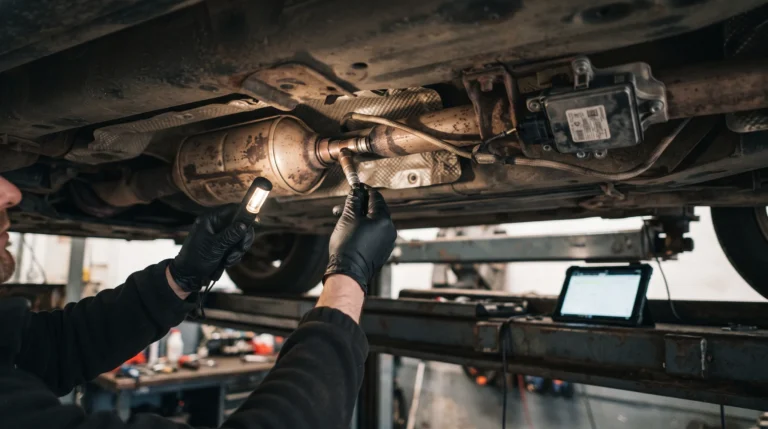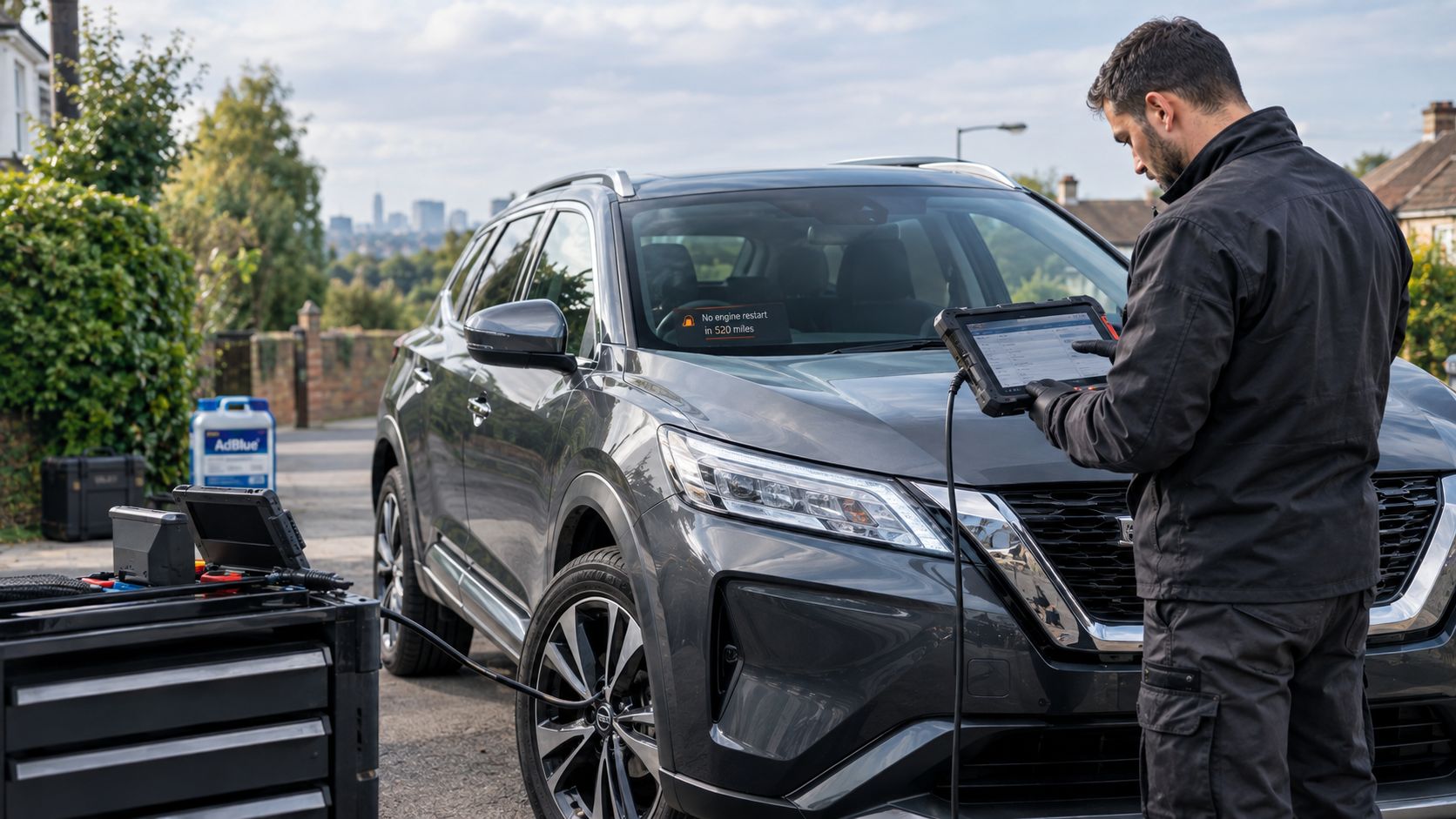

That message on your dashboard means exactly what it says. Your car has detected a fault in its AdBlue system, and once the number on screen reaches zero, the engine won’t start again after you switch it off. Not “might not.” Won’t. It’s a deliberate lockout built into the software by the manufacturer, and it isn’t something that clears itself if you keep driving and hope.
The good news is you’ve almost certainly got time. Most vehicles give somewhere between 400 and 1,000 miles once the countdown begins, and the car will usually drive completely normally throughout. The bad news is that people misread this as a soft warning rather than a hard deadline, keep driving on it, and end up stranded at a petrol station with a car that simply won’t turn over.
Here’s what’s actually happening, why it started, and what to do about it.
Why Your Car Is Counting Down
AdBlue gets injected into the exhaust as part of the SCR system, which exists to cut NOx emissions on diesel engines. Under Euro 6 rules, that system has to keep working, not just be fitted at the factory and forgotten about. Manufacturers were required to build in something that stops drivers ignoring a broken emissions system indefinitely.
The countdown is that something. When the ECU spots a fault, whether it’s low fluid, a dead sensor, a blocked injector, or a wiring problem, it starts the clock. Keep driving without fixing it and eventually the car takes the decision out of your hands.
It’s worth understanding that the countdown isn’t a measure of how damaged your car is. A perfectly healthy engine with one faulty £150 sensor gets the same countdown as a vehicle with a seized dosing pump. The number on your dash tells you how long you’ve got, not how serious the underlying problem is.
What the Message Looks Like on Different Cars
Manufacturers word this differently, which causes a fair bit of confusion. You might see “Engine will not restart in 800 miles,” “No engine start possible in XXX miles,” “AdBlue empty, engine start prevented,” or on some models, a count of remaining engine starts rather than miles. Some cars show a yellow warning first, then escalate to red as the number drops.
Mercedes drivers in particular often see a “remaining starts” figure instead of a mileage count, which we’ve covered in more detail in our guide on why a Mercedes AdBlue light keeps coming back on. Peugeot owners tend to see slightly different phrasing again, covered in our Peugeot AdBlue fault guide. Whatever the wording, the mechanism underneath is the same.
If you’re not sure whether the symbol you’re looking at is even the AdBlue warning, our guides on the AdBlue warning symbol and the AdBlue sign on your dashboard walk through what each one means.
Can You Keep Driving?
Yes, and that’s exactly what makes this warning so easy to underestimate. In most cases the car drives completely normally right through the countdown. No juddering, no loss of power, nothing that feels like a problem. Some vehicles do drop into a reduced power mode as the number gets low, but plenty don’t.
Then you stop for fuel, switch off out of habit, and discover the number reached zero somewhere in the last few miles. At that point you need a technician and, quite often, recovery to get the vehicle somewhere it can be worked on.
So yes, you can keep driving. What you shouldn’t do is treat the countdown as background noise. Every mile is a mile you’re not getting back.
Will Topping Up the Tank Fix It?
Sometimes, if the fault genuinely is low fluid and you catch it early. On many vehicles, adding enough AdBlue and running the engine for a short drive will clear the warning and reset the countdown on its own.
Often though, it doesn’t work, and that’s when people get frustrated. If the warning is still there after a proper top-up, or it disappears for a day and comes straight back, the fluid was never the problem. A faulty level sensor, a quality sensor reading incorrectly, or a dosing fault will keep triggering the countdown regardless of how full the tank is. We’ve written specifically about this in our guide on why an AdBlue warning light won’t clear, which covers exactly what’s going on when a refill doesn’t help.
There’s also a subtler version of this problem worth knowing about. Some sensors misread fluid that’s the wrong concentration or has been contaminated, which throws a quality fault rather than a level fault. Our piece on AdBlue quality faults explains how that differs from a straightforward empty tank.
What’s Actually Causing It
The countdown is a symptom. Underneath, it’s usually one of a handful of things.
Low or contaminated fluid is the simplest, and the easiest to rule out. Beyond that, level and quality sensors fail fairly regularly and are a common cause of countdowns on cars with perfectly full tanks. Dosing injectors block or crystallise, particularly on vehicles that mostly do short journeys and never get the exhaust properly hot. NOx sensors fail too, and because they’re closely tied to the AdBlue system, a dying NOx sensor produces warnings that look identical to an AdBlue fault. If you’re trying to work out which of the two you’re dealing with, our comparison of the NOx sensor versus the AdBlue quality sensor is worth a read.
Cold weather plays a part as well. AdBlue freezes at around -11°C, and most systems have a tank heater to prevent that. When the heater fails, you get crystallisation building up around the injector and sensors, which is a slow-developing fault that often surfaces as a countdown in the middle of winter. Our guide on whether AdBlue crystallisation can be repaired covers what’s involved in sorting that.
Wiring and connectors deserve a mention too. Corrosion or a loose pin between a sensor and the ECU produces fault codes that look exactly like a failed component, even when the part itself is fine.
Reading the Fault Codes
If you’ve had the car scanned, the codes give a much better picture than the dashboard message does. Codes like P204F, P20EE, P207F, P229F and P203E each point to different parts of the system, pressure faults, dosing performance, sensor circuits, catalyst efficiency. Our guide on AdBlue system fault codes explained breaks down what the common ones mean in plain terms.
This matters more than it might seem. Two cars can show the same “no restart in 600 miles” message and have completely different faults behind it. The code is what tells you whether you’re looking at a £150 sensor or a £700 pump.
Can You Reset the Countdown Yourself?
Realistically, no, not once it’s properly started. Some manufacturers allow a reset if you top the tank up before the countdown begins, but once the number is on the dash and dropping, most vehicles need a diagnostic reset through the ECU.
People try the usual things, cycling the ignition repeatedly, disconnecting the battery, clearing the code with a cheap scan tool. Occasionally the code clears. Almost always it comes back within a few days, because clearing a code doesn’t fix whatever set it. Worse, repeated attempts can muddy the picture for whoever eventually diagnoses it properly.
If the countdown has already hit zero, stop trying to start the engine. It won’t help and you’ll flatten the battery, which just adds a second problem to the first.
What It Costs to Put Right
This depends entirely on what’s actually wrong, which is why we won’t quote a number over the phone before seeing the vehicle. A sensor fault sits at the cheaper end. A pump or injector replacement costs considerably more. Our breakdown of AdBlue system repair costs in the UK gives realistic ranges for the common jobs, and if it turns out to be the pump specifically, our guide on AdBlue pump replacement costs covers that in more detail.
What we can say is that fixing it early is nearly always cheaper. A fault left to run can take other components with it, turning a single sensor replacement into a larger repair covering the injector or catalyst as well.
Repair, or Take the System Out Entirely?
For most drivers using the car normally on public roads, repairing the fault is the sensible route. It keeps the vehicle compliant, keeps it MOT-ready, and keeps the SCR system doing what it was designed to do. Our AdBlue repair service covers diagnosis and replacement of whichever component has actually failed, and our broader AdBlue fix service handles the full system where more than one thing is involved.
Some drivers ask about removing the system instead, particularly on older or higher-mileage vehicles where the same fault keeps returning. An AdBlue delete removes the SCR strategy from the ECU, and AdBlue removal and AdBlue bypass are related routes worth understanding before deciding anything.
Be aware there are real implications to this. Disabling emissions equipment on a road-going vehicle affects MOT compliance and can affect insurance, and it isn’t the right answer for every car. We’ve written honestly about the trade-offs in our comparison of AdBlue delete versus AdBlue repair, alongside guides on how an AdBlue delete actually works, whether a delete could cause long-term engine damage, and what it means for warranty and insurance. Worth reading all three before committing either way.
Where the problem traces back to the NOx sensor rather than AdBlue itself, our NOx sensor service covers that separately, and if you’re dealing with related emissions faults, we also handle EGR solutions, EGR delete, EGR removal, DPF solutions, and urea repair, urea removal and urea delete work.
Getting It Sorted in London
London is where most of our countdown callouts come from, and the reason is fairly obvious once you think about it. Short journeys, stop-start traffic, and vehicles that rarely get a sustained motorway run are exactly the conditions that lead to injector crystallisation and slow-developing sensor faults.
We cover every borough. Our engineers are regularly out across Westminster, Camden, Islington, Hackney, Tower Hamlets, Southwark, Lambeth and Greenwich in the inner boroughs, and out to Barnet, Enfield, Haringey, Waltham Forest, Redbridge, Havering, Barking and Dagenham and Newham across the north and east.
West and south-west, we cover Ealing, Hounslow, Hillingdon, Harrow, Brent, Hammersmith and Fulham, Kensington and Chelsea, Wandsworth, Richmond upon Thames, Kingston upon Thames, Merton and Sutton. South and south-east, that’s Lewisham, Bromley and Bexley.
If you want the overview rather than a specific borough, our AdBlue repair in London page covers the service across the capital, and we also run dedicated AdBlue diagnosis in London and AdBlue reset in London services for exactly the situation this article describes. If you’ve already decided a delete is the right route, our AdBlue delete near me in London page has the detail.
Outside London
We travel well beyond the M25. Across the South East we cover St Albans, Loughton, Dartford, Sevenoaks, Epsom, Esher and Slough.
Further afield, we’re in Glasgow, Edinburgh, Leeds and Sheffield. Across Shropshire we cover Shrewsbury, Telford, Oswestry and Bridgnorth, and throughout the West Midlands we’re in Coventry, Dudley, Walsall, Wolverhampton and Solihull.
Over in Staffordshire we cover Stoke-on-Trent, Stafford, Cannock and Lichfield, and across Warwickshire we’re in Warwick, Leamington Spa, Stratford-upon-Avon, Rugby and Nuneaton. In the East Midlands and Lincolnshire, that’s Bourne, Peterborough, Grantham, Spalding, Stamford and Market Deeping.
Our full locations page is everywhere we cover. Running a fleet? Our HGV remapping service is worth a look alongside any AdBlue work.
What To Do Right Now
If the countdown is still running, book a diagnostic before it reaches zero. That’s genuinely the whole advice. It’s cheaper, quicker, and you won’t need recovery.
If it’s already at zero, don’t keep cranking the engine. Note down any fault codes if you have them, or photograph the dashboard message, and get in touch. We can usually reach you the same day.
Frequently Asked Questions
Get clear answers about AdBlue countdown warnings, no-engine-restart messages, common causes, driving limits, resets and mobile AdBlue diagnosis.
Your car has detected an AdBlue or SCR fault and started a countdown. Once it reaches zero, the engine won’t start again after you switch it off. It’s a software lockout, not a mechanical failure.
Usually between 400 and 1,000 miles, depending on the manufacturer. Some models run shorter countdowns closer to 250 miles. The figure on your own dashboard is the accurate one.
No. In almost all cases you can keep driving normally until you switch the engine off. The restriction applies to restarting, not to running.
Sometimes, if low fluid is genuinely the cause and you catch it early. If the warning persists after a proper top-up, the fluid was never the problem.
The engine won’t restart once the countdown expires. You’ll need a technician with diagnostic equipment, and often recovery to get the vehicle somewhere it can be worked on.
Not reliably once it’s started. Most vehicles need a diagnostic reset through the ECU. Battery disconnection and cheap scan tools rarely work and can complicate the diagnosis.
No. The lockout is about emissions compliance, not engine health. A perfectly sound engine with one faulty sensor gets the same countdown as a car with a major fault.
Cold weather is a common trigger. AdBlue freezes around -11°C, and a failing tank heater can cause crystallisation and sensor faults that surface as a countdown when temperatures drop.
Far from it. Sensors, injectors, pumps, wiring and NOx sensor faults can all trigger countdowns, and many do so with a completely full tank.
Yes. We carry the same OEM-level diagnostic equipment a dealer uses and can diagnose and resolve most countdowns at your home, workplace or the roadside.
It shouldn’t, if the actual cause was diagnosed properly rather than the code simply being cleared. Repeat faults usually mean the root cause was missed the first time round.
Book before midday and we can usually reach you the same day across London and most of our coverage areas.
Countdown Running? Let’s Sort It
Don’t wait for the number to hit zero. Get a free, no-obligation quote and we’ll tell you exactly what’s causing it and what putting it right involves. Call 0330 043 4431 to speak to an engineer, or read more about our team.