

If you’ve typed this question into Google at 11pm with a service light glaring at you from the dashboard, you’re not alone and you’re asking exactly the right question before you spend a penny.
An AdBlue fault can turn a perfectly good car into a limp-home nightmare almost overnight. So when someone mentions a “delete” as a fix, the appeal is obvious. But the two words that stop most UK owners in their tracks are warranty and insurance. Nobody wants to solve one problem and quietly create a much bigger one.
This guide breaks down exactly how an AdBlue delete affects manufacturer warranty cover and car insurance in the UK, what the law actually says about driving with one fitted, and where the real risks sit so you can make an informed decision before doing anything to the vehicle.
Quick summary box:
- An AdBlue delete will almost always put manufacturer warranty cover for the engine and emissions system at risk.
- It can invalidate your car insurance if you don’t disclose it; this is the bigger practical risk for most UK owners.
- It’s an automatic MOT failure and illegal to use on a public road in the UK.
- UK consumer law limits how much of your warranty a dealer can void, not whether they can void anything at all.
Why This Question Matters So Much Right Now
AdBlue and SCR (Selective Catalytic Reduction) systems have become one of the most common failure points on modern diesels sold in the UK. NOx sensors fail, dosing modules seize, tanks crystallise in cold weather and repair bills can run into four figures. It’s little wonder that “AdBlue delete” searches spike every winter.
But a delete isn’t a like-for-like repair. It’s a modification that removes or disables part of the emissions control system entirely. That distinction is exactly what warranty providers and insurers care about.
How an AdBlue Delete Interacts With Your Manufacturer Warranty in the UK
The straightforward part
Manufacturer warranties cover defects in materials and workmanship; they’re not designed to protect you against changes you make to the vehicle yourself. Once you remove or bypass the SCR system, you’ve altered how the engine and emissions system were designed to function. That’s usually enough for a manufacturer to decline a related claim, and in many cases, a lot more than just the “related” claim.
What UK consumer law actually says
Under UK consumer protection principles, a dealer or manufacturer can’t simply void your entire warranty the moment they spot a modification. They’re expected to show that the fault being claimed for is genuinely connected to the modification before refusing cover for it.
In practice, this protection is narrower than it sounds. Dealers tend to interpret “connected” broadly for anything touching the emissions or engine management system, and an AdBlue delete sits squarely in that zone. So while a claim for, say, a faulty window motor should still be honoured, expect resistance on almost any claim involving the engine, turbo, emissions, or ECU — not just AdBlue-specific ones.
What this means for you, practically
- Routine items unrelated to the engine (infotainment, suspension, interior trim) are less likely to be affected.
- Anything touching the engine, emissions, turbo, or ECU becomes a grey area the moment a delete is fitted.
- A dealer noticing a delete during any visit even for something unrelated may flag the vehicle’s file, affecting future goodwill claims too.
- If a warranty claim is refused, you’re entitled to ask the dealer to explain exactly how the modification relates to the fault, rather than accept a blanket refusal.
Insurance: The Risk Most UK Owners Underestimate
Here’s the thing that genuinely surprises most people: warranty voiding is usually the smaller problem. Insurance is where things get expensive.
There are three distinct risks, and they’re not the same thing.
1. Voided policy
Most UK motor insurance policies require you to declare modifications, and an AdBlue delete is a modification in every sense that matters to an insurer it changes how the vehicle was manufactured to run. Fail to declare it and your insurer can treat the policy as void from the start, not just refuse the one claim.
2. Claim denial without full policy cancellation
Some insurers won’t void the whole policy but will decline a specific claim if they establish the modification contributed to the incident, or simply that it wasn’t disclosed as required. You could still be paying premiums on a policy that quietly isn’t covering you for the thing you actually need it for.
3. Criminal liability after an accident
This is the one people rarely think about until it’s too late. Driving a vehicle you know isn’t insured because an undisclosed modification has invalidated the policy can amount to driving without insurance under UK law, regardless of your intentions when you bought the cover. If there’s an accident involving injury, that exposure gets serious very quickly, on top of any civil liability for damages.
Summary box — insurance risk ranked by severity:
- Driving uninsured after an accident (criminal exposure)
- Full policy voided, all future claims refused
- Single claim denied, policy otherwise intact
- Higher premium on renewal once disclosed
Legal Status: Is an AdBlue Delete Actually Illegal in the UK?
Yes, for use on public roads. Removing or disabling emissions control equipment breaches the vehicle’s type approval, which is the legal basis for it being roadworthy at all. It’s also, unsurprisingly, an automatic MOT failure the moment a tester spots it either visually or via the OBD readout.
None of this means every car with a delete gets caught immediately. It means the risk sits with you for as long as you own and drive the vehicle on UK roads.
Can a Dealer or Garage Actually Detect an AdBlue Delete?
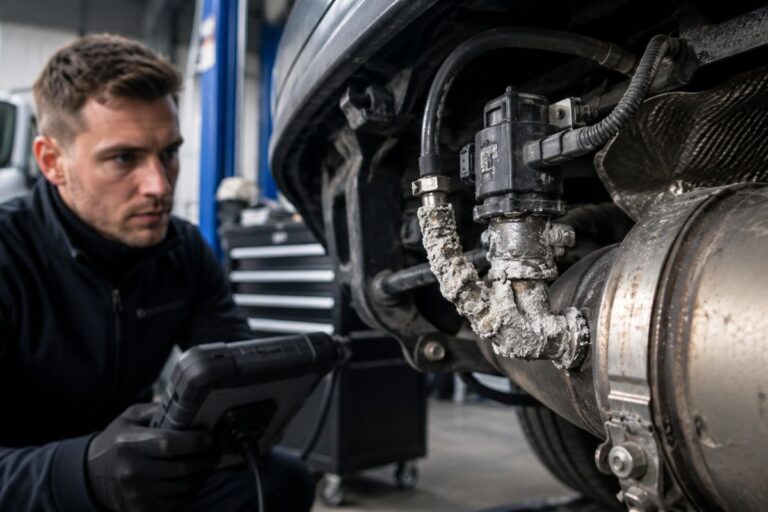
Yes, usually quite easily. A quick diagnostic scan flags missing SCR components, altered fault code patterns, or software that doesn’t match the expected calibration. Visual inspection during any lift-based service, an oil change, tyre rotation, anything can also reveal a physically removed tank, blanked-off dosing module, or rerouted piping. It’s not something that reliably stays hidden, and it’s exactly what an MOT tester is trained to look for.
Weighing Repair Against Delete
An AdBlue delete does solve the immediate fault, and it’s typically cheaper than a full SCR repair. For some owners a car nearing the end of its life, or a commercial vehicle close to replacement that trade-off can look reasonable once the risks above are factored in. For anyone keeping the car long-term, financing it, or relying on comprehensive insurance cover, the exposure usually outweighs the savings.
Understanding what a genuine SCR repair involves and what a diagnostic scan can tell you before committing either way both help clarify which option actually fits a given car and budget see our AdBlue repair services and NOx sensor diagnostics pages for more detail.
Frequently Asked Questions
Straight answers to the questions UK drivers ask before considering an AdBlue delete.
Yes. A standard diagnostic scan can flag missing SCR components or mismatched software, and physical signs may also be visible during a routine service when the vehicle is inspected.
Only if you have disclosed the modification and your insurer has confirmed cover on that basis. An undisclosed delete can put your policy and any claim at risk, with potentially serious consequences if you are found to be driving without valid insurance.
Yes, for road use. Removing or disabling the vehicle’s emissions control system breaches its approved emissions configuration and can result in an MOT failure.
The vehicle can fail its MOT and may need the emissions system restored before it can legally pass a retest. More serious or repeated emissions-system tampering can also attract enforcement action from the relevant authorities.
Not automatically. In the UK, a warranty claim generally needs to be connected to the modification for the modification to be relevant to that claim. In practice, however, claims involving the engine, emissions system or ECU may face significant resistance once a delete is identified.
Declare the modification to your insurer directly and get confirmation of cover in writing. Specialist modified-vehicle insurers may be more willing to consider this type of vehicle than mainstream providers.
It can. An emissions-control system that has been removed, disabled or tampered with can result in an MOT failure if identified during the inspection or through relevant diagnostic checks.
A full delete generally disables the SCR system, often alongside removing or altering related components. A bypass or emulator attempts to make the ECU behave as though the system is functioning without operating as designed. The legal, warranty and insurance risks are broadly similar because the vehicle’s emissions-control system is no longer operating in its approved configuration.
Often, yes, provided the original components are still available and the ECU software can be restored. It is worth discussing the restoration with the specialist who carried out the work, or another qualified professional, before selling the vehicle.
Yes. Relevant modifications should be disclosed to your insurer regardless of whether you expect to make a claim. Failing to disclose a modification can put your policy at risk if the insurer later discovers it.
Where This Leaves You
An AdBlue delete isn’t a decision to make in a panic at 11pm with a warning light on. It’s a genuine option with genuine trade-offs: warranty exposure, an insurance disclosure requirement, and an MOT failure risk. The right call depends on the car, the budget, and how long you’re planning to keep it.