
You’re driving your Mercedes and the AdBlue light pops up on the dash. A bit annoying, but not the end of the world. You get it reset, either at a garage or with your own code reader, and off it goes. Job done, or so it seems. Then a week later, maybe two, you’re sitting at the lights and there it is again. Same warning. Same spot on the dash. And now you’re wondering whether the last person who “fixed” it actually fixed anything at all.
If that’s roughly where you are right now, you’re in good company. This is one of the most common things Mercedes owners get in touch with us about, and it’s rarely random bad luck. There’s almost always a reason the light keeps coming back, and understanding that reason is the difference between spending money on another reset that buys you two more weeks, and actually sorting the car once and for all.
The short version is this. A reset clears the warning message. It does not repair the thing that triggered the warning in the first place. Mercedes SCR systems, the setup that handles AdBlue dosing to cut NOx emissions, are also stricter than a lot of other manufacturers about sensor accuracy and fluid quality. That’s part of why Mercedes diesels run cleanly, but it’s also exactly why small problems get flagged quickly and keep getting flagged until someone actually deals with them.
Why a Reset Doesn’t Actually Fix Anything
Here’s a comparison that tends to land with people. Resetting an AdBlue fault is a bit like closing a browser tab because a website crashed. The tab’s gone, the error message is gone, but the website is still broken. Open it again and you’ll get the same crash. Reset your AdBlue light without dealing with the cause and the car will simply re-detect the same fault the next time it checks, whether that’s the next cold start, the next motorway run, or the next time the sensor takes a reading.
That’s a genuinely different situation to a warning that clears itself after a proper drive on a cold morning, which is the car being cautious rather than flagging a real fault. If you’re not sure which one applies to you, it’s worth reading our guide to what the AdBlue warning symbol actually means, and our broader AdBlue fault guide walks through how to tell a fault that needs attention apart from one that was never really a problem.
The Actual Reasons It Keeps Coming Back
There’s no single answer here. It could be one of several things, sometimes more than one at once, and the only way to know for certain is a proper diagnostic scan rather than a guess. That said, some causes show up again and again on Mercedes, more than on most other brands we work on.
A NOx sensor that’s slowly drifting out of spec
Mercedes SCR systems use NOx sensors positioned before and after the catalyst, constantly checking that AdBlue dosing is actually reducing emissions the way it’s supposed to. When one of these sensors starts giving slightly inaccurate readings, even by a small margin, the system flags it as a fault. You get it reset, it clears, everything seems fine, and then a week or two later that same sensor drifts back out of tolerance and you’re staring at the same light again. In our experience, this is the single most common reason for a recurring AdBlue fault on Mercedes specifically. If you want to understand how this differs from a quality sensor fault, our comparison of NOx sensor vs AdBlue quality sensor breaks it down properly.
A quality sensor that’s misreading the fluid
Mercedes has a reputation for being fussy about the quality sensor, which checks the concentration of the AdBlue itself rather than simply how much is left in the tank. Every so often, fluid that’s perfectly fine, bought from a reputable supplier and well within spec, still trips a false quality reading. It happens more than people expect. Our dedicated piece on AdBlue quality faults covers what’s actually going on when this happens and how to rule it out.
A dosing injector that’s partly blocked or crystallised
If AdBlue leaks or drips from the injector, even a small amount, it dries out quickly once it meets any heat and turns into a hard, crusty deposit. That build-up restricts proper dosing, the car detects the shortfall, and the warning appears. A reset does absolutely nothing here, because the physical blockage is still sitting there in the injector regardless of what the dashboard says. Our guide on whether AdBlue crystallisation can actually be repaired explains what this looks like up close and when it can be cleaned rather than replaced outright.
A pump or dosing module starting to wear out
The pump’s job is to move AdBlue from the tank to the injector, and when it starts to fail, it rarely just stops working overnight. More often it gets inconsistent, delivering slightly less than it should under certain conditions. That inconsistency is often enough to trip a fault, get cleared with a reset, and then trip again the next time the pump has to work a bit harder, on a cold start or a longer motorway stretch, for example. If you’re trying to work out whether this is likely to be your problem, our article on AdBlue pump replacement cost in the UK gives a realistic sense of what’s involved.
A fault code that was never fully cleared to begin with
This one catches a lot of people out. Sometimes the warning light gets switched off at the dashboard, but the underlying fault code is still logged deeper in the system, particularly if whoever did the reset used a basic generic tool rather than proper Mercedes-specific diagnostic equipment. When that’s the case, the light can come straight back, sometimes within hours rather than weeks. Our explainer on AdBlue system fault codes covers why the tool used for the reset matters just as much as the reset itself.
When it won’t clear at all, not even temporarily
Worth mentioning separately, because it’s a slightly different problem to a light that clears and then returns later. If yours simply refuses to go away, even for a day, that points to something more active than a stored fault code. Our guide on the AdBlue warning light that won’t clear deals with that scenario on its own.
What a Proper Diagnostic Actually Involves
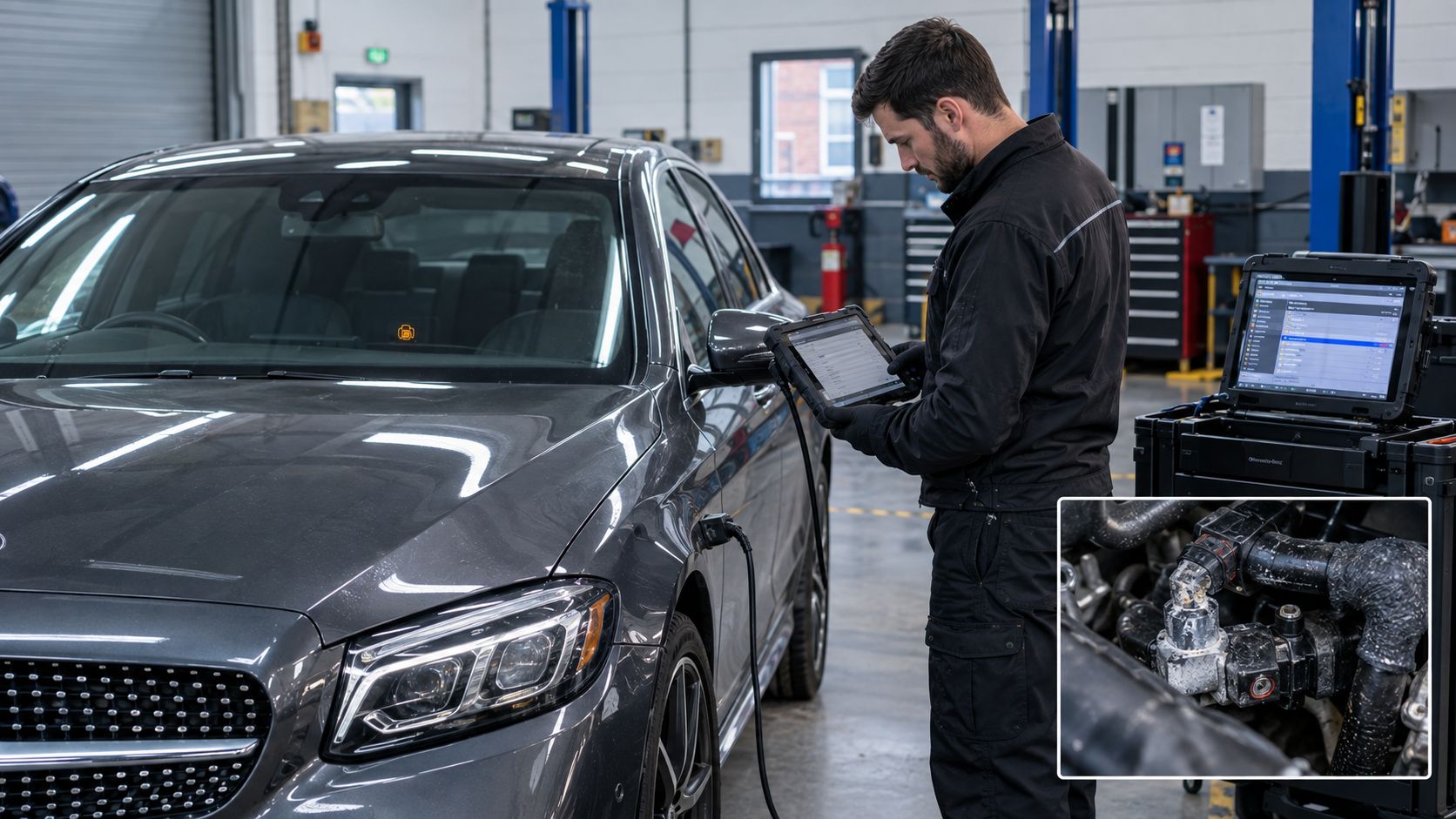
It’s worth knowing what “proper diagnostic” actually means, because it’s not the same thing as plugging in a code reader for thirty seconds. A technician working on a Mercedes AdBlue fault will typically connect Mercedes-specific diagnostic software rather than a generic OBD tool, which reads the manufacturer’s own fault codes in far more detail than a generic reader can manage. From there, they’ll check live sensor data while the engine’s running, comparing what the NOx sensors and quality sensor are actually reporting against what they should be reporting under those conditions. That’s often enough to spot a sensor that’s drifting even before it throws a hard fault.
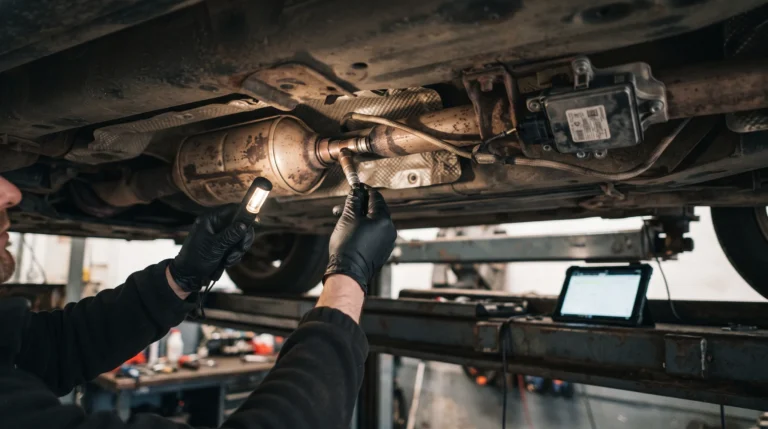
If the sensors look fine, the next step is usually a physical check of the injector and dosing lines for signs of crystallisation or leaks, and a look at the pump’s performance under load rather than just at idle. It’s this combination, live data plus a physical inspection, that actually identifies the cause, rather than just clearing the code and hoping it doesn’t come back a third time.
Recurring Fault or One-Off? Here’s How to Tell
| What’s happening | Likely cause | What it usually needs |
| Cleared after a longer drive, only appeared after a cold night | AdBlue was temporarily frozen or thickened | Nothing, or just a proper drive |
| Cleared with a reset, came back days or weeks later | Failing sensor, blocked injector, or worn pump | Full diagnostic scan |
| Never really clears, even briefly | Deeper fault, or a code that wasn’t properly cleared | Mercedes-specific diagnostic tool |
| Flashing light, or a noticeable drop in power | Active fault, not just a stored code | Get it checked straight away |
On that last point, a flashing light is worth taking more seriously than a solid one. Our article on AdBlue light flashing explains what that specific pattern usually indicates and why it shouldn’t be left for a few more weeks.
Why This Seems to Happen More on Mercedes Than Other Brands
It really does come down to tolerances. Mercedes SCR systems are calibrated to be strict about AdBlue quality and sensor accuracy, and that’s a big part of why their emissions control performs so well in real-world testing. The flip side is that smaller deviations, the kind a less fussy system might simply absorb without complaint, trip a fault on a Mercedes. It’s not unique to the brand either. Peugeot owners run into a broadly similar pattern for slightly different reasons, which we’ve covered separately in our Peugeot AdBlue fault guide, so if you’ve swapped notes with a Peugeot-driving friend and found the symptoms sound identical, that’s not a coincidence.
What Happens If You Just Keep Resetting It
It’s tempting to treat a recurring AdBlue light as background noise, especially if resetting it takes two minutes and the car still drives fine otherwise. The trouble is the underlying fault doesn’t sit still while you ignore it. A sensor that’s drifting tends to drift further, not less. A partly blocked injector tends to get more blocked, not less. What starts as an informational warning that clears with a reset can, over weeks or months, progress to a countdown warning telling you the engine won’t restart after a set number of starts, or a genuine drop in power as the system compensates for dosing it no longer trusts. Sorting the actual cause early is almost always simpler, and cheaper, than waiting until the car forces the issue.
What Actually Fixes It
- Stop resetting it as your only response. Each reset without a proper look under the bonnet buys you a few more days at best, not a solution.
- Get a full diagnostic scan, ideally with Mercedes-specific equipment rather than a generic reader, for the reasons covered above.
- Take note of the pattern before you book it in. Does it come back after roughly the same mileage, the same number of days, or only in certain weather? That detail genuinely helps whoever diagnoses it.
- Have the AdBlue itself checked. It’s not the most common cause on this list, but a bad batch or contaminated fluid can be the real problem rather than any component.
- Ask what your actual options are once the cause is found. Sometimes it’s a sensor clean or replacement, sometimes it’s more involved. Our guide on AdBlue system repair cost in the UK, what to expect is worth reading before you commit to anything.
If It Just Won’t Stay Fixed
If your Mercedes has had the same fault reset more than once and it keeps coming back regardless, it’s a fair time to start weighing up repair against an AdBlue delete. That’s not the right decision for everyone, and there are legal and warranty considerations worth understanding properly before going down that road. Our comparison of AdBlue delete vs AdBlue repair lays out the practical differences between the two, how an AdBlue delete actually works explains the process itself, and AdBlue delete warranty and insurance considerations covers what to check before you decide anything. And if long-term reliability is what’s really on your mind rather than just the immediate fix, whether an AdBlue delete could cause long-term engine damage is worth reading so you’re weighing up the whole picture.
Not Sure What You’re Actually Looking At?
Mercedes dashboards can show a few different variations of AdBlue warning depending on how serious the issue is, and it’s not always obvious at a glance which one you’ve got in front of you. Our overview of AdBlue warning lights and what the AdBlue sign on the dashboard means should help you work out exactly what you’re dealing with before booking anything in.
Where We Cover This Across the UK
This isn’t a fault that’s confined to one part of the country. Wherever there are Mercedes diesels on the road, this problem shows up, and we cover diagnostics and repair right across the UK.
London London itself, with dedicated AdBlue reset and AdBlue diagnosis services, plus borough coverage across Bromley, Hillingdon, Ealing, Bexley, Barnet, Enfield, Hounslow, and Brent.
South East England Dartford, Slough, Esher, Epsom, Sevenoaks, Loughton, and St Albans, or the wider South East England coverage page.
West Midlands, Staffordshire & Warwickshire Coventry, Solihull, Wolverhampton, Walsall, Dudley, Stoke-on-Trent, Stafford, Cannock, Lichfield, Nuneaton, Warwick, Leamington Spa, and Stratford-upon-Avon, or the West Midlands, Staffordshire, and Warwickshire hub pages.
Shropshire Telford, Shrewsbury, Oswestry, and Bridgnorth, or the Shropshire hub page.
East Midlands & Lincolnshire Grantham, Peterborough, Spalding, Stamford, Market Deeping, and Bourne, or the East Midlands & Lincolnshire hub page.
Yorkshire & Scotland Leeds, Sheffield, Glasgow, and Edinburgh.
Not sure which page covers your area? The full location lists everywhere we currently work.
Our AdBlue & Urea System Services
Once resetting the light has stopped being a real answer, here’s what we actually offer for Mercedes and other diesels, right across the UK:
- AdBlue Repair and AdBlue Fix to properly diagnose and resolve the cause, not just the symptom
- AdBlue Bypass and AdBlue Delete where that’s genuinely the right route for your situation
- Urea Repair, Urea Removal, and Urea Delete, the same system under the name it’s also commonly known by
- NOx Sensor services specifically for sensor-related faults like the ones covered above.
A recurring Mercedes AdBlue light is your car telling you something specific, not just being difficult. Find out what that something is, and there’s nothing left for the light to keep coming back for.
Frequently Asked Questions
Get clear answers about Mercedes AdBlue faults, recurring warnings, diagnosis, repairs and mobile AdBlue support.
Because the reset only clears the warning on the dashboard, it doesn’t touch whatever caused it. If the underlying problem, a sensor, an injector, or a pump, is still there, the car finds it again and the light returns.
It comes up a lot, yes. Mercedes SCR systems are set to tighter tolerances for AdBlue quality and sensor accuracy than some other brands, which makes them very effective but also quicker to flag a fault when something drifts even slightly.
There’s no set number, but resetting it over and over without fixing the cause is risky. The underlying fault stays active the whole time, and eventually the system can move to a countdown warning or reduced power, rather than just a light on the dash.
It can, though it’s less common than a sensor or component issue. Contaminated or off-spec AdBlue, even from a decent supplier, can occasionally trip a genuine quality fault that keeps returning until the fluid itself is replaced.
Get the scan. Resetting it repeatedly without finding the cause just delays the next warning, and the issue behind it can quietly get worse while you’re doing that.
Not necessarily, especially if it’s just an informational warning with no drop in power. But if it turns into a countdown to no-start or comes with a flashing light, that’s a sign to get it looked at rather than keep driving on it.
Ideally yes. A basic generic OBD reader can clear a code, but Mercedes-specific diagnostic kit is what actually identifies which sensor, injector, or module is causing the recurring fault in the first place.
Topping up AdBlue if the tank is genuinely low is fine, but beyond that, guessing at sensors or injectors without proper diagnostic tools tends to waste time and sometimes money. A scan first saves you doing unnecessary work.
It depends on the vehicle and what’s found, but a full diagnostic scan is generally a same-day job, which is part of why we offer mobile diagnostics rather than requiring you to book the car in and wait.
Yes, we cover London, the South East, the Midlands, Yorkshire, and Scotland. Check the locations directory for your nearest coverage area.