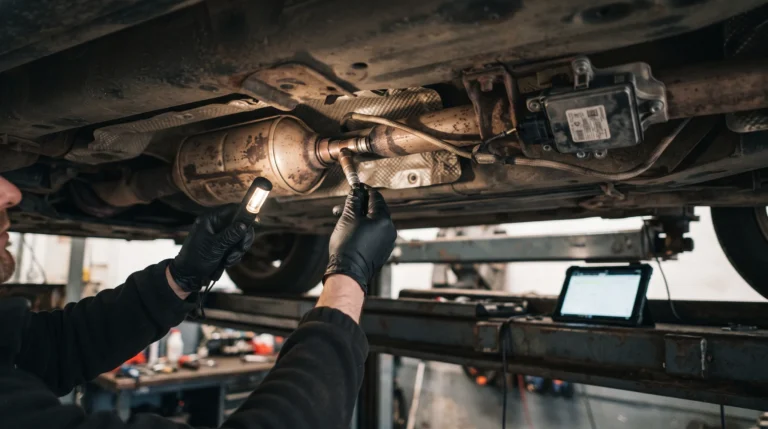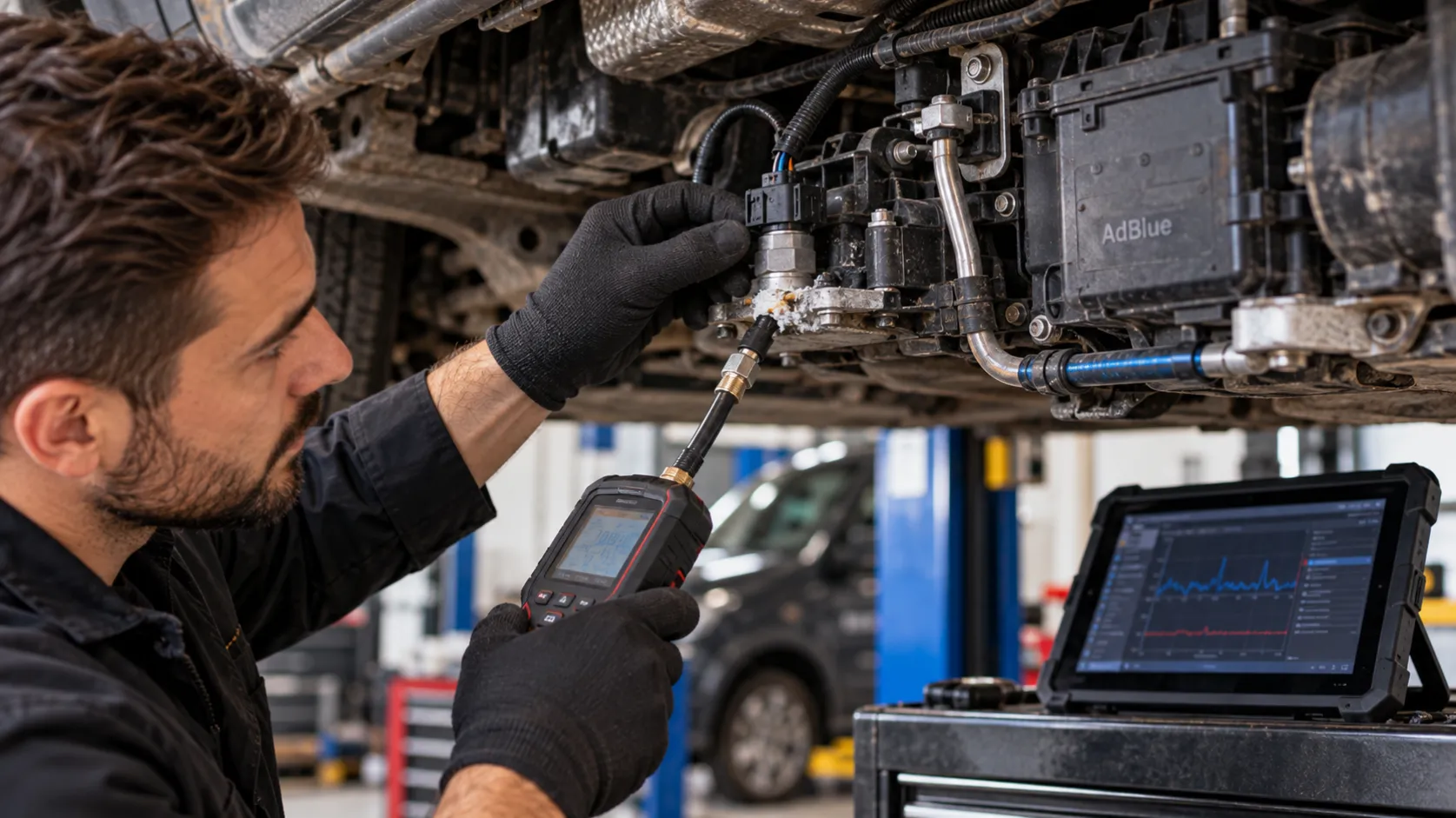

An AdBlue pressure sensor fault means the sensor watching pressure in your SCR system is sending the ECU a reading that doesn’t match reality. Not low fluid. Not a dosing problem by itself. A pressure signal that’s wrong, missing, or jumping around.
That distinction matters. It changes where the actual fault sits, and it’s one of the faults we get asked about most here at AdBlue Fault.
The sensor’s job is simple enough on paper. It sits in or near the AdBlue delivery system and tells the ECU whether the pump’s building the pressure it’s supposed to, so the system knows the injector can dose fluid accurately when it fires. Once that sensor starts reporting something inaccurate, the ECU’s basically guessing on pressure. It reacts cautiously. Usually a warning light, a stored code, and eventually reduced performance if nobody’s looked at it yet.
What the Pressure Sensor Actually Does
Picture the pump pushing AdBlue through a small delivery line toward the injector. For dosing to happen accurately, the system needs to know pressure in that line is sitting where it should, not too low, not too high. The sensor’s the component reporting that number back in real time.
Get a wrong reading, and the ECU’s guessing. It might think pressure’s too low and push the pump harder to compensate. It might think everything’s fine when the pump’s actually struggling. Accurate dosing depends on an accurate pressure reading. A faulty sensor breaks that chain even when everything else in the system’s working just fine.
What Causes a Pressure Sensor Fault
A failed sensor is the most straightforward cause. Sensors wear out internally over time, sometimes drifting gradually out of range before failing completely, sometimes going all at once without much warning.
Wiring and connector corrosion comes a close second. We catch this one more often than a genuinely dead sensor, if we’re honest. The connector sits in a fairly exposed spot underneath the vehicle, picking up road spray, salt, and general grime year after year. A corroded pin sends a signal that looks exactly like a sensor fault even when the sensor itself is perfectly fine.
We had a Transit come in last month showing what looked like a textbook failed sensor. Erratic readings, a stored circuit code, the lot. Turned out the sensor was fine. The connector behind it had corroded enough that the signal was getting interrupted intermittently, which is exactly why we always check wiring before assuming the part itself needs replacing.
Crystallised urea blocking the sensor’s port is another real possibility. AdBlue’s roughly 32.5% urea in water, and if it sits without moving near the sensor’s mounting point for long enough, the water evaporates and leaves crystals behind that physically interfere with an accurate reading.
A struggling pump can produce what looks exactly like a pressure sensor fault too, even when the sensor’s reporting correctly. If the pump genuinely can’t build proper pressure, the sensor’s just doing its job, reporting a real problem sitting somewhere else. Diagnosis has to tell these two apart rather than guessing which one it is.
Less often, a blocked or pinched line between the pump and sensor causes something similar, since restricted flow changes the actual pressure the sensor’s measuring.
Symptoms You Might Notice
The AdBlue warning light’s usually first. Often paired with a dashboard message referencing the AdBlue or emissions system depending on your car. Some drivers notice the engine hesitating slightly under load now and then, though that’s not universal and isn’t something to rely on as an early warning by itself.
Inconsistent readings are genuinely telling if you’ve got access to live data. A sensor failing gradually often shows erratic, jumpy values rather than one clean, stable number, well before it actually fails outright and a code gets stored.
Reduced performance tends to follow if it’s left alone. The ECU treats an unreliable pressure signal as grounds to limit how the engine runs, on the basis that accurate emissions dosing can’t be guaranteed anymore. From there, a restart countdown can show up, the same pattern as most other AdBlue faults once the car decides compliance genuinely can’t be maintained.
Can You Keep Driving With This Fault?
For a while, generally yes. Especially before any countdown message appears. The engine itself isn’t being damaged by a bad pressure reading on its own.
Don’t leave it indefinitely though. Once the car drops into reduced performance or starts counting down, you’re working against a clock that’s rarely convenient. Getting it looked at as soon as the light comes on sidesteps the whole situation.
How We Diagnose a Pressure Sensor Fault
We start with a full fault code scan to confirm exactly what’s stored. The specific code often narrows things down before we’ve even touched the car.
From there we check the sensor’s actual output against real measured pressure in the system, rather than trusting the dashboard reading alone. It’s the only reliable way to tell whether the sensor itself is faulty, or whether it’s accurately reporting a genuine pressure problem caused by the pump, a blocked line, or crystallisation somewhere else in the system.
We check wiring and the connector directly too, since corrosion or a damaged connection produces symptoms that look identical to a failed sensor, as the Transit case above shows well enough. Skip that step and replace the sensor outright, and the same fault turns up again within weeks, part changed for nothing.
If sensor and wiring both check out clean, we move to testing pump performance and checking for restriction in the delivery line, since either can produce a reading that’s technically accurate but still sitting outside normal range.
The Fault Codes You’re Likely to See
Rather than just listing these in a table, it helps to know roughly what each one’s actually telling the ECU, since the number alone doesn’t explain much on its own.
P20E8 shows up when reductant pressure is reading too low. P20E9 is a related low pressure code, usually paired with its own system warning. P20EE points specifically at the pressure sensor’s circuit, a range or performance issue rather than a simple pressure reading problem. P20EF goes a step further again, a circuit malfunction on the sensor itself rather than just an out of range value. P2025 sits at the opposite end of the scale, reductant pressure reading too high rather than too low.
Which one your car actually stores depends on how far the reading’s drifted and which manufacturer’s own coding convention applies. A code reader alone tells you there’s a pressure problem without necessarily telling you exactly where it’s coming from.
Sensor Fault or Pump Fault? Easy to Mix Up
A pump struggling to build pressure and a sensor inaccurately reporting normal pressure as low can look almost identical from the driver’s seat. Same warning light. Similar codes. Similar reduced performance.
Measuring actual pressure independently of what the sensor’s reporting is the only real way to tell them apart. We don’t jump straight to replacing the sensor for this reason. Do that on a car with a genuine pump problem, and the fault comes straight back, the customer’s paid for a part that didn’t need changing, and the real problem’s still sitting there completely unresolved.
Does This Happen the Same Way on Every Make?
The underlying principle stays consistent across every SCR equipped diesel, but sensor location and exposure to road grime and heat varies by manufacturer. We see pressure sensor faults regularly on Volkswagen, Audi, BMW, Mercedes, Ford, Vauxhall, Peugeot, Citroën, Jaguar and Land Rover models. Our vehicles page has more manufacturer specific detail if you want to check your particular model first.
Related AdBlue Guides Worth Reading
A few other articles connect closely to this fault. Our guide on NOx sensor versus AdBlue quality sensor is worth reading if you’re trying to work out which sensor’s actually involved in yours. Our piece on AdBlue quality faults covers a related but distinct issue that can show similar warning behaviour.
Warning light won’t clear even after checking fluid levels? Our guide on an AdBlue warning light that won’t clear explains why. Our broader AdBlue system fault codes explained guide and our general AdBlue fault guide both give wider context beyond just this one fault. If crystallisation turns out to be involved, our article on whether AdBlue crystallisation can be repaired covers that specifically.
Our Services for This Kind of Fault
Fixing a pressure sensor fault properly usually draws on more than one of our core services, depending what’s actually found. Our AdBlue diagnosis service is always where this starts, confirming exactly what’s wrong before anything gets replaced. From there, our AdBlue repair service covers the sensor, wiring, or pump work itself, and our AdBlue reset service clears the fault properly once the underlying issue’s genuinely fixed, not just cleared and waiting to come back.
If a pressure fault connects to a wider sensor issue, our NOx sensor service covers that side of things, and our AdBlue bypass service remains available as advice and support for suitable vehicles where that’s being considered, with legal requirements and intended use taken into account. For commercial vehicles, our HGV remapping service covers related emissions work on larger diesel fleets.
What Does This Typically Cost to Fix?
Diagnosis and repair for a pressure sensor fault starts from £249, a starting price rather than a fixed one. The actual cost depends whether it’s the sensor itself, a wiring repair, or a pump issue behind it. We always confirm the exact cause and give a firm price before anything goes ahead.
Our page on system repair cost in the UK and what to expect sets out the wider cost picture, and our guide on AdBlue pump replacement cost is worth a read if pump failure turns out to be behind your pressure fault.
AdBlue Repair Across North London
We cover pressure sensor faults right across the north of the city. It’s an area with a genuinely steady stream of AdBlue work, particularly on the busier routes through Barnet and Enfield, where a lot of short, stop start driving feeds the crystallisation issues that sit behind plenty of pressure faults. We also cover Haringey, Camden, Islington, Waltham Forest and Harrow, each with its own dedicated page covering local coverage in more detail.
AdBlue Repair Across East London
East London’s a big part of what we cover too, from Hackney and Tower Hamlets through to Newham and Redbridge. Further out, we cover Barking and Dagenham, Havering and Greenwich, all with their own pages setting out exactly what we offer locally.
AdBlue Repair Across South London
South of the river, we cover Lambeth, Southwark and Lewisham, along with Bromley, Bexley and Sutton further out toward the edge of the city. We also cover Merton, Wandsworth, Kingston upon Thames and Richmond upon Thames, each area with its own page covering local service details.
AdBlue Repair Across West London
West London rounds out our coverage, including Ealing, Hammersmith and Fulham and Hounslow. We also cover Hillingdon, Brent, Kensington and Chelsea and Westminster, with each page setting out what we offer in that specific area.
Not sure which page covers your postcode? Our main AdBlue repair London page and the full locations directory both list everywhere we currently work.
AdBlue Pressure Sensor FAQs
Get clear answers about AdBlue pressure sensor faults, diagnosis, pressure problems, wiring issues, repairs and replacement.
Not reliably. Confirming whether the sensor’s genuinely faulty, or accurately reporting a real pressure problem elsewhere, needs proper diagnostic equipment measuring actual system pressure, not just reading the dashboard fault code.
Only if the sensor’s actually the cause. A struggling pump or a blocked line won’t be fixed by a new sensor, and the fault comes straight back.
No fixed lifespan. Depends on driving pattern, exposure to road salt and moisture, and general wear. Some fail suddenly, others drift out of range gradually over months.
It can be, depending on your vehicle’s age, mileage, and the manufacturer’s emissions component warranty terms. Worth checking with your dealer, though plenty of drivers come to us once a warranty’s already lapsed.
No, this is a pressure reading issue, not a fluid level one. Low level triggers its own separate warning entirely, so if the tank’s topped up and this fault’s still showing, it isn’t a level problem.
A general garage can read the stored code, but confirming whether it’s the sensor, the wiring, or the pump usually needs equipment and experience specific to SCR systems. A lot of these cars end up with a specialist after a general diagnosis hasn’t fully sorted things.
That pattern often points to a wiring or connector issue rather than a fully failed sensor, since a loose or corroded connection can produce an intermittent fault that clears temporarily before coming back, much like the Transit case mentioned earlier.
Indirectly, yes, particularly if crystallisation’s involved. Cold weather increases the chance of AdBlue sitting still long enough to crystallise around the sensor or delivery line.
Yes, the same principle applies to any diesel vehicle running SCR emissions control. For commercial vehicles, our HGV remapping page covers related work on larger diesel fleets.
Once the actual cause is confirmed, most sensor and wiring related repairs are same day. A pump replacement, if that’s the cause, can take a little longer depending on parts availability.
Not dangerous to you as a driver, no, but ignoring it raises the risk of reduced performance or eventually a restart countdown once the ECU decides emissions compliance can’t be guaranteed.
Not the engine directly, though a struggling pump left unaddressed can wear further, and what might’ve been a straightforward repair early on can become more involved the longer it sits.
Book Your AdBlue Diagnosis
Dashboard showing an AdBlue warning and you suspect a pressure sensor fault? Get in touch through our contact page and we’ll book a proper diagnosis before anything gets replaced unnecessarily. Catching this early is almost always the easier and cheaper route.