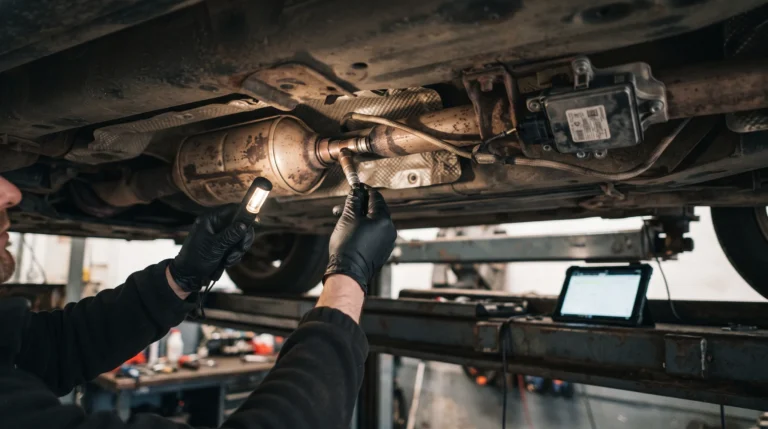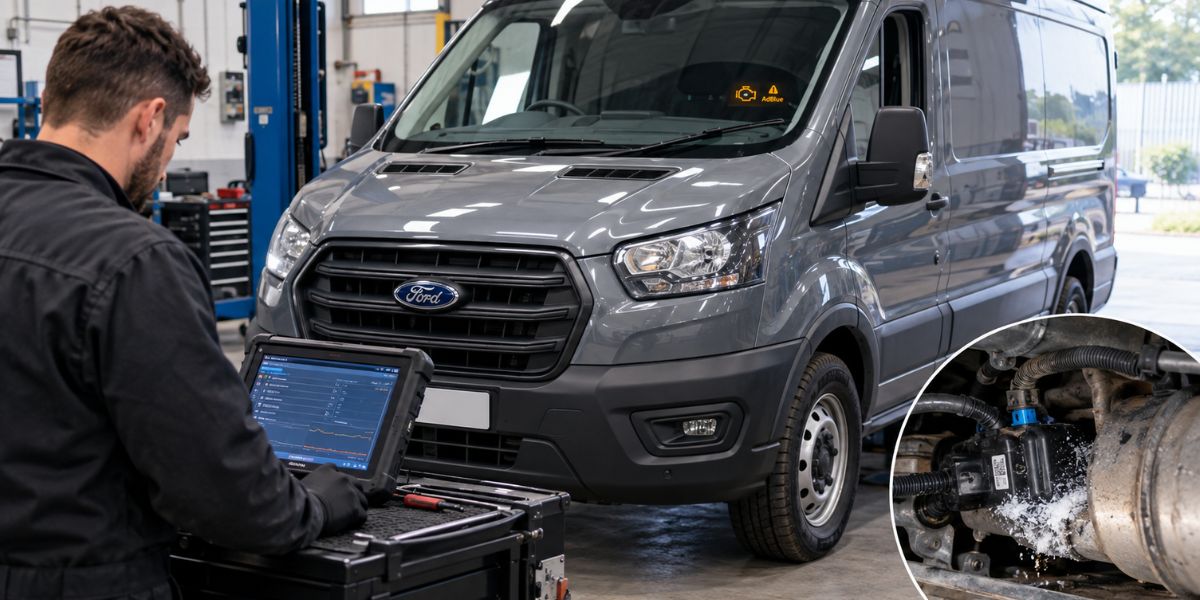

P20EE means the Transit’s SCR system isn’t cutting NOx as well as it should. The van reads the exhaust gas before and after the catalyst, and when the drop between the two is too small, it logs P20EE and turns on the AdBlue warning. The usual causes are a worn NOx sensor, a blocked or crusted AdBlue injector, low pressure from the pump, poor quality AdBlue, or a leak in the exhaust ahead of the sensors. Less often the catalyst itself is tired. A scan with live data shows which one you’ve got.
Left alone, P20EE turns into a mileage countdown, and when the miles run out the Ford Transit won’t restart once you switch it off. AdBlue repair and diagnosis at AdBlue Fault start from £249, which is a starting price and not a fixed one. We work 7 days a week and have completed 5,000+ jobs. Call +44 330 043 4431 or message us on WhatsApp, 24/7. The rest of this guide answers the questions Transit owners ask us most.
What does P20EE actually mean on a Ford Transit?
The full description is SCR NOx catalyst efficiency below threshold, bank 1. In plain words: the van sprays AdBlue into the exhaust to break down NOx, then checks whether it worked. If the after catalyst reading isn’t low enough compared with the before reading, the computer decides the catalyst isn’t doing its job and sets the code.
The important bit is that the code describes a result, not a broken part. P20EE says “the cleaning isn’t happening”. It doesn’t say why. That’s what makes it annoying, because at least five different faults can produce the same code, and swapping parts at random gets expensive fast.
It’s most common on diesel Transits with an AdBlue system, including the 2.0 litre EcoBlue vans. Wording on the dash varies between models and years, so go by what your own screen says.
Why does my Transit throw P20EE?
Here are the causes we check, roughly in the order we’d expect to find them.
A tired NOx sensor. The two sensors sit in the exhaust and live in a hot, sooty place. After enough miles they drift, respond slowly or stop giving believable numbers. If the sensor after the catalyst reads high when the real gas level is fine, the van blames the catalyst. It’s one of the most common reasons for P20EE, and it’s also the one people replace first. Sometimes that’s right. Sometimes the sensor was innocent. Our NOx sensor service page explains what we do, and NOx sensor vs AdBlue quality sensor helps you tell the two apart.
A blocked or crusted injector. If the exhaust doesn’t get hot enough, some of the spray never turns to vapour. It dries into a hard white crust around the injector tip, the spray narrows, and the van under-doses. Less AdBlue means less NOx reduction, and P20EE follows. See can AdBlue crystallisation be repaired? for when it can be cleaned and when the part has to go.
Low pressure from the pump. The pump has to hit a set pressure before the injector can dose properly. A worn pump or a partly blocked line means less fluid reaches the exhaust, and the result is the same. Our guide to AdBlue pump replacement cost in the UK covers what to expect if that’s the cause.
Poor quality AdBlue. Old, watered down or contaminated fluid doesn’t break NOx down as well. Buying from a sealed bottle or a proper pump matters more than most people expect. Read the AdBlue quality fault guide for what that looks like.
An exhaust leak before the sensors. A small leak upstream can let air into the exhaust and skew the sensor readings, so the van thinks the cleaning has failed when it hasn’t. This is easy to miss, and it’s worth a look before anyone condemns an expensive part.
A tired catalyst. It does happen, particularly on high mileage vans, or if contaminated fluid has got into the system. But it’s the last thing we’d suspect, not the first, and it’s the most expensive answer. We rule the cheaper causes out before going there.
An engine fault pushing NOx up. If the engine is producing more NOx than the system was designed to handle, the SCR system can look like it’s failing when it’s actually being overloaded. It’s uncommon, but worth knowing about.
And then there’s the boring pair: a weak battery and out of date software. Either can throw a false code, which is one more reason to scan properly before spending money.
How do I know if it’s the NOx sensor?
You can’t tell from the driver’s seat, and a code reader on its own won’t tell you either. What separates a genuine sensor fault from a sensor that’s just reporting bad news is the live data.
We watch both sensors while the system runs. If the before and after readings track each other in a way that makes no sense, or one of them barely moves, the sensor is suspect. If both sensors behave sensibly but the after reading stays high, the problem is more likely the dosing side: the injector, the pump or the fluid. That’s the difference between replacing one part once and replacing three parts over three visits.
“Can I just top up the AdBlue and clear the code?”
Topping up won’t touch P20EE, unless the tank was nearly empty and that was the actual cause. If the tank has fluid in it, more fluid changes nothing.
Clearing the code is a different story. A code reader can wipe P20EE, but the van runs its checks again on the next drive and finds the same problem. It might take a few days, but it comes back. Clearing it also wipes the history that an engineer would like to see. Our post on why the AdBlue warning light won’t clear explains why resetting alone never works.
“Will the Transit go into a countdown?”
Yes, that’s what usually happens. The first thing you notice is an AdBlue or emissions warning, and the van drives normally. If the fault is confirmed, a mileage countdown starts. The distance depends on the model, so trust your own dash and not a rule of thumb. When it reaches zero, the Transit keeps running while the engine is on, but it won’t restart after you switch off.
The countdown doesn’t pause and it doesn’t reset when you park. If it’s running, book now and avoid long trips away from base. Read no engine restart in X miles for what to expect at each stage. A flashing warning has its own meaning, covered in AdBlue light flashing.
Do short trips and delivery work bring it on?
They do, and it’s the reason Transits meet this code so often. The SCR system needs a properly hot exhaust to spray cleanly and burn off deposits. A van that does drop after drop, with a few minutes of driving between each, never gets there. Crystals build up on the injector and the sensors spend their lives heating up and cooling down.
A longer steady run now and then helps keep things cleaner. It won’t repair a failed part, so don’t expect a motorway drive to clear a confirmed fault. If your Transit does mostly short, stop start work, tell the engineer. It often explains why the fault keeps coming back on your van and never on someone else’s.
What else shows up alongside P20EE?
P20EE rarely arrives alone. Other codes tell us where to look.
P204F is a general reductant system performance code, and it usually leads us to the injector and how well it’s dosing. P20E8 means the reductant pressure is too low, which points at the pump or a blocked line. P229F is a NOx sensor signal that’s stuck. P2047 is an injector circuit fault, so the plug and wiring come first. If P20EE turns up with one of those, we’ve got a strong lead. If it’s the only code, we rely more on the live data.
For a bigger list of codes and what they mean, see AdBlue system fault codes explained.
“What does the repair involve?”
Diagnosis first. We connect professional diagnostic equipment, read every stored code, and watch the live data with the system running. We check the physical side too: connectors, lines, signs of crystals, and the exhaust for leaks ahead of the sensors.
Then the fix depends on what we found. It might be cleaning or replacing the injector, replacing a NOx sensor, replacing the pump, correcting a wiring fault, flushing poor fluid, or repairing a leak. Only once the cause is dealt with do we reset the system, so the warning and countdown clear for good. You get a clear price before any Ford Transit repair starts. See our AdBlue Repair, AdBlue diagnosis in London and AdBlue Reset pages, and AdBlue Fix if you’d like a place to start.
How much does it cost to fix P20EE on a Transit?
AdBlue repair and diagnosis start from £249. That’s a starting price, not a fixed price, because the final cost depends on what has failed. A dirty connector is a very different job from a pump or a sensor. We confirm the price once we understand the fault on your van.
Because P20EE can come from more than one part, a proper diagnosis often saves money. It stops you paying for a sensor you didn’t need. For typical ranges across the UK, see system repair cost UK: what to expect.
Transit, Transit Custom or Transit Connect: does it matter?
The code is the same, but the hardware isn’t. Sensor positions, injector access and pump design differ between models and years, so the fix can differ too. Tell us the model, the year and the engine when you get in touch, and we can tell you what to expect before you book. If you run other makes in a mixed fleet, our Peugeot AdBlue fault guide, the Mercedes AdBlue light keeps coming back on post and the vehicle page may help.
How do I stop P20EE coming back?
Fix the cause, not the code. Most repeat P20EE faults happen because a part was swapped on a guess and the real problem was left in place.
After that, the habits are simple. Use sealed, in date AdBlue. Don’t run the tank close to empty as routine. Give the van a longer steady run when you can. Keep an eye on battery health, because low voltage throws false faults. And deal with the first warning light instead of waiting for the countdown. None of it is complicated, but it adds up over a year of van work.
Where do you help Transit owners?
Across a lot of the country. Here’s where we have local pages.
London. Start with AdBlue repair London, or pick your borough: Barking and Dagenham, Barnet, Bexley, Brent, Bromley, Camden, Ealing, Enfield, Greenwich, Hackney, Hammersmith and Fulham, Haringey, Harrow, Havering, Hillingdon, Hounslow, Islington, Kensington and Chelsea, Kingston upon Thames, Lambeth, Lewisham, Merton, Newham, Redbridge, Richmond upon Thames, Southwark, Sutton, Tower Hamlets, Waltham Forest, Wandsworth and Westminster.
South East England. The South East hub, plus St Albans, Loughton, Dartford, Sevenoaks, Epsom, Esher and Slough.
West Midlands. The West Midlands hub, Coventry, Dudley, Solihull, Walsall and Wolverhampton.
Staffordshire. The Staffordshire hub, Stoke-on-Trent, Stafford, Cannock and Lichfield.
Warwickshire. The Warwickshire hub, Nuneaton, Rugby, Warwick, Leamington Spa and Stratford-upon-Avon.
Shropshire. The Shropshire hub, Shrewsbury, Telford, Oswestry and Bridgnorth.
East Midlands and Lincolnshire. The regional hub, Bourne, Peterborough, Grantham, Spalding, Stamford and Market Deeping.
Yorkshire and Scotland. Leeds, Sheffield, Glasgow and Edinburgh.
Not on the list? Send us your postcode. The full locations hub has everything in one place.
Ford Transit P20EE FAQs
Get clear answers about Ford Transit P20EE faults, AdBlue problems, SCR efficiency, NOx sensors, repair costs and driving with an active fault.
It’s worth acting on. The van is still driveable at first, but a confirmed fault leads to a countdown, and once that runs out the Transit won’t restart after you switch off. The sooner you diagnose it, the more choice you have.
The warning can come and go, particularly if the cause only shows in certain conditions, such as cold weather or heavy load. But the fault hasn’t gone away, and it normally returns. Don’t wait for it to sort itself out.
Rarely as a first answer. A tired catalyst is possible on high mileage vans, but the NOx sensors, injector, pump, fluid quality and exhaust leaks are all more likely, and much cheaper. We rule those out first.
Yes. Old, diluted or contaminated fluid doesn’t break NOx down properly, so the efficiency reading drops. Sealed, in date AdBlue avoids the problem. If you’ve put diesel in the AdBlue filler, don’t start the engine and call us.
It can. A leak ahead of the sensors can skew their readings and make the system look as if it isn’t working. It’s easy to overlook, which is why we check the exhaust as part of a diagnosis.
Not on its own. A reset clears the message, but it doesn’t repair the cause. The van finds the same fault on the next drive and the light comes back.
On some vehicles, an SCR fault can bring an emissions warning and reduced power, with the countdown still running. If your Transit feels flat as well as showing the AdBlue message, don’t wait.
It depends on the model and what the countdown says. Once miles are showing, every mile counts against you, and the countdown doesn’t pause when you park. Read how the AdBlue countdown works.
No. P20EE means the SCR system isn’t reducing NOx enough. P204F is a wider performance code for the reductant system. They often appear together, and that pair usually points towards the injector or dosing side.
No. Sometimes the sensor is the cause, and sometimes it’s reporting an accurate result from a problem elsewhere. That’s why we look at live data first. It stops you paying twice.
You can check the fluid level, top up with clean AdBlue and read the code. The repair itself needs live data and the right tools, and clearing the code without a repair only hides the problem for a while.
It can contribute. AdBlue starts to freeze at about minus 11 degrees Celsius, and a weak heater or a stiff, cold system can lower the dosing. If your fault shows up on frosty mornings, tell the engineer.
It can, depending on the fault and how the van responds, but it’s not the main worry. The bigger issue is the countdown, and the risk of the van refusing to restart.
AdBlue repair and diagnosis start from £249. That’s a starting price, not a fixed price, and we confirm the final cost once we know the cause. See AdBlue pump replacement cost UK and system repair cost UK for typical ranges.
We work on most diesel vans with an AdBlue system. Send us the model, the year and the engine, along with the code and what the dash says, and we’ll tell you what to expect.
Get your Transit checked before the countdown runs out
If your Ford Transit is showing P20EE or an AdBlue warning, don’t wait for the miles to run down. Call +44 330 043 4431 or message us on WhatsApp, 24/7. We work 7 days a week and have completed 5,000+ jobs. You can also use our contact page. Tell us the model, year, postcode and what the dash says, and we’ll take it from there.
More guides: AdBlue fault guide, AdBlue warning light, AdBlue warning symbol, AdBlue sign on dashboard, AdBlue warning light won’t clear, AdBlue system fault codes explained, AdBlue quality fault, NOx sensor vs AdBlue quality sensor, can AdBlue crystallisation be repaired, AdBlue pump replacement cost UK, system repair cost UK, no engine restart in X miles, Peugeot AdBlue fault, Mercedes AdBlue light keeps coming back on, BMW