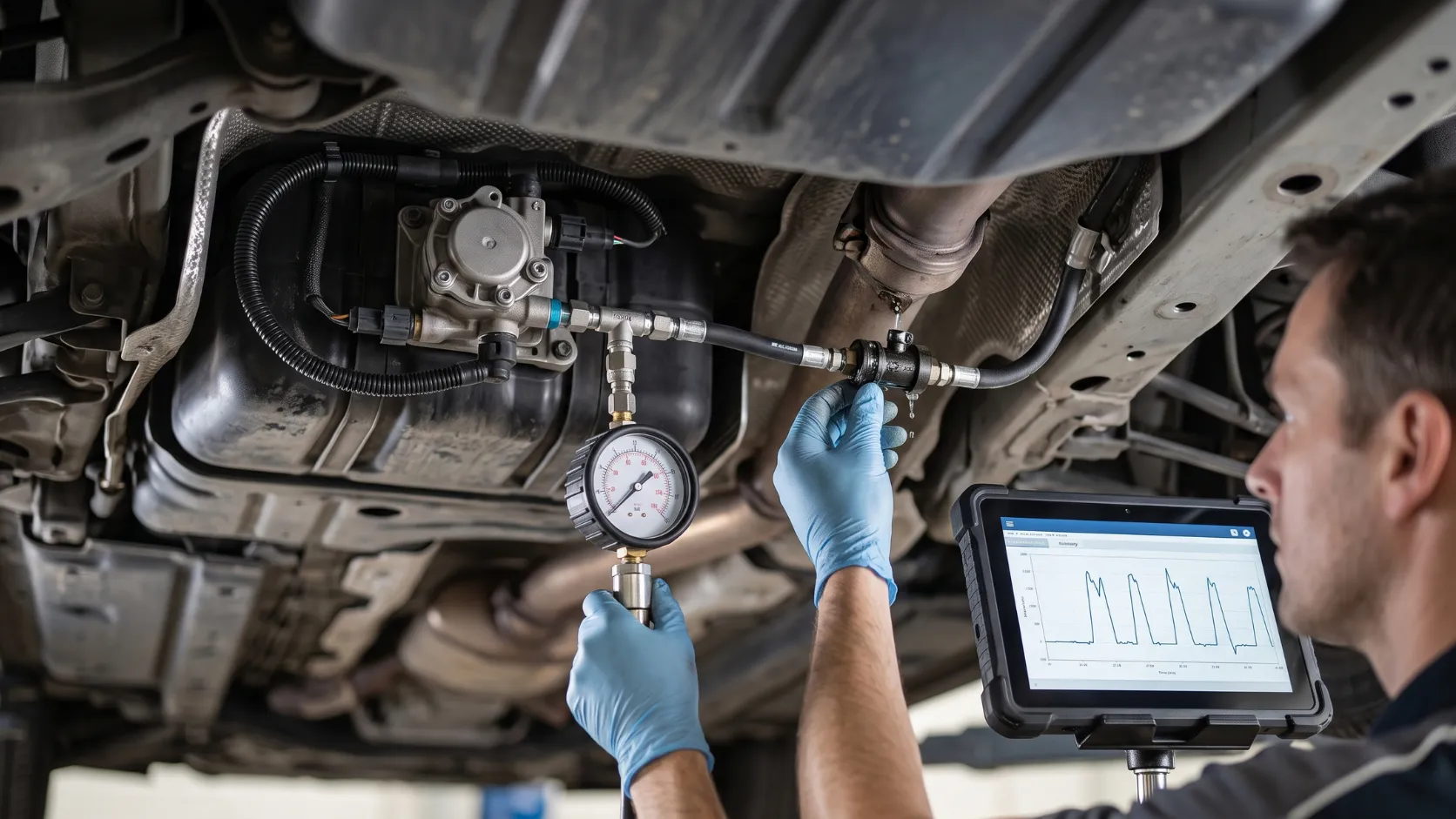

Pressure climbs. Then it falls back before the dosing module can actually use it. Then it climbs again. That cycle, over and over, every few minutes, with the warning light flickering in time with it, is the real giveaway here. An AdBlue system that won’t hold pressure almost never just dies outright. It fights to hold a number and keeps losing.
That matters more than it sounds like it should. A system that never builds pressure in the first place is usually a dead pump, and there’s not much mystery to it. But build then drop is a different animal entirely. Something’s letting pressure escape that shouldn’t be, a valve that won’t stay shut, a sensor lying to the ECU, a seal that’s worn thin enough to leak under load. We’ll get into which one it usually is, how a proper technician actually tells them apart, and what it tends to cost once you know.
What’s Going On Inside the System When This Happens
A pump pulls AdBlue from the tank and pressurises it, somewhere between 5 and 9 bar depending on the vehicle, then holds it there so the dosing module can inject exact amounts into the exhaust stream. The ECU watches that pressure number constantly. Drop it for even a second and the ECU knows.
Here’s the thing most people get backwards. When pressure cycles like this, the pump’s usually fine. It’s doing its job. Something downstream just won’t let the system keep what the pump’s giving it.
Picture a tyre with a slow puncture. Pump air in, it holds for a bit, then it’s soft again. Nobody blames the foot pump for that.
The Parts That Usually Cause This
A handful of components are behind this specific pattern, far more often than anything else.
Purge valve not sealing properly. Its job is clearing the lines when the engine shuts off, so nothing freezes solid overnight. Fails to close fully once the system’s running again, and it bleeds pressure straight back toward the tank. Builds, leaks, drops. Pump tries again. Same loop, every time.
A non return valve on its way out. Sits in the line specifically to stop AdBlue flowing backward. Wear in the seat, or a bit of debris lodged where it shouldn’t be, and pressure sneaks back toward the pump every time the system tries to settle into its target.
A pressure sensor telling lies. Sometimes nothing’s actually wrong. The fluid’s holding pressure exactly like it should, and the sensor itself is the thing cycling, feeding the ECU a false drop that triggers a response to a leak that doesn’t physically exist. We go deeper on this specific failure in our guide to AdBlue pressure sensor faults, including the handful of ways to actually tell a lying sensor from a real leak.
Wear at the injector seal. A seal that’s thinned out lets a little fluid slip past where it’s not meant to, dropping line pressure each time the dosing valve fires. Different problem to the one in our guide on AdBlue injectors not opening, where the valve’s stuck shut rather than leaking once it opens. Easy to confuse the two from the dashboard alone.
Crystallised urea narrowing a line. Not blocking it outright, just squeezing it. That creates its own odd pressure behaviour, spikes as the pump forces fluid through the narrowed bit, drops once flow catches back up. A full blockage reads completely differently. Pressure that never builds at all, not one that climbs and falls.
Why Cycling, Specifically, and Not a Flat Failure
A dead pump gives you flat, boring, obvious failure. Pressure stays low. It stays there. Nothing interesting happens, mechanically speaking.
Cycling tells a different story. The system is actively fighting to hold a number, winning for a minute, losing it, trying again. That’s genuinely good news for whoever’s diagnosing it, because it rules out a dead pump and a total blockage straight away. What’s left is narrower. A seal, a valve, a sensor.
We had a Transit in not long ago with this exact complaint. Dashboard flicking between fine and a pressure warning every four or five minutes, like clockwork. Owner was bracing for a pump replacement quote. Turned out to be a non return valve with a chip in the seat you could barely see without pulling it apart properly, letting just enough fluid creep backward each cycle to trip the threshold. Four pound part. Fixed it completely.
Not every case is that cheap. But it’s a good reminder that the loud, scary sounding fault on the dashboard doesn’t always match the size of the actual part behind it.
The Fault Codes You’ll Usually See With This
A handful of codes show up again and again alongside this specific symptom. P2080 points to the pressure sensor circuit reading something outside its expected range. P20B9 flags pump control performance, meaning pressure isn’t reaching its target reliably even though the pump’s running. P203E ties back to the heater circuit, which affects fluid viscosity enough to throw pressure readings off, particularly in the cold. P20EE is a straightforward pressure too low code, often genuinely linked to a leak somewhere in the line. P2E16 means the pressure signal itself looks implausible to the ECU, which more often than not means the sensor’s the problem rather than the pressure.
If your scan tool’s thrown something not on that list, our full AdBlue system fault codes explained guide covers the wider range.
Does the Brand of Vehicle Change Any of This?
A bit, yeah. Ford Transit vans lean toward heater circuit faults specifically, since a struggling heater throws viscosity and pressure readings off together in cold weather. Mercedes and Audi systems, in our experience, show purge valve wear more than most, down to how those two manage line clearing on shutdown.
Peugeot and Volkswagen models past 80,000 miles tend toward dosing module seal wear specifically. And Jaguar and Land Rover SCR systems run pressure targets that sit slightly outside the norm for other brands, which occasionally trips up a generic scan tool into flagging a fault that’s actually nothing at all. Brand knowledge isn’t just a nice extra here. It genuinely changes what gets checked first.
How We Actually Work This One Out
Not by swapping parts and hoping. That’s the expensive way.
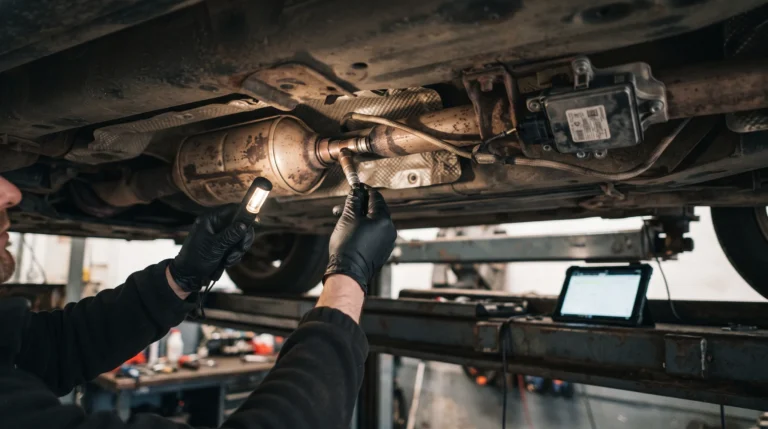
First, live data gets pulled and watched over several minutes rather than glanced at once, so the actual build and drop pattern shows itself rather than a single number that could mean almost anything. Then the lines get pressure tested independently of the pump, which tells us straight away whether the leak sits upstream or downstream of it. The purge valve and non return valve get physically inspected next, since both of them can look completely fine from the outside while failing internally. The pressure sensor’s reading gets checked against a known reference too, ruling out a false signal before anything mechanical gets touched. Only once all of that points somewhere specific does a part actually get replaced.
Skip that sequence and go straight for a pump swap, and there’s a good chance you’re paying for it twice. The pump goes in, the fault comes straight back within days, and the actual cause, usually a valve worth twenty or thirty quid, never got looked at.
What Does Fixing This Actually Cost?
Honestly, it depends entirely on which part turns out to be the real cause, which is exactly the argument for proper diagnosis before anyone commits to a number. Our AdBlue pump replacement cost page and the broader system repair cost guide both lay out typical ranges, and a valve or sensor fix sits well below a full pump swap in most of what we see.
We quote from £249. Starting price, based on what’s actually found, not a flat number regardless of the fault.
Could It Just Be Crystallisation?
Possible, especially if the vehicle’s sat unused for a stretch or has a habit of running the AdBlue tank low before refills. Our guide on whether crystallisation can be repaired covers how that actually gets confirmed and cleared out. Worth ruling in or out early, since it points toward a flush and clean rather than swapping a valve or seal.
Is a Warning Light That Won’t Clear the Same Problem?
No, and it trips people up constantly. A light that stays on after a genuine fix is usually its own separate issue, often just needing a reset procedure rather than another repair. We cover that specifically in our guide on AdBlue warning lights that won’t clear.
What’s described on this page is the fault itself, still active, still cycling. Not a light stuck on after the real problem’s already gone.
Where the NOx Sensor Fits Into All This
It’s a separate part with its own way of failing, but there’s a connection worth knowing about. A NOx sensor giving bad readings can push the ECU into requesting more AdBlue dosing than the engine actually needs, which puts the pressure system under extra strain even when the pump, valves, and lines are all working as they should. If your diagnosis hasn’t turned up a clean pressure side answer yet, our comparison of NOx sensor faults against AdBlue quality sensor faults is worth reading next.
And If You Just Leave It?
The countdown warning gets louder and more frequent the longer it sits. Eventually the vehicle simply won’t restart until the actual fault’s dealt with, and topping up the fluid won’t touch that once you’re at that stage. Our guide on the engine restart countdown walks through exactly how that escalation plays out and roughly how many miles you’ve got before it locks the car out entirely.
Driving around with it for a few weeks won’t usually make the mechanical problem worse. It just means the clock’s running on the lockout, quietly, in the background.
Our Services for This Fault
- AdBlue Diagnosis, the right starting point here rather than guessing at parts
- AdBlue Repair, covering the valve, seal, or pump work once we know what’s actually wrong
- AdBlue Reset, for clearing the warning once the real fault’s genuinely fixed
- NOx Sensor Services, for when the pressure cycling turns out to be a symptom rather than the cause
- AdBlue Bypass, advice and support for suitable vehicles where this is being considered, with legal requirements and intended use taken into account
- HGV Remapping, for commercial vehicles where this shows up alongside other performance issues
Where We Cover This Fault
Not just one corner of the country. Our full locations hub lists everywhere we work, but here’s the breakdown by region.
London
Every borough, through our London hub and individually across Barking & Dagenham, Barnet, Bexley, Bromley, Camden, Ealing, Enfield, Greenwich, Hackney, Hammersmith & Fulham, Haringey, Harrow, Havering, Hillingdon, Hounslow, Islington, Kensington & Chelsea, Kingston upon Thames, Lambeth, Lewisham, Merton, Newham, Redbridge, Richmond upon Thames, Southwark, Sutton, Tower Hamlets, Waltham Forest, Wandsworth, and Westminster.
South East England
Slough, Esher, Epsom, Sevenoaks, Dartford, Loughton, and St Albans all sit under our South East England hub.
East Midlands and Lincolnshire
Peterborough, Stamford, Grantham, Spalding, Bourne, and Market Deeping fall under this East Midlands and Lincolnshire hub.
West Midlands
Our West Midlands hub runs through Wolverhampton, Solihull, Walsall, Dudley, and Coventry.
Staffordshire
Stoke-on-Trent, Stafford, Cannock, and Lichfield, all through the Staffordshire hub.
Warwickshire
Rugby, Warwick, Leamington Spa, Nuneaton, and Stratford-upon-Avon, covered via the Warwickshire hub.
Shropshire
The Shropshire hub takes in Telford, Shrewsbury, Oswestry, and Bridgnorth.
Main Cities
Further afield, we’re also working in Leeds, Sheffield, Glasgow, and Edinburgh.
Around Edinburgh
And just outside Edinburgh itself, Livingston, Musselburgh, Bathgate, Dalkeith, Bonnyrigg, and Broxburn.
AdBlue Pressure Cycling FAQs
Quick answers about AdBlue pressure cycling, pressure drops, valve faults, sensors, leaks and diagnosis.
Something downstream of the pump is letting it escape faster than the pump can hold steady. Usually a purge valve, a non return valve, or a seal that’s worn through. Not the pump itself, most of the time.
Not worse. Different. No pressure at all generally means a dead pump or a full blockage. Cycling means the pump’s alive and something specific is letting pressure leak back out.
Yes, genuinely. A faulty sensor reports drops that never happened, and the ECU reacts exactly as if there’s a real leak, even with a perfectly healthy system underneath it.
The fault itself won’t usually escalate fast on its own. The countdown warning will, though, and that’s the part that eventually stops the car restarting.
Often. A heater circuit that’s struggling throws off fluid viscosity enough to disturb pressure readings, which is exactly why some of these show up specifically once the weather turns.
Unlikely. Watching a pressure trend over several minutes and testing valves individually needs kit most general garages just don’t keep on the shelf.
Not really. Low fluid usually throws its own separate warning. Running low for a long stretch can feed into crystallisation down the line, but that’s a different mechanism entirely.
Sometimes, yes. Cheapest possible explanation, and worth ruling out early precisely because it’s so easy to check.
No. This isn’t a fluid level problem. It’s mechanical, so adding more AdBlue doesn’t touch whatever’s actually causing the leak.
Not really, no. The dashboard tells you there’s a pressure issue. It doesn’t say which component’s behind it, which is the whole reason proper diagnosis exists.
A bit, yes. Short trips don’t give the system time to run full heating and purge cycles, and that seems to wear components like the purge valve faster over time.
No. This is the costly mistake we see most. A new pump does nothing for a leaking valve or seal, so the fault comes straight back within days, brand new pump or not.