
AdBlue freezes at around minus 11 degrees Celsius. That single fact is why every modern SCR system has a small heater built into the tank and lines, and it’s why, when that heater packs in, you tend to notice it on exactly the kind of cold London morning where you least want a warning light staring back at you.
Here’s the short version. The heater’s job is to keep AdBlue liquid enough to pump, dose and inject, even when it’s freezing outside. When it fails, the system can’t reliably deliver AdBlue in cold weather, and that’s what triggers the warning lights, the fault codes, and eventually the limp mode or no restart warnings that follow. This guide walks through what the heater actually does, how to tell it’s the heater rather than something else in the system, what’s usually behind it failing, and what actually needs to happen to fix it.
So what does the AdBlue heater actually do?
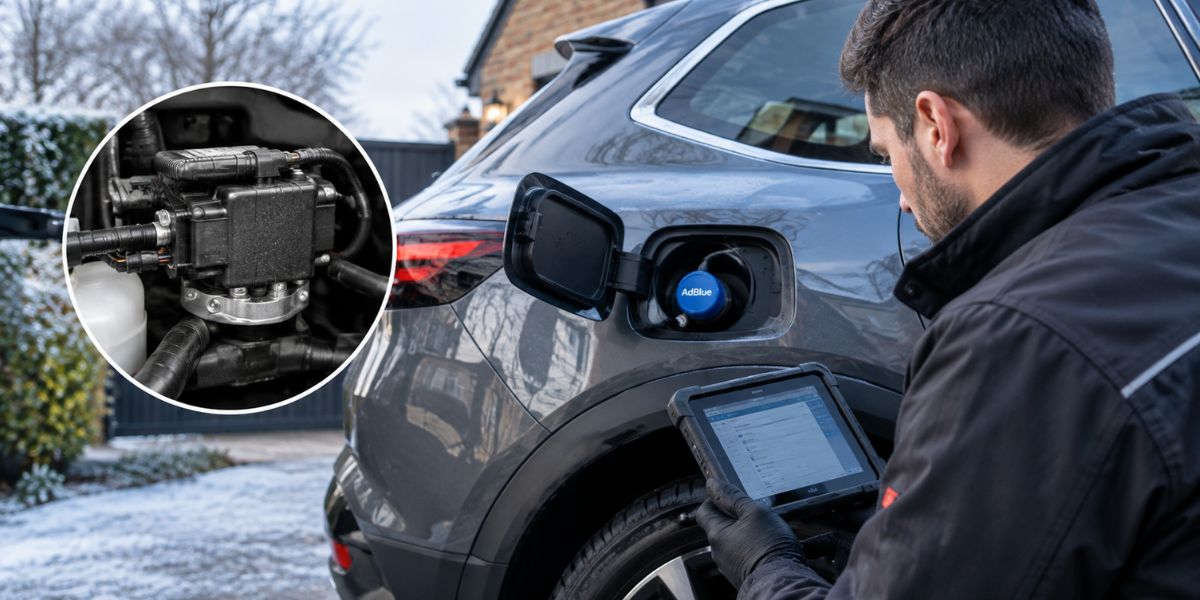
Inside the tank sits a module doing several jobs at once. It measures fluid level, checks quality, pumps AdBlue toward the injector, and heats it when temperatures drop. There’s also heating built into the lines running to the dosing injector itself. Together, that’s what stops AdBlue turning to slush overnight.
Most vehicles build in a short grace period on a cold start, because the system already expects the fluid might still be frozen and doesn’t throw a fault immediately. The heater is supposed to be doing its job during that window. If it isn’t, the system stays unable to dose for longer than it should, sometimes for the whole trip.
How do I know it’s the heater and not something else?
Honestly, the pattern usually gives it away before you’ve even booked anyone. A heater fault tends to look like this:
- The AdBlue or SCR light comes on specifically in cold weather, clears once things warm up, then comes straight back the next cold morning
- A dashboard message about a system fault or reduced performance shows up mostly through winter
- The car’s been running completely fine all spring and summer
- A restart countdown appears after a run of cold starts in a row
- The engine takes noticeably longer than normal to come out of reduced power on a cold morning
That last one especially gets misread as a general engine problem rather than an AdBlue heater issue, partly because the codes it throws can look similar on a basic scan tool to unrelated SCR faults. If you’re not sure what your warning light is actually telling you, our guide to the AdBlue warning light and our page on what to do when it won’t clear both cover the wider picture beyond just the heater specifically.
Why does this seem to get worse in winter, especially in London?
Because it genuinely is seasonal. Heater related faults get reported far more often between November and March than any other time of year, and London’s stop start traffic doesn’t help. A car doing mostly short trips through congested streets doesn’t get the sustained engine bay heat that a longer motorway run would give it, so the tank and lines spend more time sitting near freezing. Parking outside overnight on a cold street rather than in a garage adds to it too. None of that causes the heater to fail on its own, but it’s exactly the set of conditions that exposes a heater that’s already on its way out.
What’s actually causing my heater to fail?
A handful of specific things sit behind most of the heater faults we actually see.
A burnt out heater element. It’s a wear part, like any heating element, and it can fail from age, from repeated thermal cycling, or occasionally a manufacturing defect. Once it’s gone, there’s no intermittent fix. It’s either working or it isn’t.
Corroded or damaged wiring and connectors. The tank module sits somewhere fairly exposed and damp, and the wiring feeding the heater can corrode at the connector over time, especially on older cars or ones that have had any water ingress near the tank. A corroded connection often causes an intermittent fault for a few weeks before it fails completely, which is why some drivers notice the warning coming and going before it settles into something constant.
A faulty control module or relay. The heater doesn’t just switch itself on, it’s told to by the vehicle’s electronics based on what the temperature sensor’s reading. If that relay or control circuit fails, the heater can stop getting power even though the element itself is perfectly fine.
A stuck or failed temperature sensor. Sometimes the heater’s completely fine but the sensor that’s supposed to tell the system it’s cold enough to need heating has failed, so the heater never gets triggered when it should. From behind the wheel, this looks identical to the heater itself being dead.
If you’re seeing a warning symbol you don’t recognise alongside any of this, our page on what the AdBlue warning symbol actually means is worth a look, and if the light’s flashing rather than staying solid, that’s covered separately on our flashing AdBlue light guide, since a flashing light usually means something more urgent than a heater fault alone.
What fault codes actually show up with this?
A specific handful tend to point at the heater circuit rather than the pump, sensor or injector:
| Fault code | What it typically points to |
| P203C | AdBlue heater circuit malfunction |
| P203D | AdBlue heater circuit open |
| P203E | AdBlue heater circuit low voltage |
| P203F | AdBlue heater circuit high voltage |
| P2200 | NOx sensor circuit, sometimes triggered alongside a heater fault in cold conditions |
If a code’s come up that isn’t one of these five, our full fault code guide and our breakdown of what AdBlue system fault codes actually mean cover the wider picture. It’s also worth knowing this isn’t always a heater problem specifically. Sometimes what looks the same is actually a quality sensor issue, or gets confused with a NOx sensor fault, which is a completely different part of the system with its own set of causes.
Is it safe to keep driving with it like this?
In the short term, usually, yes, provided you’re still just looking at a warning light and not an active countdown. But it’s worth getting booked in rather than riding it out through winter hoping it sorts itself. Once the system decides it genuinely can’t dose AdBlue reliably, most modern diesels move into reduced power mode, and some will eventually refuse to restart once switched off. That’s a considerably bigger headache than the original warning light ever was. Our guide on what happens when the countdown to engine restart starts explains exactly what that stage looks like and how much time you’re realistically working with once it appears.
How do you actually diagnose this properly?
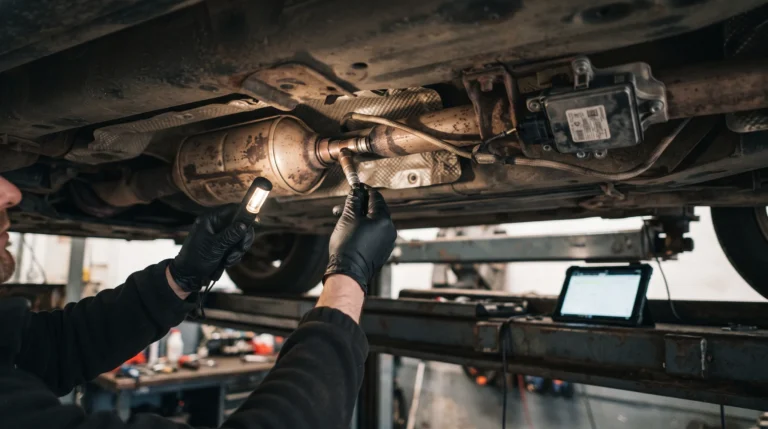
Confirming it’s genuinely the heater, rather than a pump, injector or sensor fault that just looks similar, is most of the work. We connect diagnostic equipment to read exactly which codes are stored, check live data from the temperature sensor against what conditions actually are, test the heater circuit’s resistance and voltage directly instead of guessing from the code alone, and inspect the tank module’s wiring and connectors for corrosion or damage. That combination is what separates a genuinely dead element from a wiring fault or a control module issue, and the fix is different depending on which one it turns out to be.
What does fixing it actually involve?
Depends entirely on what the diagnosis turns up. A failed heater element or damaged section of the tank module usually means a component replacement. A corroded connector or damaged wiring loom can often be repaired without replacing the whole module, which keeps the bill down considerably. A faulty relay or control module is more of an electrical fix, sorting the circuit that’s meant to be switching the heater on in the first place.
Our AdBlue Repair service covers exactly this, starting from £249. That’s a starting price, not a flat fee for every job, and we’ll confirm the actual cost once we know exactly what’s failed. For a rough sense of what repairs like this typically run to across the wider AdBlue system, our repair cost guide and our specific breakdown of pump replacement costs are both worth a read if you want context before booking anything in.
If the fault’s already thrown stored codes that need clearing once the physical repair’s done, that’s what our AdBlue Reset service handles. And if you’d rather just get the fault properly identified before committing to anything, our AdBlue Diagnosis service does exactly that on its own, no repair commitment attached.
What about an AdBlue bypass instead of repairing it?
Some owners ask about this, particularly on older cars where a full tank module replacement feels disproportionate to what the car’s actually worth. We offer advice and support for suitable vehicles where a bypass is being considered, with legal requirements and the vehicle’s intended use taken into account, through our AdBlue Bypass service. It’s worth knowing that’s a genuinely different route to repair, and our page comparing AdBlue delete against AdBlue repair lays out that decision more fully if you’re weighing it up. It isn’t the right call for every car, and we’ll tell you honestly if repair makes more sense for yours.
Does this affect certain makes more than others?
We see heater faults across pretty much every SCR equipped diesel, but a handful of brands come up more often, usually down to tank module design or how exposed the wiring loom is to moisture. We’ve written specific guides for common patterns on Volkswagen, including a dedicated look at VW warning lights after a refill, on Audi and our Audi AdBlue system fault breakdown, BMW, Mercedes and our piece on why the Mercedes AdBlue light keeps coming back on, Ford alongside our Ford Transit P20EE fault guide, Vauxhall, Peugeot and our separate Peugeot AdBlue fault page, and Citroën, if you want detail specific to what you’re actually driving.
If your AdBlue light has been an ongoing headache rather than a one off, it’s worth reading our wider AdBlue fault guide too, since it covers how the different fault types relate to each other beyond just the heater.
Where We Help
We cover AdBlue heater diagnosis and repair right across London, including Lambeth, Kingston upon Thames, Kensington and Chelsea, Islington, Hounslow, Richmond upon Thames, Hammersmith and Fulham, Greenwich, Enfield, Ealing, Camden, Merton, Wandsworth, Barnet, Southwark, Sutton, Tower Hamlets, Westminster, Newham, Lewisham, Waltham Forest, Redbridge, Bromley, Bexley, Brent, Harrow, Haringey, Hackney, Barking and Dagenham and Havering, alongside our main London AdBlue repair page.
Outside London, we also cover Leeds, Sheffield, Glasgow and Edinburgh, plus the wider South East England region covering Dartford, Sevenoaks, Epsom, Esher, Slough, St Albans and Loughton, the East Midlands and Lincolnshire area covering Peterborough, Bourne, Grantham, Spalding, Stamford and Market Deeping, the West Midlands covering Wolverhampton, Walsall, Dudley, Solihull and Coventry, Staffordshire covering Stoke-on-Trent, Stafford, Cannock and Lichfield, Warwickshire covering Nuneaton, Rugby, Warwick, Leamington Spa and Stratford-upon-Avon, and Shropshire covering Telford, Shrewsbury, Oswestry and Bridgnorth.
AdBlue Heater Warning Light FAQs
Get clear answers about AdBlue heater faults, cold-weather warning lights, heater diagnosis, repair costs, countdowns and AdBlue system faults.
A warning that appears mainly in cold weather can point towards an AdBlue heating problem. AdBlue can freeze at around -11°C, so the heating system helps keep the fluid usable in cold conditions. If the heater is not working correctly, the fault may become more noticeable when temperatures drop and appear to improve again when the weather becomes warmer.
Topping up AdBlue will not repair a failed heater. If the fluid level is already adequate, the problem may be the system’s ability to heat and deliver the fluid correctly in cold conditions. A top-up may appear to help temporarily, but the same warning can return if the underlying heater fault remains.
The cost depends on what has actually failed. A wiring or electrical repair can cost less than replacing a complete AdBlue tank module. Our AdBlue Repair service starts from £249, but this is a starting price rather than a fixed fee. The actual cost can be confirmed after the fault has been properly diagnosed.
It can, if the fault is left unresolved. Many vehicles provide warnings and may start a no-start or countdown message before restricting operation. Depending on the vehicle and the severity of the SCR fault, the system may eventually prevent the engine from restarting if it determines that AdBlue cannot be dosed correctly.
It can be, depending on the vehicle’s age, warranty terms and the cause of the failure. If your vehicle is still covered by a manufacturer or extended warranty, it is worth checking with the manufacturer or dealer before paying for repairs yourself.
Parking undercover may reduce how quickly the AdBlue system becomes cold, which can make a weak heater fault less noticeable. However, it will not repair a failed heating element or faulty circuit. A heater that is already failing can still produce warnings when temperatures drop sufficiently.
There is no fixed lifespan for an AdBlue heater. Its service life varies between vehicles and depends on the design of the system, operating conditions and age. Heater-related failures can become more common as the vehicle and its AdBlue components get older, particularly after repeated exposure to cold weather.
A basic code reader may identify that an AdBlue or SCR fault is stored, but identifying the exact cause can require more detailed diagnostic equipment. Proper diagnosis may involve checking live data, electrical connections, heater resistance and the relevant control circuit to determine whether the problem is the heater, wiring or another component.
An AdBlue heater fault does not normally cause direct mechanical damage to the engine. The main concern is the SCR emissions system. If the system cannot dose AdBlue correctly, the engine control system may restrict vehicle operation or trigger a countdown, creating a driveability issue rather than directly damaging the engine.
The vehicle continuously monitors the SCR and AdBlue system. When temperatures rise and the fluid is no longer at significant risk of freezing, the heating system may be needed less. This can cause the warning to disappear temporarily even though the underlying heater or electrical fault has not actually been repaired.
The exact setup varies by vehicle. Many SCR systems use heating elements within the AdBlue tank or tank module and may also heat sections of the lines leading towards the injector. These components can be controlled or wired in different ways, so a fault in one part of the heating system can produce symptoms similar to another.
Incorrect or poor-quality AdBlue is more commonly associated with fluid quality faults and crystallisation than a heater failure itself. Always use AdBlue that meets the required ISO 22241 specification. If you are also experiencing a quality-related warning, our guide to AdBlue quality faults explains the issue in more detail. You can also read our guide on whether AdBlue crystallisation can be repaired.
Diesel vehicles that use SCR and AdBlue require a way to manage the fluid in cold conditions, and many systems incorporate heating into the tank and/or AdBlue delivery system. The exact heating arrangement varies by manufacturer and vehicle, so the presence and location of individual heater components should be confirmed for the specific model.
Not necessarily. Some vehicles may clear a warning after successful repair and several completed drive cycles, while others require stored fault codes, adaptations or system values to be reset using suitable diagnostic equipment. If the warning remains after the physical repair, an AdBlue Reset service may be required.
Get the vehicle properly diagnosed rather than replacing parts based only on symptoms. A warning that appears in cold weather and disappears as temperatures rise can point towards a heating issue, but the same dashboard warning can have several causes. Checking the stored fault codes, live data and relevant electrical components can identify what is actually failing before a repair is carried out.
Talk to Us About It
If your AdBlue warning light is following a cold weather pattern, or you’re already seeing a countdown message, get in touch through our contact page with your vehicle’s make, model and postcode, and we’ll get you booked in.