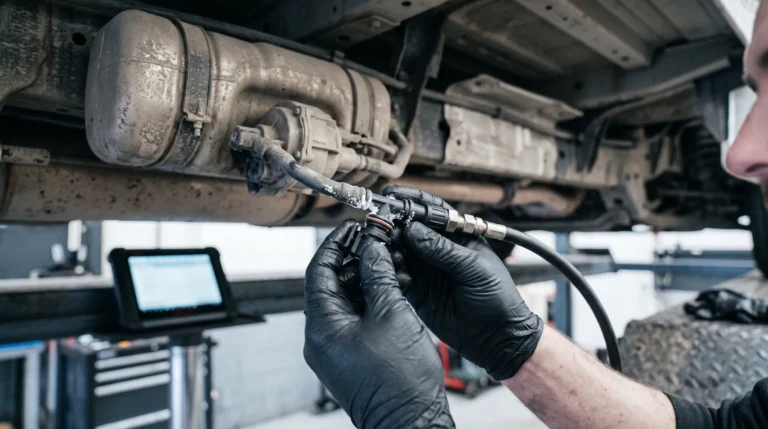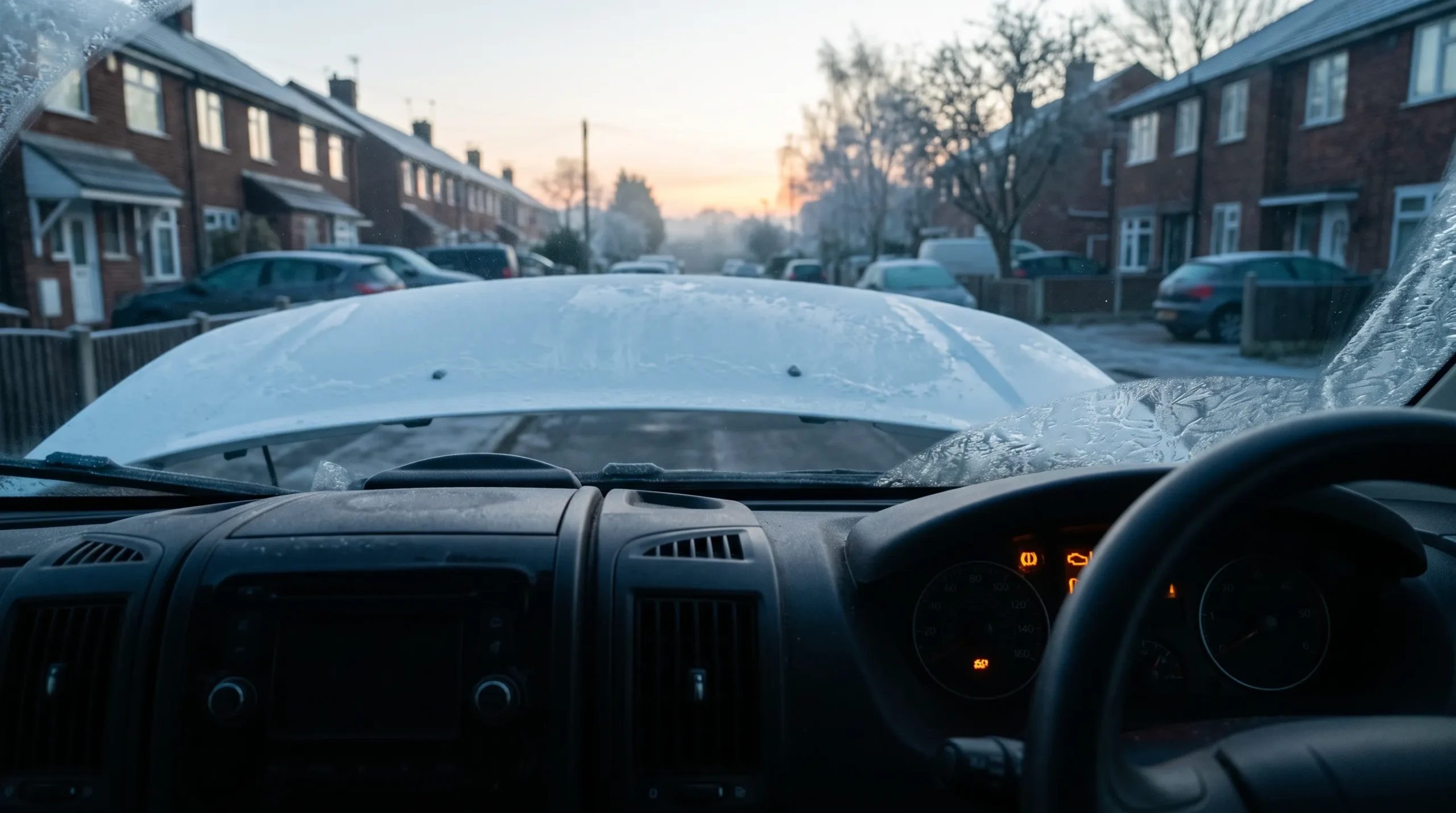

An AdBlue heater fault means the car has found a problem with the parts that stop AdBlue from freezing. AdBlue is mostly water, and it freezes at about minus 11 degrees Celsius. Frozen AdBlue can’t be pumped, so the car uses small heaters to keep it liquid. They sit in the tank, in the pump unit and, on some cars, in the pipe and the dosing unit. If the car’s computer (the ECU) finds that one of them isn’t working, it stores a fault code and switches on the AdBlue warning. If the fault stays, a countdown starts. When the countdown ends, the car won’t restart after you switch it off.
Most heater faults appear on cold mornings and go away once the car has warmed up. They return with the next frost. That pattern is your best clue, because a worn pump or a blocked injector doesn’t care what the weather is doing.
“Why does AdBlue need a heater at all?”
Because the car won’t try to spray frozen fluid. On a cold start it checks the temperature of the AdBlue first, and warms it up if it needs to.
How it gets warmed depends on the make. Some cars have an electric element inside the tank unit. Others run hot engine coolant through a small loop, with a valve that opens when heat is needed. A lot of cars use both. Many also have a heated pipe between the tank and the injector, because that pipe is thin, hangs under the car and freezes first.
A temperature sensor in the tank tells the computer when the fluid is warm enough to use.
You never see any of this happening. You only find out when one part stops working and the car tells you.
“What does an AdBlue heater fault look like on the dashboard?”
Usually an AdBlue or engine warning light on a cold start. Some cars also show a message like “AdBlue system fault” or “AdBlue heater malfunction”. The wording changes from one make to another, so don’t rely on the exact message.
The pattern is usually the same. The light comes on on a frosty morning. You drive for twenty minutes, the engine warms up and the light goes out. Two days later it’s cold again and the light is back. After the fault has been stored a few times, the dashboard stops treating it as a glitch and shows a countdown in miles.
Other things you might notice are a warning on short winter trips but not on long motorway runs, and a fault that clears on its own after a mild week. The tank level can look fine the whole time. If you’ve topped up and the light still comes back, the level was never the problem. Our guide on an AdBlue warning light that won’t clear covers that in more detail.
Signs to match against the weather
The weather is the quickest way to tell a heater problem from other AdBlue faults. This table shows how the common signs usually line up.
| What you notice | What it often points to |
|---|---|
| Warning on frosty mornings, gone by midday | The heater isn’t responding when the car asks for heat |
| Warning on short winter trips, not on long motorway runs | The heater is too slow to warm the fluid |
| Warning clears on mild days and returns with the next frost | A heater fault that only gets checked when it’s cold |
| Warning with a full tank | The level isn’t the problem, so check the heater, sensor and wiring |
| Warning every morning in every season | Probably not the heater, look at the pump, pressure or injector |
| Countdown to no restart appears | The fault has been stored many times and needs a diagnosis soon |
“Why does the warning only show up in cold weather?”
A broken heater does nothing wrong on a warm day, because nothing needs heating. The car mostly runs its heater checks when the fluid is at risk of freezing. In summer the heater is never asked to prove itself, so a dead element can sit in the tank for months without a single warning.
Then the first frost arrives. The car asks the heater to switch on, gets no answer and logs the fault. It feels like the car broke overnight. Usually the heater has been broken for a while.
“What makes an AdBlue heater fail?”
There’s no single cause, and the fix for one does nothing for another. A proper diagnosis pays for itself here.
The heating element is the obvious suspect. It sits in urea solution for years and goes through hundreds of heat cycles. Eventually the wire inside breaks or the element corrodes. On many cars the element is built into the tank or pump unit, so a dead element can mean a whole new unit.
Wiring is the next most common. The wires run under the car, where they get road spray, grit and winter salt. The insulation can rub through or crack. A damaged wire makes the circuit read as open or shorted, and the car logs a heater fault even though the element is fine.
Connectors come close behind. When AdBlue dries it leaves a white crust, and a tiny leak at a joint can push that crust into the plug. A green or white coating on a pin makes it harder for current to pass, so the heater never gets full power.
Then there are the smaller things people miss. A blown fuse or a tired relay can cut the power to the heater. A faulty temperature sensor can tell the car the fluid is colder than it is, which looks like a heater problem when the heater is working fine. On cars heated by coolant, a stuck valve stops hot coolant reaching the tank. And a weak battery can drop the voltage so low on a cold start that the car records a heater fault by mistake.
Heater faults often sit in the P20B range of codes, though the exact number and wording change between makes. The code tells us which circuit complained. It doesn’t tell us why, so a scan is only the start of the job. Our guide on AdBlue system fault codes explained lists the common ones.
Causes at a glance
Heater fault signs by weather and driving
| What you notice | What it often points to |
|---|---|
| Warning on frosty mornings, gone by midday | The heater isn’t responding when the car asks for heat |
| Warning on short winter trips, not on long motorway runs | The heater is too slow to warm the fluid |
| Warning clears on mild days and returns with the next frost | A heater fault that only gets checked when it’s cold |
| Warning with a full tank | The level isn’t the problem, so check the heater, sensor and wiring |
| Warning every morning in every season | Probably not the heater, look at the pump, pressure or injector |
| Countdown to no restart appears | The fault has been stored many times and needs a diagnosis soon |
AdBlue heater fault causes at a glance
| Possible cause | What it often looks like | How we check it | Usual fix |
|---|---|---|---|
| Failed heating element | Heater code, element reads open or out of range | Measure resistance across the element | Replace the tank or pump unit on most cars |
| Damaged wiring | Fault comes and goes, circuit reads open or shorted | Test the wiring along its length | Repair or replace the damaged section |
| Corroded connector | White or green crust on the plug, weak current under load | Check voltage and earth at the plug under load | Clean the plug or fit a new pin |
| Blown fuse or tired relay | Heater circuit dead with no sign of damage | Check the power supply to the circuit | Replace the fuse or relay |
| Faulty tank temperature sensor | Tank reading doesn't match the weather or the engine bay | Compare live data with the outside temperature | Replace the sensor or unit |
| Stuck coolant valve | No heat reaching the tank on coolant heated cars | Check the valve opens and coolant flows | Replace the valve |
| Weak battery | Heater code on cold starts, other odd electrical faults | Load test the battery and watch voltage during a start | Replace the battery, then clear the code |
Heater fault or pump fault? How to tell them apart
| Fault | When it shows up | Typical clues | Where to read more |
|---|---|---|---|
| Heater fault | Frost and cold starts, clears when warm | Heater circuit code, the fault follows the thermometer | This article |
| Pump fault | Any temperature | Pressure faults, struggles to build pressure warm or cold | Pump repair or replace and pressure builds then drops |
| Pressure sensor fault | Any temperature | Readings that make no sense to the car | AdBlue pressure sensor fault |
| NOx sensor fault | Doesn't follow the frost | Emissions warnings | NOx sensor page |
| Distance related fault | After a set distance of driving | Appears once the system has warmed up | Fault after 10 to 20 miles |
A heater fault is the one that follows the thermometer. If your warning appears on frosty mornings and clears when the weather warms up, the heater should be near the top of the list.
“Will resetting the warning make it go away?”
For a short time, maybe. A reset wipes the stored code and the light goes out. If the heater is still faulty, the car runs its check again on the next cold start, fails it again and the light comes back. Resetting the same fault every few days gets you nowhere.
A reset is useful at the end of a repair, once the part is fixed and the car needs to forget the old fault. It’s not much use at the start. If you’ve reset it and it keeps coming back, get it diagnosed first. Our AdBlue reset service is the last step of a repair, not a replacement for one.
“How do we test an AdBlue heater?”
We start with a scan. The stored codes and the freeze frame data tell us which circuit failed and what the temperature was when it did.
Next we look at live data. We compare the tank temperature reading with the outside temperature and with what the engine bay is doing. A tank sensor reading minus 20 on a mild day, or stuck at frozen while the engine is hot, points at the sensor before the heater.
Then we test the circuit. We measure the resistance across the heater element and compare it with the figure for that car. That shows whether the element is fine, open or shorted. We check voltage and earth at the heater plug while it’s under load, because a circuit that looks fine with nothing running can drop out the moment current is drawn. We look along the wiring, with extra attention to the parts that hang low or run near the exhaust. On coolant heated cars we check that the valve opens and hot coolant reaches the tank.
Only after all of that do we say which part has failed. It sounds slow written down. It also stops people paying for a new tank unit when the real problem was a corroded plug that cost almost nothing to fix.
“Can the heater be repaired, or does the whole unit go?”
Sometimes it can be repaired and sometimes it can’t. It depends on what failed and how the maker built the part.
Wiring and connector faults can be repaired. A damaged section of wire can be mended or replaced, a corroded plug can be cleaned or renewed, and a blown fuse or relay is a small job. Those repairs make up a good share of the heater faults we see.
An element built into a sealed tank or pump unit is different. On many cars the maker doesn’t sell the element on its own, so the choice is to replace the whole unit. Before any work starts, we tell you whether it’s a wiring job or a unit job, and what the unit replacement involves. Our AdBlue repair page lists what we cover, with prices starting from £249.
If you’re weighing up a bigger job, our cost article on AdBlue pump replacement gives a rough idea of what these units cost in the UK.
“How long can you drive with the heater warning on?”
You can keep driving while the countdown runs, but the clock is ticking. A heater fault that isn’t repaired will eventually start a countdown in miles. When it reaches zero, the car won’t restart after you switch it off.
It usually won’t stop while you’re driving. That makes the risk easy to underestimate. A car that was fine at the motorway services can refuse to start in the car park.
If you see a countdown, treat it as a deadline. Book the diagnosis while the number is still high.
An unrepaired heater fault can also stop the AdBlue system working in cold weather. That means the car isn’t cleaning its exhaust gases properly on those trips, which is why the warning exists in the first place.
What you can do at home, and what to avoid
Check the tank is topped up with AdBlue that meets the ISO 22241 standard. Low fluid and heater faults can show up together, so this removes one possible cause. If you have a garage, parking inside on frosty nights helps, because the heater has to run less often.
Don’t pour hot water into the tank or over it. It dilutes the fluid and can damage the unit. Don’t add anything labelled as an AdBlue cleaner or additive either. The wrong chemical can contaminate the system, and fixing contamination costs far more than fixing a heater. Our guide on the AdBlue quality fault shows what that looks like.
Don’t keep clearing the code with a cheap reader. It wipes the pattern the technician needs to see.
A van that complained every frosty morning
Take a 2019 diesel van used for early starts. In October the AdBlue light comes on at the first cold start, then goes out by the time the driver reaches the first job. The driver tops up the tank, clears the light and carries on. A week later it’s back and it stays on longer. This time a message says the engine won’t restart in 800 miles.
The scan shows a stored heater circuit code. The tank temperature reads correctly, so the sensor is fine. The resistance across the element is within the specification, so the element is fine too. The voltage test at the plug shows almost nothing getting through under load. The cause is a corroded connector pin with a white crust around it, a few centimetres from where the wiring drops below the tank.
The connector gets cleaned and the pin is replaced. The fault code is cleared and the system runs a dosing test. The next frosty morning the van starts with no warning. It’s a cheap repair that would have turned into an expensive unit replacement if someone had guessed.
This is an example of how a diagnosis works, not a record of one customer’s job.
Get an AdBlue heater fault checked at your door
AdBlue Fault is a mobile service. We come to your home or workplace and test the car where it’s parked. We cover London and areas across the UK, and the phone line is open around the clock on 0330 043 4431. If you’re not sure the heater is the problem, start with an AdBlue diagnosis, which finds the cause before any parts are ordered.
For more on warnings and what they mean, our AdBlue warning light guide and the complete AdBlue fault guide are good places to read next. You can also contact us with your vehicle details and we’ll tell you what to do next
Quick answers
01What is an AdBlue heater fault?
A fault in the heating that stops AdBlue freezing. It can be in the tank, the pump unit, the pipe or the dosing unit.
02Why does the warning come and go?
The car mostly checks the heater when it's cold, so the fault shows up in frost and clears when the car warms up.
03What causes it?
A failed element, damaged wiring, a corroded connector, a blown fuse or relay, a faulty tank temperature sensor, a stuck coolant valve or a weak battery.
04Will resetting the warning fix it?
Only for a short time. The fault returns on the next cold start if the heater is still faulty.
05Can I drive with the warning on?
Yes, until the countdown ends. After that the car won't restart once the engine is switched off.
06Can it be repaired?
Wiring, plugs, fuses and relays can be repaired. A heater built into a sealed unit may need the whole unit replaced.
07How much does it cost?
AdBlue repair starts from £249. The final cost depends on which part has failed, which we confirm after the diagnosis.