
Depends entirely on what’s actually gone wrong with it, which isn’t the answer most people want when they’re staring at a warning light and trying to work out roughly what this is going to cost. Some injector faults are a fairly quick fix. Others genuinely aren’t, and no amount of cleaning changes that.
We get asked this constantly at AdBlue Fault, usually by someone who’s read online that injectors are expensive and is hoping we’ll tell them it’s something smaller. Sometimes it genuinely is. Sometimes the injector really has had it. The only honest way to know is to actually look, not guess from how old the car is or what a forum thread said happened to someone else.
“What does the AdBlue injector actually do?”
It’s the last part in the chain. Fluid gets pumped from the tank, builds up to the right pressure, and the injector’s job is to spray a precise, tiny amount of it into the exhaust at exactly the right moment, so the SCR system can treat NOx emissions properly. Get that spray even slightly wrong, too little, too much, badly atomised, and the whole emissions process downstream stops working the way it’s supposed to.
It’s a small, precise component doing a repetitive job with a fluid that isn’t exactly forgiving. AdBlue crystallises if it dries out anywhere, and an injector’s internal tolerances are tight enough that even a small amount of residue can throw things off in a way a bigger, less sensitive part would shrug off completely.
“Which injector problems can genuinely be repaired?”
More than people expect, to be fair, though less than with some other AdBlue parts.
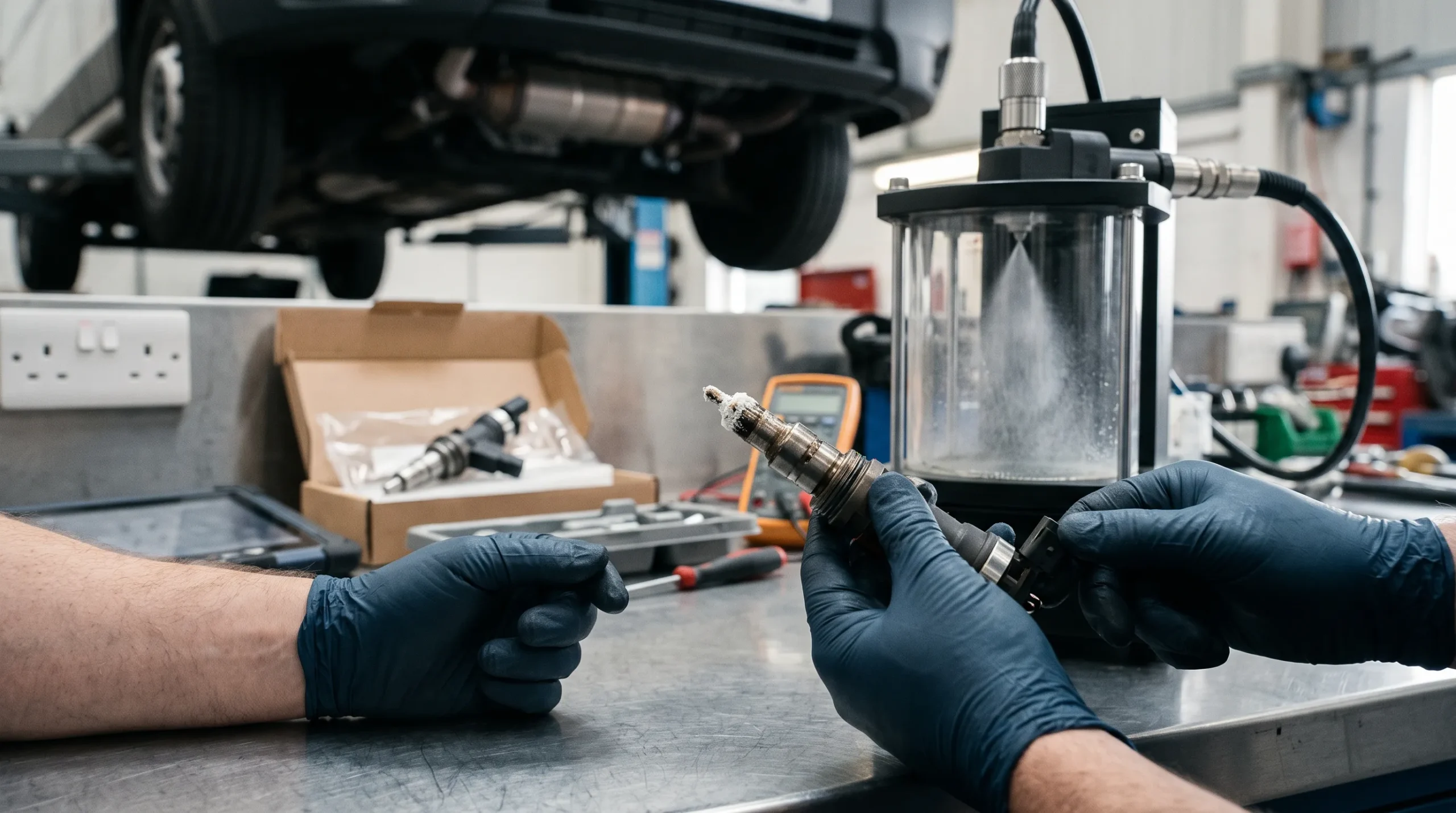
A clogged nozzle from crystallised urea is the one we see most. AdBlue sitting still near the injector tip for too long leaves hard deposits behind that restrict or distort the spray pattern. Properly cleaning that out, done carefully and with the right approach, often restores completely normal spraying without replacing anything.
Wiring and connector issues sit right alongside that as a repairable cause, and honestly we probably catch this one as often as the injector itself being at fault. The injector’s connector sits somewhere exposed to damp and road grime, and a corroded pin produces symptoms, and sometimes even the exact same fault code, as a genuinely failed injector. We had a Citroën Berlingo in a few months back already flagged by another garage for a new injector. Took us under an hour to trace it to the connector instead. Cleaned it, reset the fault, van was out the same day for a fraction of what a new injector would’ve run.
A stuck valve inside certain injector designs can sometimes be freed rather than replaced too, depending on how that specific unit’s built and how long it’s been stuck for. Caught early, before anything’s seized completely, that’s often a straightforward fix.
“And which faults mean it actually has to be replaced?”
Some, unfortunately, don’t leave much choice, and pretending otherwise just wastes everyone’s time and money.
Internal wear to the injector’s precision components is the big one. These parts are machined to extremely fine tolerances, and once that wear’s happened, no amount of cleaning brings the spray pattern back to where it needs to be. It’s not dirt sitting in the way anymore. It’s the part itself no longer shaped the way it needs to be.
A cracked or damaged injector body is similarly final. Thermal cycling, age, or sometimes a bit of over-tightening during a previous repair can crack the housing, and once that’s happened there’s no reliable way to seal it back up.
The electrical coil burning out inside the injector is another one that needs a straight swap. That coil’s what actually triggers the spray, and once it’s gone, cleaning the outside of the unit does nothing for a problem that’s sitting in the wiring built into the part itself.
A valve that’s seized completely rather than just sticking is the same story. Early on, a sticking valve can sometimes be freed. Left too long, it seizes solid, and at that point there’s nothing left to work loose.
“How do you actually work out which one it is?”
Not by assuming, and not by defaulting to whichever answer happens to be quicker to quote over the phone.
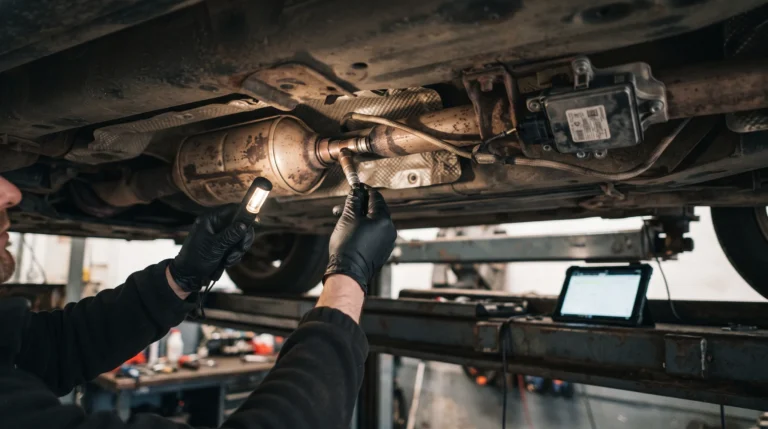
We start with a full fault code scan, since the exact pattern often narrows things down a lot before anything’s physically been touched. From there we check wiring and the connector directly, given how often that turns out to be the real cause rather than the injector itself, exactly like the Berlingo above.
If wiring checks out clean, we test the injector’s actual spray pattern and flow rate against what it should be delivering, rather than assuming a stored code automatically means the injector’s finished. A restricted or uneven spray with no electrical fault behind it usually points to crystallisation, which is worth attempting to clean before reaching for a replacement part.
Only once cleaning’s been tried properly and the spray still isn’t right, or there’s clear mechanical or electrical damage inside the unit, do we call it a genuine replacement. At that stage we’ll say so plainly rather than trying to make a repair stick that isn’t going to hold.
What symptoms actually point toward the injector?
The AdBlue warning light tends to be first, usually with a dashboard message referencing the AdBlue or emissions system specifically rather than anything more precise. A slight smell near the exhaust, different from normal diesel exhaust smell, sometimes shows up too, though it’s not something every driver notices or can place easily.
Left long enough, performance drops the way it does with most AdBlue faults, since the ECU limits how the engine runs once dosing accuracy can’t be guaranteed. A restart countdown tends to follow that, same pattern as nearly every other AdBlue fault once nothing’s been addressed.
Two Injectors, Same Warning Light, Different Verdicts
A Volkswagen Crafter came in a while back with a stored injector fault and a spray test that looked genuinely poor. Owner was already expecting the bad news. Turned out the nozzle was heavily crystallised rather than mechanically damaged. A proper clean brought the spray pattern straight back to where it should be, and the injector itself never needed replacing at all.
A Mercedes Sprinter we saw not long after told a different story entirely. Similar fault stored, similar initial complaint. This time the flow test showed the valve inside had actually seized, not just stuck, and cleaning made no difference whatsoever. That one needed a new injector, and there wasn’t a cheaper route around it once the valve itself had gone that far.
Neither outcome was obvious from the dashboard alone. Both looked identical until someone actually tested them properly.
What Does This Actually Cost?
Varies a lot depending on which of the above it turns out to be, and we always confirm the real cause before quoting a firm number rather than pricing blind. A clean and reset sits well below the cost of a full injector, often by a considerable margin.
Our page on system repair cost in the UK and what to expect sets out the broader picture across different AdBlue repairs, and our guide on AdBlue pump replacement cost is worth a read too, since pump and injector costs often get compared by people trying to budget for either.
Could This Actually Be a Stuck Valve Rather Than a Dirty Nozzle?
Worth telling apart properly, since the fix differs. Our guide on an AdBlue injector stuck closed covers that specific failure, and our page on an injector not opening the dosing valve looks at a closely related symptom if dosing isn’t happening at all rather than happening poorly.
Is Crystallisation Always to Blame When an Injector’s Restricted?
Not always, though it’s common enough to check first. AdBlue can crystallise anywhere fluid’s allowed to sit still, not only right at the injector tip. Our guide on whether AdBlue crystallisation can be repaired covers that wider issue beyond just how it affects the injector specifically.
Does a Pump Fault Ever Get Mistaken for an Injector Fault?
Yes, fairly often actually. If the pump can’t deliver proper pressure, the injector ends up spraying poorly even though it’s completely healthy itself. Our guide on whether an AdBlue pump can be repaired or needs replacing covers that overlap from the other direction, worth a read if pressure readings look off alongside the injector symptoms.
Will the Warning Clear Once the Injector’s Sorted?
Usually not without a proper reset afterward, even once the real fault’s genuinely fixed. Our guide on an AdBlue warning light that won’t clear explains why that light can linger, and our AdBlue fault guide and AdBlue system fault codes explained pages give wider context if your scan tool’s thrown something not covered here directly.
Our Services for This Kind of Fault
Sorting an injector fault properly usually draws on more than one of our services, depending what’s actually found once we’re in there. AdBlue diagnosis is always the starting point, confirming the real cause before anything gets replaced unnecessarily. AdBlue repair covers the cleaning, wiring, or injector work itself, and AdBlue reset clears the fault properly once everything’s actually sorted.
If an injector fault connects to a wider sensor issue, our NOx sensor service covers that side separately. For commercial vehicles, HGV remapping covers related emissions work on larger diesel fleets.
Does Your Vehicle Make a Difference Here?
A little. The underlying mechanics stay consistent across any SCR equipped diesel, but injector design and how easily it’s accessed varies by manufacturer. We see injector faults regularly on Volkswagen, Audi, BMW, Mercedes, Ford, Vauxhall, Peugeot, Citroën, Jaguar and Land Rover models. Our vehicles page has more detail on your specific model if that’s useful.
Where We Cover This Across London
North London
Barnet and Enfield see a fair amount of injector work, often tied to stop start driving that feeds the crystallisation sitting behind a lot of these faults. We’re also regularly out in Haringey, Camden, Islington, Waltham Forest and Harrow.
East London
Hackney, Tower Hamlets, Newham and Redbridge make up a big share of our east London work, alongside Barking and Dagenham, Havering and Greenwich.
South London
South of the river we cover Lambeth, Southwark and Lewisham, plus Bromley, Bexley and Sutton. Merton, Wandsworth, Kingston upon Thames and Richmond upon Thames are covered too.
West London
West London rounds things out, including Ealing, Hammersmith and Fulham and Hounslow, plus Hillingdon, Brent, Kensington and Chelsea and Westminster.
Not sure which page covers your postcode? Our AdBlue repair London page and the full locations directory list everywhere we currently work.
AdBlue Injector FAQs
Clear answers about AdBlue injector faults, cleaning, replacement, diagnosis, wiring problems and repair.
No, not reliably. Both show up the same way on the dashboard. It takes an actual flow and spray test, plus a wiring check, to know which one applies.
When cleaning’s actually possible, yes, usually by a fair margin. But if the valve’s seized or the coil’s burnt out, cleaning changes nothing and just delays the inevitable.
Not always. Confirming whether it’s crystallisation, wiring, or genuine internal damage needs proper flow testing equipment, which is part of why a lot of these cars end up with a specialist eventually.
No. Wiring and connector faults can produce an identical code to a genuinely failed injector, which is exactly why we check wiring before ever pricing a replacement.
No fixed figure. It depends on driving pattern, how often crystallisation’s been allowed to build up, and general maintenance. Some last the life of the vehicle, others struggle sooner.
Not something we’d recommend. These parts have tight internal tolerances, and the wrong cleaning approach can damage them further rather than fixing anything.
It can be, depending on your vehicle’s age and the manufacturer’s emissions component warranty. Every repair we carry out also comes with its own workmanship warranty regardless.
A clean and reset, or a wiring repair, is usually same day. A full replacement can take a little longer depending on parts availability for your specific vehicle.
Yes, the same mechanics apply to any SCR equipped diesel. Our HGV remapping page covers related work on larger diesel fleets.
Not dangerous to you directly, no, but leaving it raises the risk of reduced performance or eventually a restart countdown once the system can’t guarantee accurate dosing anymore.
Book Your AdBlue Injector Diagnosis
Not sure whether your injector needs cleaning, repairing, or replacing? Get in touch through our contact page and we’ll find out properly before anything gets swapped that doesn’t need to be. Confirming the real cause first is almost always the cheaper route.