
Depends what got in there, and how long it sat before anyone noticed. That’s genuinely the whole answer, annoying as it sounds. A tank that picked up a splash of diesel and got caught within a day or two is a completely different job to one that’s been running contaminated fluid through the pump and injector for weeks.
We see this more than people expect at AdBlue Fault, usually from someone who topped up with whatever bottle was nearest, or filled at a pump that wasn’t properly separated from diesel. Nobody does it on purpose. It just happens, and once it has, the question stops being “how do I clean the tank” and becomes “what’s actually still working underneath.”
“What actually counts as AdBlue contamination?”
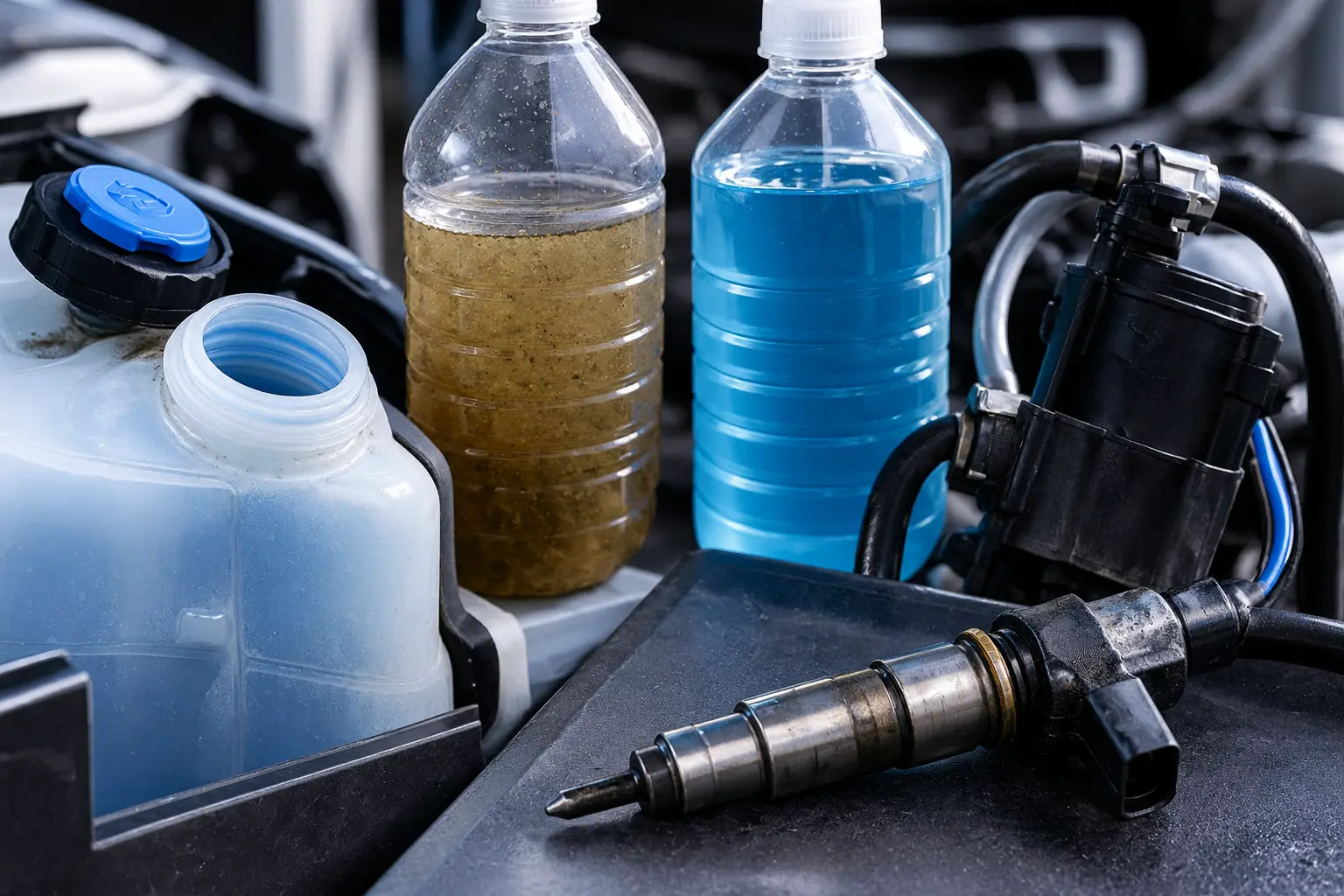
Mostly it’s one of three things. Diesel getting into the AdBlue tank, usually from a mixed up filler cap or a fuel nozzle that went in the wrong hole. Water getting in, sometimes from a badly sealed cap left out in the rain, sometimes from AdBlue that was already diluted before it went in the bottle. And wrong fluid entirely, someone grabbing screenwash or a generic additive that was never AdBlue in the first place.
All three do roughly the same thing once they’re in the system. They change the chemistry of what the pump’s moving and what the injector’s spraying, and none of the components downstream were built to cope with that.
“Why does a bit of contamination cause so much damage?”
Because AdBlue systems are tuned pretty tightly around one specific fluid. The pump, the lines, the injector, even the sensors, are all calibrated around AdBlue’s exact properties, not whatever got mixed in with it.
Diesel in the system tends to coat internal surfaces with a film that AdBlue doesn’t normally leave behind, and that film can gum up the fine tolerances inside the injector almost immediately. Water dilutes the urea concentration below what the system expects, which throws off dosing accuracy and can trigger a quality fault even while everything mechanically still works. The wrong fluid entirely is the least predictable of the three, since nobody really knows what reaction it’ll have with the seals and metals inside until it’s already happened.
“What’s usually fine, and what’s usually written off?”
Good news first, if there is any. The tank itself is almost always salvageable. Draining it, flushing it properly, and refilling with genuine AdBlue sorts the tank out completely in the vast majority of cases we see.
Lines are mostly salvageable too, provided contamination hasn’t sat in them for an extended stretch. A proper flush through the delivery lines clears most residue out before it’s had time to actually damage anything.
The pump is where it gets less predictable. A pump that ran briefly on contaminated fluid before anyone caught it often comes through fine once everything’s flushed. One that’s been running contaminated fluid for days or weeks, especially with diesel involved, is a different story. Internal wear from the wrong fluid doesn’t reverse once it’s happened, and a pump in that state usually needs replacing rather than cleaning.
The injector tends to be the most fragile part in all this. Its tolerances are tiny, and even a small amount of residue or the wrong chemistry passing through it can leave it clogged or damaged in a way that cleaning alone won’t fix. We’ve opened up injectors after contamination jobs and found deposits that weren’t going anywhere without a replacement part.
Sensors can go either way. A quality sensor that’s picked up a contaminated reading often clears once the system’s properly flushed and refilled, since it was reading what was actually there rather than failing itself. But a sensor that’s had direct exposure to something like diesel for a long period can degrade and need replacing on its own merits.
“How do you actually work out what’s saveable on a specific vehicle?”
We don’t assume anything going in, which matters more here than on almost any other AdBlue job we do. First step is confirming exactly what got into the system and roughly how long ago, since that single detail changes everything about what we expect to find.
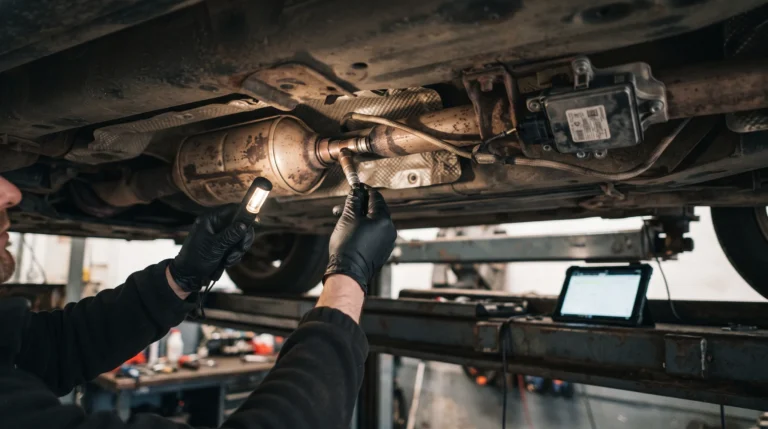
From there we drain and inspect the tank, checking for residue, discolouration, or anything that doesn’t look like normal AdBlue. We test the pump’s actual performance rather than assuming it’s fine just because it’s still running, since a pump can turn over and still be delivering nowhere near the pressure it should. The injector gets checked for flow and spray pattern, which is usually where contamination damage shows up most clearly if it’s happened.
Once we know what’s actually compromised, we flush everything that can be flushed, replace whatever genuinely needs replacing, and refill with proper AdBlue before testing the whole system end to end. Clearing the fault code too early, before everything’s actually confirmed clean, just brings the warning straight back once the ECU notices something’s still off.
What symptoms actually show up first?
The AdBlue warning light, almost always, sometimes alongside a dashboard message that’s vague about what’s actually wrong. A quality fault code is common early on, something like P2048 or a related code depending on the manufacturer, since that’s often the first thing the ECU notices once the fluid composition’s off.
Some drivers notice a smell they can’t quite place near the tank area, particularly with diesel contamination. Others don’t notice anything at all until the warning light’s already on and the countdown’s started. Left alone, performance drops the same way it does with most AdBlue faults, and a restart countdown tends to follow soon after.
A tank topped up in a hurry, and what it cost him
A courier driver came to us a few months back after grabbing what he thought was AdBlue from a garage forecourt during a long shift. Turned out to be a generic additive, not AdBlue at all, and he’d put nearly two litres through before the warning light even came on.
We drained the tank and found the pump was still working, just about, but delivering well under the pressure it should’ve been. The injector wasn’t so lucky. Flow testing showed it badly restricted, and no amount of flushing was going to bring that back. New injector, full flush through the tank and lines, fresh AdBlue, and the van was back out within the day. Could’ve been worse. Could’ve been a lot cheaper too, if he’d checked the label before filling.
A second one stuck with us for different reasons. A driver who’d had rainwater get into the tank through a cap that hadn’t sealed properly for weeks without him noticing. By the time the warning came on, the fluid was diluted enough to throw a quality fault, but nothing mechanical had actually failed. Drain, flush, refill, done. Sometimes contamination’s genuinely just a fluid problem, and sometimes it’s taken out a part along the way. You don’t know which until it’s actually open.
“Is this different from an AdBlue system that’s just crystallised?”
Related but not the same thing. Crystallisation happens when AdBlue’s left sitting still and the water in it evaporates, leaving hard deposits behind. Contamination is a different substance entirely getting into the mix. Our guide on whether AdBlue crystallisation can be repaired covers that separate issue if crystals rather than contamination are what you’re actually dealing with.
Could this be confused with a quality sensor fault instead?
Easily, since contamination often shows up as a quality fault first regardless of what’s actually in the tank. The difference is what’s behind the fault code. Our guide on NOx sensor versus AdBlue quality sensor explains that distinction, and our page on AdBlue quality faults is worth reading if your fault points that way without a clear contamination event behind it.
Does this ever affect the injector in ways that look like something else entirely?
Yes, and it trips people up a fair bit. A contaminated injector can present almost identically to an injector that’s stuck closed or one that simply isn’t opening the dosing valve, since both end up with restricted or absent dosing regardless of the root cause. Worth ruling contamination in or out early, since it changes what else around the injector needs checking.
Will the warning clear on its own once everything’s cleaned out?
Not reliably, no. Our guide on an AdBlue warning light that won’t clear explains why the light often needs a proper reset even once the real problem’s been fixed. Our wider AdBlue system fault codes explained guide and general AdBlue fault guide both help if your scan tool’s showing something not covered specifically here.
What does a job like this actually cost?
Depends heavily on what’s salvageable once we’re actually in there, same as with most AdBlue repairs. A straightforward drain and flush with nothing mechanically damaged sits well below a job involving a new pump or injector on top of that.
Our page on system repair cost in the UK and what to expect sets out the broader cost picture across different AdBlue faults, and our guide on AdBlue pump replacement cost is worth a look if pump damage turns out to be part of what’s found.
What we actually do about it
Contamination jobs usually pull in more than one of our services depending what’s found once we’re in there. AdBlue diagnosis confirms the extent of it before anything gets replaced unnecessarily. AdBlue repair covers the flush, the pump, or the injector work itself, and AdBlue reset clears the fault properly once everything’s genuinely sorted rather than just topped up and hoped for.
If contamination’s connected to a wider sensor issue, our NOx sensor service picks that up separately. For commercial vehicles, HGV remapping covers related emissions work on larger diesel fleets.
Does the vehicle you drive change any of this?
A little, mostly down to tank design and how easy the system is to access and flush properly. We see contamination jobs across Volkswagen, Audi, BMW, Mercedes, Ford, Vauxhall, Peugeot, Citroën, Jaguar and Land Rover models, often on vans and HGVs more than cars simply because they’re filled more often, by more hands, during a working day. Our vehicles page has more detail on your specific model if you want to check first.
Where we cover this across London
North London
Barnet and Enfield see a reasonable share of contamination jobs, often tied to commercial vehicles filling up on the go. We’re also regularly out in Haringey, Camden, Islington, Waltham Forest and Harrow.
East London
Hackney, Tower Hamlets, Newham and Redbridge make up a large part of our east London coverage. Further out we cover Barking and Dagenham, Havering and Greenwich too.
South London
South of the river we’re regularly in Lambeth, Southwark and Lewisham, along with Bromley, Bexley and Sutton. Merton, Wandsworth, Kingston upon Thames and Richmond upon Thames are covered too.
West London
West London includes Ealing, Hammersmith and Fulham and Hounslow, plus Hillingdon, Brent, Kensington and Chelsea and Westminster.
Not sure which page covers your postcode? Our AdBlue repair London page and the full locations directory list everywhere we currently reach.
Had a Contamination Scare? Get It Checked Properly
Topped up with the wrong fluid, or suspect water’s got into the tank somewhere along the way? Get in touch through our contact page and we’ll find out exactly what’s been affected before anything unnecessary gets replaced. The sooner it’s looked at, the more there usually is left to save.
AdBlue Contamination FAQs
Clear answers about diesel contamination, AdBlue tank flushing, pump and injector damage, and what to do after the wrong fluid has been added.
Almost always, yes. The tank itself is rarely the part that ends up written off. It’s what the contaminated fluid reached beyond the tank that decides the rest of the job.
A strong fuel smell near the filler, a sudden quality fault with no obvious cause, or simply knowing you filled at the wrong nozzle are the usual giveaways. Worth getting it checked quickly rather than waiting to see if the light goes off on its own.
Only if nothing downstream was actually damaged. A flush sorts the tank and lines in most cases, but a pump or injector that’s already been compromised needs its own separate fix.
No, and it can make things worse by pushing contaminated fluid further through the system before anyone’s had a chance to check it properly.
As soon as you notice it, ideally. The longer contaminated fluid sits in the pump or injector, the more likely it is that something beyond the tank ends up needing replacement.
Rarely, since contamination usually traces back to what was put into the tank rather than a manufacturing fault. Worth checking your specific policy regardless.
You can drain the tank, but confirming whether the pump and injector are still performing properly after contamination needs proper testing equipment, not just a visual check.