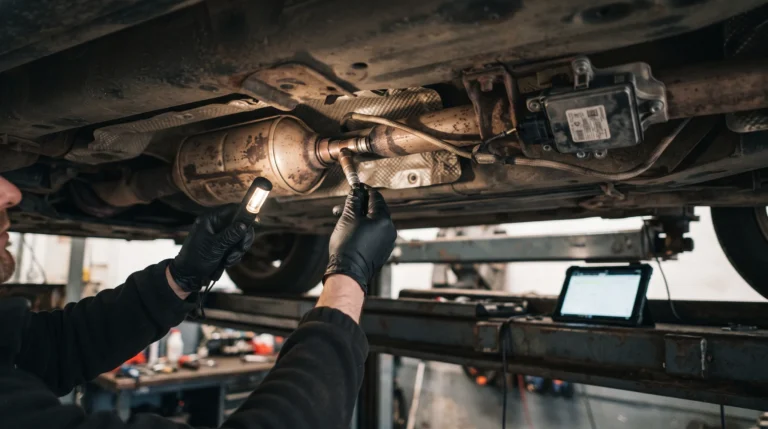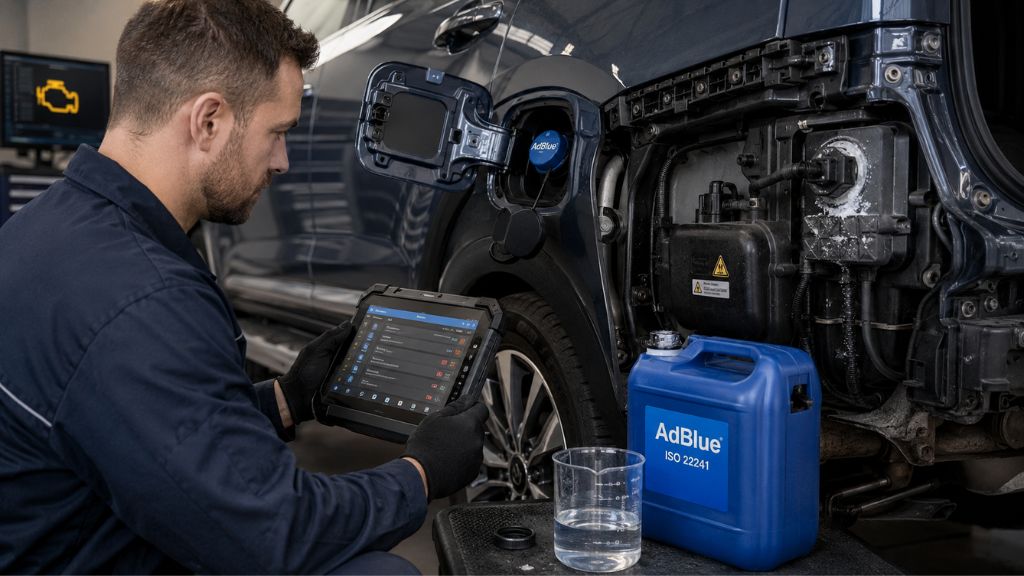

An AdBlue quality fault means the vehicle’s ECU has detected that the fluid in the AdBlue tank is not the correct concentration either too dilute, too concentrated, contaminated, or degraded. It does not necessarily mean the fluid actually is wrong. It means the quality sensor has reported a reading outside the acceptable range, which could be genuine contamination, a failed quality sensor misreading correct fluid, or crystallised deposits from a previous fault affecting the sensor’s accuracy. Understanding which of these three applies determines whether the fix is a tank drain and refill, a sensor replacement, or a cleaning procedure and getting that diagnosis right before spending money on the wrong intervention is what this guide is about.
What AdBlue Is and Why Concentration Matters
AdBlue is a precisely formulated solution of 32.5% urea and 67.5% deionised water. The concentration is not arbitrary; it is the specific ratio at which the urea decomposes into ammonia efficiently inside the SCR (Selective Catalytic Reduction) catalyst, enabling the chemical reaction that converts nitrogen oxides (NOx) into harmless nitrogen and water vapour.
If the concentration is too low the solution is too dilute, the SCR system does not have enough urea to produce sufficient ammonia, and NOx reduction falls below the required level. If the concentration is too high there is too much urea the excess deposits crystallised urea in the catalyst and injector nozzle over time, eventually causing blockages. Both directions of error produce fault codes and dashboard warnings, and both eventually trigger the no-restart countdown.
The ECU monitors concentration continuously through the AdBlue quality sensor inside the tank. When the reading falls outside the acceptable window roughly 31.8% to 33.2% urea it stores a quality fault code and begins the escalation sequence.
What Causes an AdBlue Quality Fault
1. Wrong fluid used during top-up
This is the most straightforward cause and the most avoidable. If the wrong fluid was added to the AdBlue tank, the quality sensor immediately detects the incorrect concentration.
Common wrong fluids that trigger a quality fault:
- Plain water or tap water reduces the urea concentration to near zero. Even a small amount of water in a partially filled tank dilutes the mixture below the acceptable threshold.
- Windscreen washer fluid is a surprisingly common mistake given that both filler caps can be near each other in some vehicles. Washer fluid contains solvents and detergents that are immediately detected as incorrect by the quality sensor and can also damage the pump and injector components.
- Incorrect AdBlue concentration Some aftermarket or budget AdBlue products do not reliably meet the ISO 22241 standard for 32.5% concentration. A product that is out of specification triggers a quality fault even though it is nominally “AdBlue.”
- Diesel rare but not unknown. Diesel added to the AdBlue tank causes severe contamination requiring full tank removal and cleaning. It also damages pump components and the quality sensor itself.
2. Contaminated top-up container or funnel
The fluid itself may be correct, but the container it was poured from or the funnel used to add it was contaminated. A funnel previously used for oil, coolant, or any other fluid even if it appeared clean can carry enough residue to contaminate a tank of AdBlue and trigger a quality fault.
This is one of the most common causes of quality faults in drivers who use AdBlue regularly and are careful about their fluid source. The mistake is in the handling, not the fluid.
3. Degraded or expired AdBlue
AdBlue has a shelf life. It degrades faster under certain conditions: prolonged storage above 25°C, exposure to direct sunlight, storage in a container that has been opened and resealed multiple times, and storage in unsuitable containers.
AdBlue that has been stored poorly or used past its shelf life may have a urea concentration that has drifted outside the acceptable range producing a quality fault despite being labelled correctly.
4. Quality sensor failure
This is the cause most people do not initially consider the fluid is correct, but the quality sensor has failed and is misreading it. When this happens, the quality fault code appears after a top-up with certified, fresh fluid, persists after a drain and refill, and cannot be resolved by any fluid-related intervention because the fluid is not the problem.
Quality sensor failure is more common than most people expect. The sensor sits inside the AdBlue tank and is exposed to the fluid continuously. Over time, urea crystallisation on the sensor element, corrosion of electrical connections, or internal failure of the sensor circuit produces readings that are outside the expected range even when the tank contains perfect fluid.
Distinguishing a genuine quality fault from a sensor failure requires live data diagnostic analysis specifically, checking whether the sensor reading is plausible given the known fluid source, and whether it changes appropriately when fluid conditions change. A sensor stuck at zero, stuck at an implausible figure, or reading the same value regardless of what has been added is almost certainly failed rather than accurately reporting a genuine quality problem.
5. Crystallised deposits from a previous fault
A previous contamination event, a prolonged quality fault that was not fully resolved, or a history of running the tank low repeatedly can leave crystallised urea deposits on the quality sensor element. These deposits affect the sensor’s reading even after fresh, correct fluid has been added because the sensor is effectively insulated from accurate contact with the fluid by the crystalline layer.
This is why some quality fault codes return even after a confirmed drain and refill with correct fluid. The sensor itself does not fail electrically; it is physically impaired by crystallisation. In these cases, professional cleaning of the sensor element or the full tank module is the appropriate intervention before condemning the sensor as failed.
AdBlue Quality Fault Codes
| Fault code | Description | Most common cause |
| P203A | Reductant quality performance concentration outside acceptable range | Contaminated or incorrect fluid, degraded AdBlue, or failed quality sensor |
| P2BAD | Reductant quality below threshold concentration too low | Diluted fluid water added, wrong product, or fluid degraded |
| P207F | Reductant quality sensor signal out of range | Quality sensor electrical failure or crystallisation on sensor element |
| P203F | Reductant level sensor circuit often integrated with quality sensor in same module | Level sensor and quality sensor share the same module on many vehicles |
These codes are covered in more detail alongside all AdBlue fault codes in our complete AdBlue fault codes guide. It is also worth noting that a quality fault if left unresolved often leads to secondary codes as the system begins to restrict dosing and the NOx sensors detect insufficient catalyst efficiency. P20EE (SCR catalyst efficiency below threshold) frequently appears alongside persistent quality faults and is a downstream consequence rather than a separate primary failure.
Symptoms of an AdBlue Quality Fault
Dashboard warning light: The AdBlue or SCR warning light activates steady or flashing depending on the vehicle and the severity of the fault. See our AdBlue sign on dashboard guide for how each warning type presents across common makes.
Warning after a recent top-up: One of the most diagnostic patterns is the quality warning appearing immediately after adding fluid. If the warning appears within a short drive of topping up, the new fluid, the container used, or the sensor’s reaction to the new fluid is the starting point for diagnosis.
No-restart countdown active: If the quality fault has been present for long enough, or if it is combined with a low level, the no-restart countdown may be running in the background. Check the dashboard for any mileage countdown figures.
Warning persists despite correct fluid: The specific symptom that distinguishes a sensor issue from a genuine quality problem fresh, certified, ISO 22241 AdBlue has been added, the tank is not empty, and the warning is not clear. This points toward sensor failure or crystallisation on the sensor rather than fluid quality.
Performance or limp mode: In more advanced cases where the quality fault has been present long enough that the ECU has begun restricting dosing, the vehicle may enter a reduced power mode as the system compensates for the unresolved SCR fault.
How to Diagnose the Actual Cause
The diagnostic sequence matters, working through the causes in the right order avoids draining and refilling the tank (a time-consuming and sometimes messy job) when the fault is a sensor issue, and avoids replacing the sensor when the fault is a fluid issue.
Step 1 Establish fluid history
What was added to the tank and when? Was it certified ISO 22241 AdBlue from a sealed container? Was a funnel or pouring aid used, and if so was it clean and dedicated to AdBlue? Has the stored AdBlue been open for a long time or stored in high temperatures?
If there is any doubt about the fluid source or container, a drain and refill with confirmed correct fluid is the appropriate first step.
Step 2 Read live data from the quality sensor
This is where a professional diagnostic scan produces information that generic OBD code reading does not. Live data shows the actual concentration figure the quality sensor is reporting. A sensor reading 0% concentration immediately after a fresh top-up is not reporting genuine fluid quality; it is a sensor issue. A sensor reading a plausible but low figure (for example 28%) after confirmed correct fluid has been added suggests either contamination from a previous event or a sensor beginning to fail.
Step 3 Drain, flush, and refill if fluid is the likely cause
If the fluid history is uncertain, or if live data shows a plausible but incorrect concentration, a full drain and refill with certified fresh AdBlue addresses the genuine quality issue. The tank should be drained completely, flushed with a small amount of fresh AdBlue to remove residue, and then filled with the correct fluid. A fault code reset follows the refill the system needs to evaluate the new fluid before the code can be properly cleared.
Step 4 If the code returns after confirmed correct fluid, assess the sensor
A quality fault code that returns after a confirmed drain and refills with correct, certified fluid is almost certainly a sensor issue either failure of the sensor itself or crystallisation on the sensor element impeding its accurate reading. At this point, professional cleaning of the sensor element is worth attempting before replacement; our AdBlue crystallisation repair guide covers when cleaning is the right approach. If cleaning does not restore accurate sensor function, replacement of the sensor or the full tank module is the appropriate repair.
How to Fix an AdBlue Quality Fault
Fix 1 Drain, flush, and refill
For genuine contamination or incorrect fluid, the fix is straightforward: drain the tank completely, flush with a small amount of fresh AdBlue, refill with ISO 22241 certified fluid, and reset the fault code via a professional diagnostic tool.
What to use: Only ISO 22241 certified AdBlue from a sealed, reputable source. Certified products include the likes of Kruse, Yara, and major fuel retailer own-brand AdBlue sold in sealed containers. Avoid loose, unpackaged, or unknown-source AdBlue.
What not to do: Do not add fresh fluid on top of contaminated fluid and hope the dilution corrects the problem. If the existing fluid triggers a quality fault, it needs to be fully removed rather than diluted; the sensor will continue reading the contaminated mixture regardless of how much fresh fluid is added on top.
Fix 2 Quality sensor cleaning
Where crystallisation on the sensor element is causing a false quality reading, professional cleaning of the sensor element with the appropriate cleaning solution can restore accurate function without requiring full sensor or module replacement. This is a viable option when the sensor circuit shows no electrical fault but the live reading is implausible given the fluid conditions.
Fix 3 Quality sensor or module replacement
Where the sensor has failed electrically either an open circuit, a short, or internal failure replacement is necessary. On many modern vehicles, the quality sensor is integrated into the tank module alongside the pump, heater, and level sensor. Module-level replacement is the practical repair in these cases rather than sensor-only intervention.
Coding or adaptation may be required after module replacement on some makes, particularly Mercedes and VW Group vehicles. This requires professional diagnostic software rather than a generic code reader. Our AdBlue repair service covers module assessment and replacement with correct post-repair reset procedures across all common makes.
When to consider delete instead of repair
For vehicles where the quality fault is recurring the same contamination issue has happened more than once, or the sensor has been replaced and the fault has returned; an AdBlue delete or urea delete removes the quality sensor monitoring from the ECU entirely. The vehicle no longer evaluates AdBlue concentration and no longer generates quality fault codes. This is the permanent solution to a recurring quality fault pattern rather than a repair that may need repeating.
Our AdBlue delete vs repair guide covers the full decision framework for this choice, including the legal considerations for both routes.
Preventing AdBlue Quality Faults
The most common quality faults are avoidable:
Use certified AdBlue only. Buy ISO 22241 certified AdBlue from reputable, sealed containers major fuel retailers, motor factors, and automotive suppliers. Avoid loose or unknown-source fluid.
Use a dedicated, clean AdBlue funnel. Keep a funnel that is used exclusively for AdBlue and stored in a sealed bag between uses. Never use a funnel that has been in contact with any other fluid.
Check the filler cap location before topping up. On vehicles where the AdBlue filler is positioned near the diesel or windscreen wash filler, confirming the correct cap before opening is a two-second check that prevents one of the most expensive and frustrating mistakes in vehicle maintenance.
Store AdBlue correctly. Sealed containers, away from direct sunlight, below 25°C, used before the expiry date printed on the container.
Address quality fault codes promptly. A quality fault left unresolved generates secondary codes (P20EE, P20EF) as the system attempts to compensate for incorrect dosing. Resolving it at the first warning prevents the cascade of secondary faults that make diagnosis and repair more complex.
Our Mobile AdBlue Quality Fault Service
We diagnose and resolve AdBlue quality faults as a mobile service at your home, workplace, or roadside. Every job begins with a live data diagnostic scan that evaluates the quality sensor reading against the known fluid history before any drain, repair, or replacement is recommended.
Our mobile service for quality faults includes full diagnostic scan with live data, fluid history assessment, tank drain and refill where indicated, quality sensor assessment and cleaning or replacement where required, and post-repair fault code reset with the correct procedure for your specific vehicle.
All AdBlue repair and urea repair services are available as mobile visits. For vehicles where a delete is the more appropriate solution, AdBlue delete, AdBlue bypass, and urea delete services are also available mobile. For HGV and commercial operators, see our HGV remapping and AdBlue solutions page.
Areas We Cover
We’re based around London and cover the whole of the wider South East England region, including St Albans, Loughton, Dartford, Sevenoaks, Epsom, Esher and Slough.
Further north, we cover Glasgow, Edinburgh, Sheffield and Leeds. We’re also across Shropshire, including Shrewsbury, Telford, Oswestry and Bridgnorth, and the whole of the West Midlands, taking in Coventry, Dudley, Walsall, Solihull and Wolverhampton.
Out east, we cover East Midlands and Lincolnshire, including Bourne, Peterborough, Grantham, Spalding, Stamford and Market Deeping. We’re in Staffordshire too, covering Stoke-on-Trent, Stafford, Cannock and Lichfield, and round things off across Warwickshire, including Warwick, Leamington Spa, Stratford-upon-Avon and Rugby.
Frequently Asked Questions
Get clear answers about AdBlue quality faults, fault codes, fluid contamination, sensor problems, driving with a quality fault and mobile AdBlue diagnosis.
An AdBlue quality fault means the ECU has detected that the fluid in the AdBlue tank is outside the acceptable concentration range of 32.5% urea. The cause may be contaminated or incorrect fluid, degraded AdBlue, a failed quality sensor that is misreading correct fluid, or crystallised deposits from a previous fault affecting the sensor’s accuracy. Identifying the underlying cause before taking action is what determines the correct fix.
Common AdBlue quality-related fault codes include P203A, which can relate to reductant quality performance, P2BAD, which can indicate reductant quality below the expected threshold, and P207F, which can relate to the reductant quality signal being out of range. P20EE, relating to SCR catalyst efficiency, may also appear as a secondary code when an AdBlue or SCR problem has been present for some time.
If the cause is genuinely low-quality or contaminated fluid, replacing the affected fluid with correct ISO 22241-compliant AdBlue may help, but the contaminated fluid should be fully drained before refilling. Simply adding fresh AdBlue on top of contaminated fluid does not reliably resolve a quality fault. If the quality sensor itself has failed, using correct fluid will not fix the underlying problem.
If a quality fault returns after the system has been properly drained and refilled with the correct certified AdBlue, a sensor-related problem should be investigated. The quality sensor may have developed an electrical fault, or crystallised deposits may be affecting its ability to read the fluid correctly. A diagnostic scan and live-data assessment can help determine whether the sensor is accurately detecting the AdBlue quality.
You can often drive for a short distance with an AdBlue quality fault, and the engine will not normally stop immediately while you are driving. However, an active AdBlue fault can trigger a vehicle-specific warning or restart countdown. Because the remaining countdown can vary, an active quality fault should be treated as an issue that needs prompt diagnosis rather than something to leave until later.
An AdBlue level fault generally means the vehicle believes there is insufficient fluid in the tank, in which case adding the correct AdBlue may resolve the issue. A quality fault means the vehicle has detected a problem with the perceived concentration or quality of the fluid. Adding more of the same fluid will not necessarily resolve a quality fault and could make the problem worse if the fluid itself is contaminated or incorrect. The dashboard message, diagnostic code and appropriate response can therefore be different.
Yes. We provide mobile AdBlue quality fault diagnosis across London, South East England, Yorkshire, Scotland, Shropshire, the West Midlands, Staffordshire, Warwickshire, and the East Midlands and Lincolnshire. Contact us with your vehicle make, model, year and any fault codes displayed, and we can confirm availability and advise on the most likely cause before booking a visit.
Book Mobile AdBlue Quality Fault Diagnosis
If your AdBlue quality fault has not cleared after a top-up, or if it has returned after a previous drain and refill, we carry out same-day and next-day mobile diagnosis across our full coverage area.
Contact us today with your vehicle make, model, year, and any fault codes showing. We will confirm availability, carry out a live data diagnostic scan to identify whether the fault is fluid or sensor-related, and provide a fixed-price quote for drain and refill, sensor repair, or delete before any work begins.