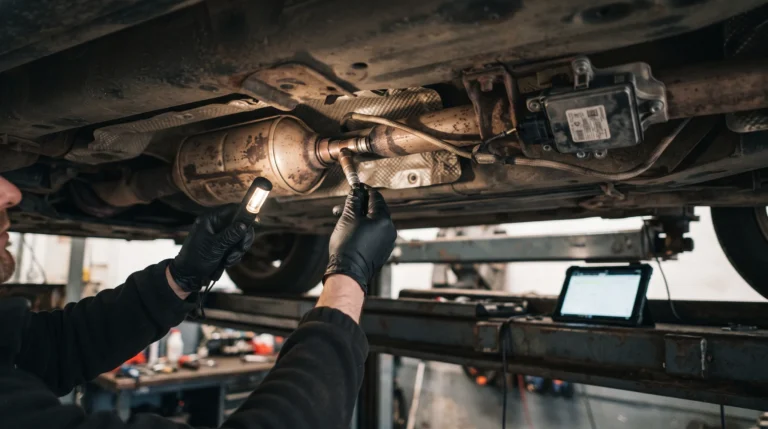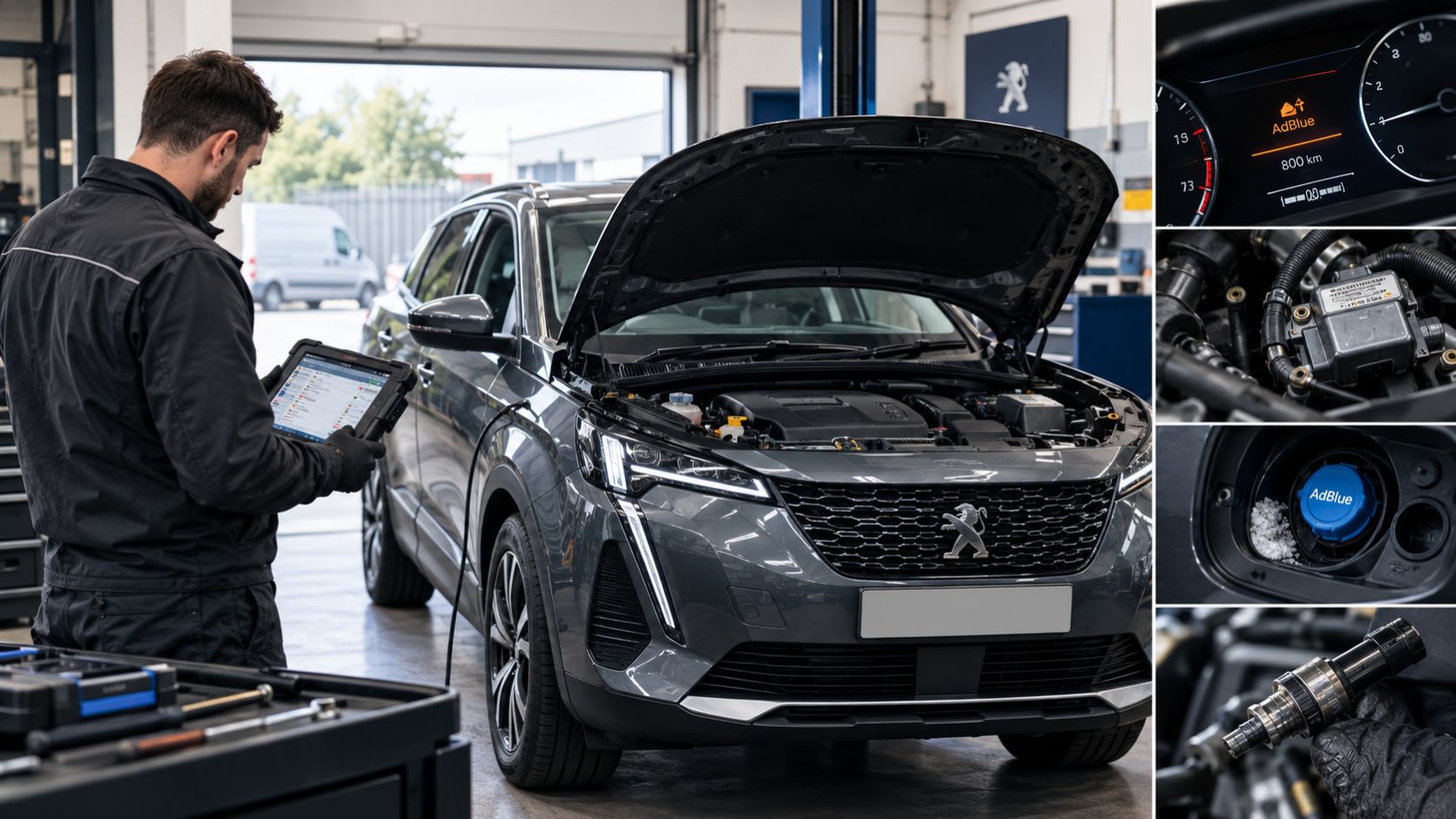

An AdBlue fault on a Peugeot BlueHDi is most commonly caused by a failed NOx sensor, an AdBlue quality fault (P207F), or an SCR catalyst efficiency fault (P20EE). Peugeot’s SCR system is among the more sensitive in the market particularly the 1.5HDi, 1.6HDi, and 2.0HDi engine variants and when a fault is detected, the vehicle follows a strict countdown to a no-restart lockout that does not wait for a convenient moment to trigger. If the message is paired with an engine management light, reduced performance, or a restart countdown, do not leave it for weeks. Once the countdown reaches zero on some Peugeot models, the vehicle may refuse to restart after being switched off. That turns a drivable fault into a recovery job. This guide covers every common Peugeot AdBlue fault, the warning lights and messages associated with each, the diagnostic approach needed to identify the actual cause, and the repair and delete options available.
Peugeot Models Affected
AdBlue faults are a problem with the following vehicles which include the 1.5HDi, 1.6HDi and 2.0HDi engines: Peugeot 208, 2008, 308, 308 SW, 3008, 508, 5008, Partner Tepee, Traveller, Partner, Expert, and Boxer.
The fault profile differs between passenger cars (308, 508, 3008, 5008) and commercial vans (Boxer, Expert, Partner). Passenger cars most commonly present with NOx sensor faults and quality sensor issues. Commercial vans, particularly the Boxer, more frequently develop pump faults, crystallisation faults, and heater failures due to higher mileage and predominantly urban operating profiles.
Peugeot AdBlue Warning Messages Explained
Peugeot uses specific dashboard messages rather than generic warning lights for AdBlue faults. The specific message on the display tells you which situation you are dealing with and whether topping up will help or whether diagnosis is needed first.
| Dashboard message | What it means | Action required |
| “Top up AdBlue” / “AdBlue level low” | Tank running low level warning | Top up with ISO 22241 certified AdBlue |
| “AdBlue: Top up now” / “X miles remaining” | Critical level countdown active | Top up immediately before switching off |
| “AdBlue: Fault. Engine start impossible in X km” | System fault not a level issue | Diagnostic scan required top up will not clear |
| “AdBlue system fault” | Component failure confirmed by ECU | Diagnostic scan required |
| Engine management light + AdBlue message | Active fault code stored | Professional diagnostic scan with Diagbox or equivalent |
| Limp mode / reduced power | Fault has progressed ECU restricting engine | Immediate diagnosis required |
A more urgent message such as “AdBlue: Fault. Engine start impossible in X km” indicates a system fault rather than low fluid. Topping up the tank will not resolve this. It requires a diagnostic scan to identify the specific fault code and the correct repair approach.
Why Diagbox Matters on Peugeot Vehicles
On Peugeot vehicles, fault codes are often displayed alongside Peugeot-specific sub-codes (such as P20EE:92 or P207F:1C) which give more detail about the exact fault type. A Peugeot-compatible scan tool is needed to read these extended codes accurately. Diagbox is the Peugeot/Citroën diagnostic tool needed to reset countdown timers, recalibrate sensors and clear permanent codes on-site.
Generic OBD scanners read the base fault code but miss the Peugeot sub-code that specifies the exact fault type within the component. This matters because the same base code P20EE for example can be caused by a failing NOx sensor, an underperforming injector, or genuine catalyst degradation. The sub-code distinguishes between these. Without it, the diagnostic picture is incomplete and the wrong component gets replaced.
We use Diagbox-compatible professional diagnostic software on every Peugeot job. We do not use generic tools on PSA Group vehicles.
The Most Common Peugeot AdBlue Faults
1. NOx Sensor Failure
An AdBlue fault on a Peugeot 308 or 508 BlueHDi is most commonly caused by a failed NOx sensor.
Peugeot BlueHDi engines typically run two NOx sensors one upstream of the SCR catalyst and one downstream. The downstream sensor is the more common failure point across the passenger car range. When it fails, the ECU cannot confirm whether the SCR system is reducing NOx effectively, triggering a P20EE (SCR catalyst efficiency) code that is often misdiagnosed as catalyst failure.
Fault codes: P2201 (upstream NOx sensor circuit), P2202 (downstream NOx sensor circuit), P20EE (SCR catalyst efficiency often triggered by downstream NOx sensor misreporting).
Why it matters: Replacing the SCR catalyst based on a P20EE code without first confirming the NOx sensor is functioning correctly is one of the most expensive diagnostic mistakes we see on Peugeot vehicles. Live data from Diagbox comparing actual versus expected NOx values across the catalyst distinguishes a sensor fault from genuine catalyst failure before any parts are ordered.
Cost: NOx sensor replacement on Peugeot: £180–£450 fitted depending on model.
2. AdBlue Quality Fault (P207F)
The AdBlue tank sensor may not be working properly, causing the system to think that the tank is empty even though it’s full. The quality sensor fault on Peugeot is similar: the sensor misreads correct fluid as out-of-specification.
Peugeot systems are known to be sensitive to contamination, failed sensors, and tank module issues. If the fluid quality is poor or the tank has been run very low for extended periods, crystallisation can affect sensor accuracy.
Fault codes: P207F (reductant quality sensor signal out of range), P203A (reductant quality performance), P2BAD (reductant quality below threshold).
Common causes on Peugeot specifically:
- Contaminated or incorrect fluid from a top-up
- A dirty funnel or container used during top-up
- Crystallised deposits on the quality sensor from a previous contamination event
- Genuine sensor failure the SID212EVO ECU on some Peugeot models is particularly strict in how it evaluates quality sensor readings
What to check first: Confirm the fluid source ISO 22241 certified AdBlue from a sealed container. If the quality fault appeared after a top-up, the fluid or the container used is the starting point. If the fault persists after a confirmed drain and refill with correct fluid, the quality sensor itself has likely failed.
Cost: Tank drain, flush, and refill service: £80–£150. Quality sensor replacement (often module-level on Peugeot): £200–£500.
3. AdBlue Pump Failure
The Peugeot Boxer is one of the UK’s most popular light commercial vehicles. Thousands of owners rely on them for daily work but AdBlue system faults are increasingly common, especially on 2015+ models. Pump failure is the leading hardware fault on the Boxer and Expert van range.
AdBlue crystallises in cold weather, blocking the system. The Boxer’s predominantly urban operating profile short trips, stop-start driving, incomplete SCR warm-up cycles accelerates crystallisation within the pump and delivery system faster than vehicles doing predominantly motorway mileage.
Fault codes: P20BA/P20B9 (reductant pump control circuit), P204F (reductant system performance).
Signs of pump failure on Peugeot:
- Fault appears after cold starts or cold weather
- No-restart countdown active despite adequate fluid level
- Ammonia smell from exhaust indicating incomplete dosing
- Fuel economy drop suggesting the system is not dosing correctly
Cost: AdBlue pump replacement on Peugeot/Boxer: £350–£700 depending on route. Crystallisation cleaning (where pump motor is intact): £100–£200.
4. AdBlue Injector Crystallisation
When the ECU detects the wrong amount of AdBlue reaching the exhaust, it logs a fault and triggers a warning. A failed injector typically needs to be replaced, cleaning sometimes helps on early-stage blockages but is not always reliable.
On the Expert and Partner, injector crystallisation is particularly common because of the short urban trips typical of these vans. The SCR system does not reach full operating temperature on short runs, the injector does not complete its full cleaning cycle, and urea deposits accumulate at the nozzle across multiple incomplete cycles.
Fault codes: P2047/P204B (reductant injector circuit fault), P20EE (SCR catalyst efficiency downstream consequence of injector under-delivery).
Cost: AdBlue injector cleaning: £80–£150. Injector replacement: £180–£350. Our AdBlue crystallisation repair guide covers when cleaning is sufficient and when replacement is necessary.
5. AdBlue Tank Heater Failure
AdBlue crystallises in cold weather, blocking the system the heater prevents freezing and crystallisation in the tank. When the heater element fails, the system cannot maintain fluid temperature in cold conditions, leading to crystallisation in the tank module and fault codes that appear predominantly in winter or on cold starts.
Fault codes: Heater circuit resistance codes, often alongside P204F or P20BA.
Pattern: Fault appears primarily in autumn and winter. Vehicles may run normally in summer with no warning. The heater fault is not self-resolving if it appears in cold weather it will return every cold season until addressed.
Cost: Heater replacement often module-level on Peugeot, £250–£600 depending on model.
6. SCR Catalyst Degradation
Genuine catalyst failure is significantly less common than the other faults on this list but does occur on very high mileage examples and vehicles that have run for extended periods with an unresolved injector or pump fault causing incorrect dosing.
Important: P20EE is the fault code for SCR catalyst efficiency, but it is most frequently caused by a failing downstream NOx sensor or an underperforming injector on Peugeot vehicles not by the catalyst itself. Replacing the catalyst without confirming the sensor and injector are functioning correctly first is an expensive mistake that does not clear the fault.
Cost: SCR catalyst replacement on Peugeot: £600–£1,400 depending on model.
Peugeot AdBlue Fault Codes Reference
| Fault code | Description | Most common cause on Peugeot |
| P20EE | SCR catalyst efficiency below threshold | Downstream NOx sensor misreporting check sensor before catalyst |
| P207F | Reductant quality sensor signal out of range | Quality sensor failure or crystallisation on sensor element |
| P203A | Reductant quality performance | Contaminated or incorrect AdBlue fluid |
| P2BAD | Reductant quality below threshold | Diluted or contaminated fluid |
| P2201 | NOx sensor upstream circuit | Upstream NOx sensor failure |
| P2202 | NOx sensor downstream circuit | Downstream NOx sensor failure most common on 308/508 |
| P204F | Reductant system performance | Pump under-delivery or multiple simultaneous faults |
| P20BA / P20B9 | Reductant pump control circuit | Pump failure common on Boxer/Expert |
| P2047 / P204B | Reductant injector circuit | Injector crystallisation or electrical fault |
For the full explanation of what each code means and how it is diagnosed, see our complete AdBlue fault codes guide.
Commercial Vans: Boxer, Expert, Partner
The commercial van range deserves specific attention because the fault profile and the economics of repair vs delete differ meaningfully from passenger cars.
The Peugeot Boxer is one of the UK’s most popular light commercial vehicles. Thousands of owners rely on them for daily work but AdBlue system faults are increasingly common, especially on 2015+ models.
For Boxer, Expert, and Partner operators, the key differences:
Short-trip urban operating profile accelerates crystallisation. Vans doing local deliveries, trade runs, and urban routes rarely complete a full SCR warm-up cycle. Crystallisation in the pump, injector, and level sensor builds faster than on motorway vehicles. This is not a maintenance failure it is the operating conditions working against the system design.
Downtime is a cost. A recovery call, a day waiting for parts, and a return to the garage for a second repair is not an abstract inconvenience for an owner-operator; it is lost revenue. For commercial Peugeot van operators who have already been through a repair cycle, AdBlue delete or urea delete is frequently the more pragmatic economic choice.
Repair cost relative to van value. A Boxer or Expert with 150,000+ miles where a pump module replacement is quoted at £500–£700 is approaching the threshold where repair economics deteriorate quickly, particularly if other SCR system components are also showing wear.
Repair or Delete: The Decision for Peugeot Owners
The right Peugeot AdBlue warning fix depends on the age of the vehicle, the exact fault, your budget, and how the vehicle is used. Where the system has become a repeat failure point, a professional software solution can remove the constant cycle of warning lights, countdown messages, and costly parts swapping.
Repair makes sense when:
- First-time, isolated fault on a Peugeot passenger car with reasonable remaining value
- Single component failure NOx sensor or quality fault confirmed by live data
- Vehicle is under warranty or will be sold through a route where system integrity matters
Delete makes more sense when:
- Repeated AdBlue faults, expensive component failure, and ongoing downtime make reliability and operating cost more important than preserving every original emissions component
- Same fault has recurred after a previous repair
- Multiple simultaneous fault codes are active
- Commercial van operator for whom downtime is a direct cost
Our AdBlue delete vs repair guide covers the full decision framework. Our pricing page sets out fixed costs for both options.
Our Mobile Service for Peugeot AdBlue Faults
We diagnose and resolve Peugeot AdBlue faults as a mobile service using Diagbox-compatible professional diagnostic software, not generic OBD tools. Every job begins with a live data diagnostic scan reading the Peugeot-specific sub-codes before any component replacement is recommended.
Our mobile service for Peugeot vehicles includes full diagnostic scan with Peugeot-specific extended code reading, live data analysis, component testing, AdBlue repair, urea repair, and AdBlue delete where repair is not the appropriate route. All AdBlue removal services and urea removal are available mobile. For Boxer and Expert fleet operators, our HGV remapping and AdBlue solutions page covers the commercial vehicle options.
Areas We Cover
We carry out mobile Peugeot AdBlue fault diagnosis and repair across the UK. In London and the South East we cover London, St Albans, Loughton, Dartford, Sevenoaks, Epsom, Esher, and Slough. In Yorkshire we cover Leeds and Sheffield. In Scotland we cover Glasgow and Edinburgh. Across Shropshire we cover Shrewsbury, Telford, Oswestry, and Bridgnorth. In the West Midlands we cover Coventry, Dudley, Walsall, Solihull, and Wolverhampton. Across Staffordshire we cover Stoke-on-Trent, Stafford, Cannock, and Lichfield. In Warwickshire we cover Warwick, Leamington Spa, Stratford-upon-Avon, and Rugby. Across the East Midlands and Lincolnshire we cover Peterborough, Grantham, Spalding, Stamford, Bourne, and Market Deeping. Not listed? Check our full locations page or contact us with your postcode. We cover a wide radius from each area and take enquiries from outside listed locations.
Frequently Asked Questions
Get clear answers about Peugeot AdBlue faults, common fault codes, diagnosis, repairs, recurring warnings and mobile AdBlue support.
Common causes include faulty sensors within the AdBlue system, a problem with the SCR catalyst, clogged AdBlue injectors, and AdBlue fluid crystallisation or degradation. On Peugeot passenger cars the most common cause is a failed downstream NOx sensor producing a P20EE code. On Boxer and Expert vans, pump failure and crystallisation from short-trip urban operating profiles are the leading causes.
If you have filled the AdBlue tank and the warning light or countdown is still showing, you have a system fault rather than an empty tank. A fault code stored in the ECU does not clear by adding fluid; it requires diagnosis of the specific failed component and a proper reset using Peugeot-compatible diagnostic software.
It will read the base fault code but miss the Peugeot-specific sub-codes that identify the exact fault type within a component. On Peugeot vehicles, these sub-codes are what distinguish a NOx sensor fault from catalyst failure, or a quality sensor failure from genuine contamination. Without them, diagnosis is incomplete and the wrong component is often replaced.
Yes. AdBlue system faults are increasingly common on Boxer models, especially 2015+ examples. The Boxer’s urban operating profile means the SCR system rarely completes a full warm-up and self-cleaning cycle, accelerating crystallisation at the pump and injector faster than vehicles doing predominantly longer runs.
P207F is the reductant quality sensor signal out-of-range code; it means the quality sensor in the AdBlue tank is reporting a reading outside the acceptable parameters. It can indicate genuine fluid contamination or a failed quality sensor misreading correct fluid. On Peugeot vehicles, P207F often appears alongside a Peugeot-specific sub-code such as P207F:1C which provides more detail about the exact fault type.
For a first-time, isolated fault on a passenger car with reasonable remaining value, repair is usually the better option. For a Boxer or Expert van with a recurring fault history, multiple simultaneous codes, or repair costs disproportionate to the van’s value, delete may be the more rational economic choice. See our AdBlue delete vs repair guide for the full decision framework.
Yes. We cover the full service area listed above using Diagbox-compatible professional diagnostic software. Contact us with your Peugeot model, year, and the fault codes or dashboard messages showing and we will confirm availability and advise on the most likely cause before booking a visit.
Book Mobile Peugeot AdBlue Diagnosis
If your Peugeot has an AdBlue fault whether it is a countdown that has started, a code that has returned after a previous repair, or a warning that appeared after a top-up we carry out same-day and next-day mobile diagnosis using Peugeot-compatible diagnostic software across our full coverage area.
Contact us today with your Peugeot model, year, engine, and the dashboard message or fault codes showing. We will confirm availability, advise on the most likely cause, and provide a fixed-price quote for diagnosis and repair or delete before any work begins.