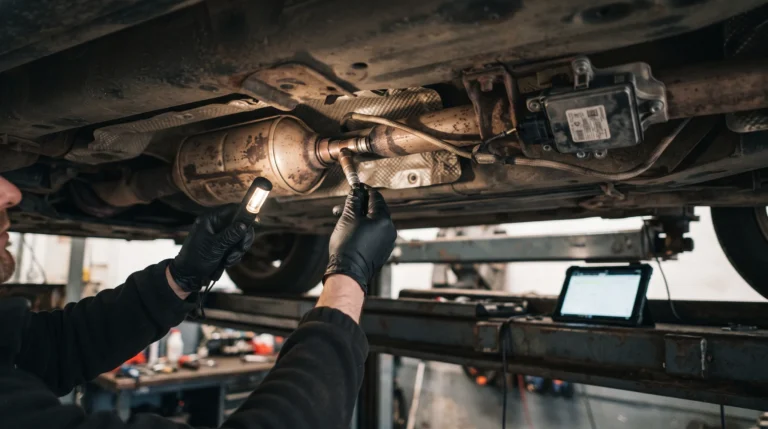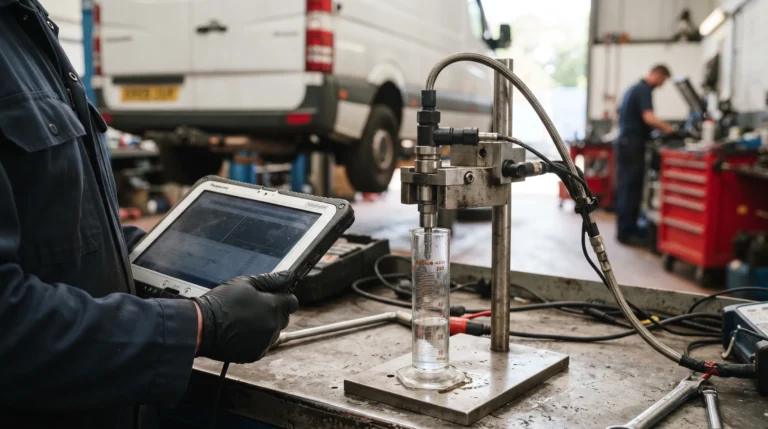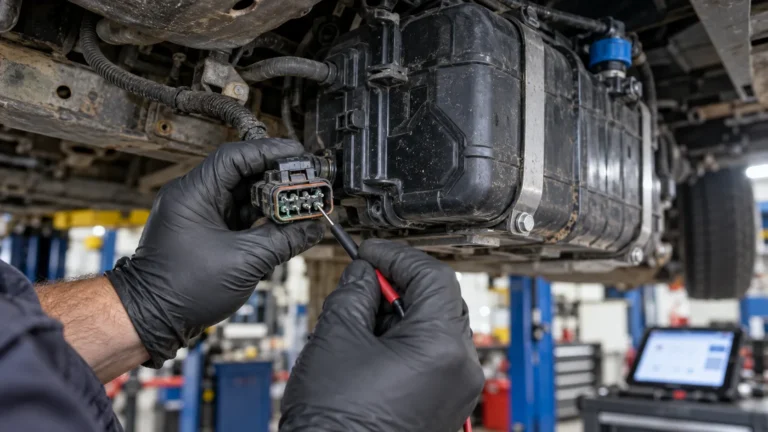

An AdBlue system fault code means your vehicle’s ECU has detected a problem within the SCR (Selective Catalytic Reduction) emissions system, not simply a low fluid level. The most common AdBlue fault codes relate to the pump (P20BA, P20B9), NOx sensors (P2201, P2202), injector (P204B, P2047), fluid quality (P203A, P2BAD), or the SCR catalyst efficiency (P20EE). Each code points to a different component and requires a different fix. This guide explains what each one means, why it comes on, and whether repair or a software delete is the right response.
Why AdBlue Fault Codes Matter
Unlike an AdBlue low-level warning which clears the moment you top up the fluid, a fault code is stored in the ECU and will not clear on its own. The vehicle knows something in the system has failed, and it will keep flagging it regardless of how much fluid is in the tank.
Left unresolved, an active AdBlue fault code causes the vehicle to enter a countdown to limp mode or a no-restart lockout. The ECU is designed this way deliberately; it treats an unresolved SCR fault the same way it treats an empty tank, because in both cases the vehicle is not meeting its emissions compliance threshold.
Reading the specific fault code is what tells you which component has failed. Without a diagnostic scan, you are guessing and guessing costs money.
How to Read AdBlue Fault Codes
AdBlue fault codes are stored as OBD-II diagnostic trouble codes (DTCs) and can be read with any OBD-II diagnostic tool that supports emissions systems. Basic plug-in code readers show the code number. Professional diagnostic tools such as those used by specialists show the full fault description, freeze frame data (what conditions triggered the fault), and whether the fault is active or stored.
The difference matters:
- Active fault the problem is present right now
- Stored/pending fault the fault occurred but has not yet triggered the warning light on every drive cycle; the system is still monitoring
A stored fault that is simply cleared with a code reset tool will return if the underlying cause is not addressed. This is one of the most common reasons people come to us after visiting a dealer or garage. The code was cleared without the fault being fixed, and it came back within days or weeks.
Our mobile diagnostic service reads the full fault data not just the code number before recommending any repair. Contact us to book a mobile diagnosis at your home or workplace.
The Most Common AdBlue Fault Codes Explained
P20EE SCR NOx Catalyst Efficiency Below Threshold
What it means: The SCR catalyst is not reducing NOx emissions as efficiently as the ECU expects. The downstream NOx sensor is detecting more NOx leaving the catalyst than the system calculates should be present.
Why it comes on:
- The SCR catalyst has degraded or been damaged by contaminated AdBlue fluid
- The AdBlue injector is not delivering the correct quantity of fluid
- The NOx sensor is reading incorrectly, making the system think the catalyst is underperforming when it isn’t
- The AdBlue pump is delivering intermittently
What to do: This code needs a live diagnostic assessment, not just a code reset. The technician needs to check actual NOx values versus expected values, confirm injector delivery rate, and assess whether the catalyst has genuinely degraded or whether a sensor is misreporting. Our NOx sensor service covers diagnosis and replacement for this fault pattern. If the catalyst has genuinely failed, an AdBlue delete is worth considering against the cost of SCR catalyst replacement.
P203F Reductant Level Sensor Circuit
What it means: The reductant (AdBlue) level sensor has a circuit fault. The ECU cannot read the fluid level accurately.
Why it comes on:
- The level sensor inside the AdBlue tank has failed electrically
- Wiring or connector corrosion between the sensor and ECU
- The tank module (which often incorporates the pump, heater, and level sensor as a single assembly) has partially failed
What to do: This fault is sometimes misdiagnosed as a low-level warning drivers top up the tank and wonder why the warning persists. The sensor itself needs testing. On many vehicles, the level sensor is integrated into the pump module, meaning replacement is a module-level job rather than an isolated sensor swap. See our AdBlue repair page for how we approach module-level faults on common makes.
P203A Reductant Quality Performance
What it means: The AdBlue quality sensor has detected that the fluid in the tank is not the correct concentration either too dilute, too concentrated, contaminated, or degraded.
Why it comes on:
- Wrong fluid used tap water, windscreen wash, or incorrect concentration topping up
- Fluid contaminated through a dirty funnel or contaminated container
- AdBlue stored incorrectly and degraded (AdBlue has a shelf life and is sensitive to heat)
- Quality sensor failure the sensor reads incorrectly even when the fluid is correct
What to do: If contamination is confirmed, the tank needs draining, flushing, and refilling with fresh, correctly concentrated AdBlue. The fault code must then be reset. If the code returns with correct fluid, the quality sensor has failed and needs replacement. This is a straightforward AdBlue fix in most cases; do not ignore it, because a quality fault left unresolved triggers the same countdown behaviour as an empty tank.
P2BAD Reductant Quality Below Threshold (Bank 1)
What it means: A variant of the quality fault code, specifically flagging that the measured urea concentration is below the minimum threshold the system will accept.
Why it comes on: Almost always contamination or incorrect fluid most commonly from topping up with water or severely diluted AdBlue. This code is also common after a professional fluid drain and refill if the flush was incomplete and residual diluted fluid remains in the system.
What to do: Full drain, flush, and refill followed by a diagnostic reset and a short drive to allow the system to re-evaluate fluid quality. If the code persists, the quality sensor needs testing. Our urea repair service handles this fault on both cars and light commercial vehicles.
P20BA / P20B9 Reductant Pump Control Circuit
What it means: The AdBlue pump has an electrical fault either an open circuit, short circuit, or a performance issue where the pump is drawing incorrect current.
Why it comes on:
- The pump motor has failed electrically
- Wiring fault between the pump and ECU (common on older vehicles where the wiring loom has aged or been disturbed during previous work)
- The pump has seized mechanically often because the tank was run dry repeatedly, causing the pump to run without fluid lubrication
- The pump module’s internal control circuit has failed
What to do: Pump faults require physical replacement of the pump unit. On most vehicles this is part of the tank module assembly, which includes the pump, heater, level sensor, and quality sensor as a combined unit. This is one of the more expensive AdBlue repairs which is why for older vehicles or those with multiple concurrent faults, an AdBlue bypass is often more cost-effective than a module replacement. Our pricing page sets out fixed costs for both options so you can compare directly.
P2047 / P204B Reductant Injector Circuit
What it means: The AdBlue injector has an electrical fault or is not operating within expected parameters.
Why it comes on:
- The injector nozzle is blocked by crystallised AdBlue deposits common on high-mileage vehicles or those where the system has been inactive for a period
- The injector solenoid has failed electrically
- Wiring fault in the injector circuit
- The injector is partially stuck open or closed
What to do: Injector faults are sometimes recoverable through cleaning if the blockage is partial and the solenoid is intact. A full injector replacement is required if the solenoid has failed. This is a component-level AdBlue repair if the same injector fault has recurred after a previous replacement, the underlying cause (usually fluid quality or pump delivery issues) needs addressing at the same time.
P2201 / P2202 NOx Sensor Circuit (Bank 1 Sensor 1 / Bank 1 Sensor 2)
What it means: The upstream (P2201) or downstream (P2202) NOx sensor has an electrical circuit fault either an open circuit, short to ground, or reference voltage problem.
Why it comes on:
- NOx sensor has failed internally
- Connector corrosion or damage NOx sensor connectors are exposed to heat and exhaust gases and are a common failure point
- Wiring damage between the sensor and ECU
- ECU fault (rare almost always the sensor or connector before the ECU)
What to do: NOx sensors can be tested for correct output voltage before replacement to confirm they have failed rather than simply read incorrectly due to a connector issue. Our dedicated NOx sensor service covers fault diagnosis, sensor testing, and replacement. It is worth noting that a faulty NOx sensor often generates an AdBlue system fault code even when the AdBlue pump, injector, and fluid are all functioning correctly which is why proper diagnosis before replacing components matters.
P2268 / P2269 Reductant Heater Performance
What it means: The AdBlue heater which prevents the fluid from freezing in cold conditions is not performing as expected.
Why it comes on:
- The heater element within the tank module has failed
- Heater relay fault
- Wiring fault in the heater circuit
- The fault is only triggered in cold weather, making it harder to diagnose in warmer months
What to do: Heater faults are worth addressing before winter if diagnosed in spring or summer. A heater fault does not immediately trigger limp mode or no-restart behaviour in most vehicles, but it causes the AdBlue to freeze in cold conditions which then prevents the pump from drawing fluid and triggers a cascade of secondary fault codes. This is a module-level repair on most vehicles.
P204F Reductant System Performance
What it means: A broader performance fault the SCR system as a whole is not operating within expected parameters, but the ECU has not isolated a specific single component as the cause.
Why it comes on: This code is often secondary to a more specific fault that has cleared itself intermittently, or it appears when multiple small faults are combining to affect overall system performance rather than a single component having failed completely.
What to do: P204F needs a thorough diagnostic session with live data checking actual vs expected NOx reduction, pump delivery rate, injector operation, and sensor outputs simultaneously. A code reset alone will not resolve this. If live data shows the system is functioning within acceptable parameters during the test but the fault keeps returning intermittently, the most cost-effective resolution is often a software AdBlue delete rather than chasing an intermittent fault through multiple component replacements.
Manufacturer-Specific AdBlue Fault Code Patterns
Different manufacturers give slightly different codes and descriptions for the same underlying faults. Here is how the most common makes present AdBlue system faults:
| Make | Common fault code presentation | Typical failure pattern |
| BMW | P20EE, P2BAD, P20BA often in combination | Pump module and quality faults are most common; pump replacement is a frequent repair on high-mileage 3-series and 5-series diesel |
| Mercedes | P20E8, P2047, P2201 often with SCR-specific Mercedes codes alongside | Injector faults and NOx sensor faults are common; coding required after sensor replacement |
| VW/Audi | P20EE, P203F, P2202 | Level sensor and catalyst efficiency codes are frequent; software recalibration often needed after repair |
| Peugeot/Citroën | Manufacturer-specific codes alongside OBD codes | PSA group vehicles often show “Urea System Fault” in French before displaying the OBD code |
| Renault | P20EE, P2BAD common on van range | Trafic and Master diesel vans frequently develop quality and pump faults |
| Ford | P20EE, P2201 | Transit range injector and NOx sensor faults common |
| Fiat/Iveco | P204F, P20BA | Ducato commercial pump module faults are the most common presentation |
Fault Code Quick Reference Table
| Code | Description | Most likely cause | Typical fix |
| P20EE | SCR catalyst efficiency below threshold | Degraded catalyst, injector under-delivery, NOx sensor | Diagnosis, injector or sensor repair, or delete |
| P203F | Reductant level sensor circuit | Level sensor or pump module failure | Sensor or module replacement |
| P203A | Reductant quality performance | Contaminated or incorrect fluid, quality sensor failure | Drain, flush, refill, or sensor replacement |
| P2BAD | Reductant quality below threshold | Diluted or contaminated fluid | Drain, flush, refill |
| P20BA / P20B9 | Reductant pump control circuit | Pump failure, wiring fault | Pump or module replacement, or delete |
| P2047 / P204B | Reductant injector circuit | Blocked or failed injector | Injector clean or replacement |
| P2201 / P2202 | NOx sensor circuit (upstream/downstream) | NOx sensor failure, connector corrosion | NOx sensor replacement |
| P2268 / P2269 | Reductant heater performance | Heater element or relay failure | Heater or module replacement |
| P204F | Reductant system performance | Multiple minor faults, intermittent failure | Full live-data diagnosis |
What Happens If You Just Reset the Code Without Fixing It?
This is the most important practical point in this guide and the one most often learned the hard way.
An OBD code reset clears the fault from the ECU’s memory temporarily. The warning light goes off. The vehicle behaves normally for a day, a week, or sometimes a few weeks.
Then the fault returns.
This is because the underlying cause of a failing pump, a degraded sensor, and contaminated fluid has not been addressed. The ECU runs its diagnostic cycle, detects the same fault, and stores the code again. The warning light comes back. And each time the fault is simply reset rather than repaired, the countdown to limp mode or no-restart behaviour continues.
Code resets have their place; they are useful after a confirmed repair to clear stored faults and allow the system to re-evaluate. They are not a fix in themselves.
Repair or Delete? How to Decide
Once the specific fault code is identified, the decision is usually straightforward.
Repair makes sense when:
- The fault is isolated to a single component
- The vehicle is relatively new or has significant value
- The component cost is proportionate to the vehicle’s worth
- It is a first-time fault with no recurring history
An AdBlue delete, bypass, or urea delete makes more sense when:
- Multiple fault codes are active simultaneously
- The same fault has recurred after a previous repair
- The repair cost (pump module, SCR catalyst) is disproportionate to vehicle value
- The vehicle is commercial and downtime for repeat repairs is unacceptable
For HGV and fleet operators where keeping vehicles on the road is critical, our HGV remapping and AdBlue solutions page covers the commercial vehicle options specifically.
Our pricing page sets out fixed costs for both repair and delete services, compares the two before making a decision, and contact us if you want a specific quote based on your fault codes and vehicle.
DPF and EGR Faults That Appear Alongside AdBlue Codes
Vehicles often develop DPF or EGR faults at the same time as AdBlue faults not because one caused the other directly, but because they share the same high-mileage, hard-worked engine profile that tends to produce emissions system failures across the board.
If your vehicle is showing AdBlue fault codes alongside DPF or EGR faults, these need to be treated as separate faults rather than assumed to be related. Our DPF solutions page covers DPF diagnosis and options. For EGR faults, see EGR solutions, EGR removal, or EGR delete depending on what you’ve already quoted.
A combined diagnosis covers all active faults in a single visit and is the most cost-effective approach when multiple systems are flagging simultaneously.
Our Mobile AdBlue Fault Code Diagnosis Service
We diagnose and resolve AdBlue system faults at your location, no recovery, no dealer wait. Our mobile service covers fault code reading, live data analysis, component testing, and same-day repair or delete where possible.
All AdBlue removal services and urea removal options are available as mobile services across our full coverage area.
Areas We Cover
- AdBlue fault diagnosis London
- AdBlue fault diagnosis Slough
- AdBlue fault diagnosis Esher
- AdBlue fault diagnosis Epsom
- AdBlue fault diagnosis Loughton
- AdBlue fault diagnosis St Albans
- AdBlue fault diagnosis Sevenoaks
- AdBlue fault diagnosis Dartford
Not listed? Check our full locations page or contact us directly we cover a wide radius from each area.
AdBlue system fault codes, answered straight
The questions we’re actually asked on the phone before a diagnostic booking — no jargon, no sales pitch.
An AdBlue system fault code is a diagnostic trouble code (DTC) stored in your vehicle’s ECU when the SCR emissions system detects a component failure — such as a pump fault, injector fault, NOx sensor fault, or fluid quality issue. Unlike a low-level warning, a fault code will not clear by topping up the tank. It requires a professional diagnostic scan to identify the specific cause and an appropriate repair or delete to resolve it permanently.
P20EE means the SCR NOx catalyst efficiency is below the threshold the ECU expects. In plain terms, the system is not reducing NOx emissions as effectively as it should. Common causes include a degraded SCR catalyst, under-delivery from the AdBlue injector, or a faulty downstream NOx sensor misreporting actual NOx levels. A live-data diagnostic session is needed to identify which component is the cause before any parts are replaced.
You can clear the stored code using an OBD reader, but the code will return if the underlying fault is not fixed. A code reset removes the warning light temporarily — it does not repair the failed component. If you clear a fault code without addressing the cause, the vehicle’s countdown to limp mode or no-restart behaviour continues in the background.
Because the failed component has not been repaired. Each time the ECU runs its diagnostic cycle, it detects the same fault and stores the code again. Repeated code resets without a repair only delay the inevitable — and in some cases accelerate the countdown to limp mode. A proper diagnosis identifies the cause so the fault is resolved rather than repeatedly cleared.
An AdBlue quality fault (P203A, P2BAD) is almost always caused by contaminated or incorrectly concentrated fluid — from using a dirty funnel, topping up with diluted fluid, or fluid that has degraded due to improper storage. Occasionally the quality sensor itself has failed and is misreading correct fluid as out-of-specification. The fix is a full drain, flush, and refill with fresh AdBlue, followed by a fault code reset. If the code returns with correct fluid, the quality sensor needs replacing.
Cost depends on which component has failed. Sensor replacements are generally lower cost; pump module replacements are higher. In cases where the repair cost is disproportionate to the vehicle’s value, or where multiple faults are active simultaneously, an AdBlue delete is often the more cost-effective option. Our pricing page sets out fixed costs for both repair and delete services.
Yes. Our mobile service covers cars, light commercial vehicles, vans, and HGVs. For commercial vehicles and fleet operators, see our HGV remapping and AdBlue solutions page for the specific options available.
An AdBlue fault covers any failure within the SCR system — pump, injector, fluid quality, heater, or catalyst. A NOx sensor fault specifically refers to a failure of the upstream or downstream NOx sensors that monitor the SCR system’s effectiveness. The two are related — a faulty NOx sensor generates an AdBlue system fault code — but the fix is different. A NOx sensor fault is resolved by replacing the sensor; an AdBlue pump or injector fault requires a different repair. This is why reading the specific fault code matters before any parts are replaced. See our NOx sensor page for NOx-specific diagnosis and replacement information.
Book Mobile AdBlue Fault Code Diagnosis
If your AdBlue warning light is on and you have a fault code stored or if a code was reset and has already returned we carry out same-day mobile diagnosis across London and the surrounding area. We read the full fault data, test the specific component, and give you a fixed-price quote for repair or delete before any work begins.
Contact us today with your vehicle make, model, year, and any fault codes already showing and we’ll confirm availability and pricing.