
An AdBlue warning symbol on your dashboard is your vehicle’s way of telling you the SCR system needs attention. Sometimes that’s nothing more than a low fluid level. Other times it’s a genuine fault that no amount of AdBlue will fix. Telling the two apart matters, because one is solved with a bottle of fluid and the other needs proper AdBlue repair.
We see this warning almost every day on our mobile call-outs, and the same question comes up constantly: “is this urgent, or can it wait?” This guide answers that, symbol by symbol, so you know what you’re actually looking at before you decide what to do next.
What Does the AdBlue Warning Symbol Mean?
Most of the time, it’s one of three things. The tank is low and needs topping up. The system has flagged a fault it can’t self-correct. Or a countdown has started that will eventually stop the engine restarting.
The icon itself is usually a small tank or pump graphic, sometimes labelled “AdBlue” or “DEF,” sometimes shown as a Urea or SCR text message instead. No two manufacturers draw it quite the same way, so don’t assume your neighbour’s Transit and your Passat are showing the same warning just because the picture looks similar.
What actually tells you how serious it is: the colour, whether there’s a mileage countdown attached, and whether any other light has come on with it. Get those three things right and you’ve got a fairly good read on urgency, even before a diagnostic tool gets near the car.
AdBlue Warning Symbols Explained
Here’s how the common warnings break down in practice.
| Symbol / Warning | Typical Meaning | Urgency | What To Do |
| Amber tank icon, no message | Level is getting low | Low | Top up when convenient |
| Amber icon with mileage countdown | Low enough that the vehicle is now tracking remaining distance | Rising | Top up soon, don’t let it run down |
| Red icon or “AdBlue system fault” message | A fault has been detected, not just low fluid | High | Book AdBlue repair a top-up won’t clear this |
| “Engine will not restart” or 0-mile countdown | Restart restriction is active or imminent | Very high | Get it looked at before the engine’s next switched off |
| AdBlue warning plus engine management light | Likely SCR- or NOx-related fault | High | Needs proper diagnosis, not guesswork |
| Warning returns days after refill | Refill hasn’t solved the actual problem | High | Points to a component fault |
If your dashboard’s showing something that isn’t quite on this list, the safe rule is: a countdown or a second warning light bumps it up to the more urgent end.
What Do the Different Colours Mean?
Amber tends to be the early, low-stakes warning, usually just a level reminder. Red generally means something the vehicle considers more serious, whether that’s a fault or a countdown that’s progressed further. Some cars flash the warning too, which is usually the system’s way of saying “this one’s active and getting worse,” not just sitting there as a reminder.
Don’t lean on colour alone though. One manufacturer’s amber can mean something quite different from another’s, and some systems only go red after you’ve ignored several amber warnings. If a message, countdown, or second light comes with it, treat that as the deciding factor over the colour.
Low AdBlue Warning vs a Genuine AdBlue System Fault
This is where most of the confusion happens, so it’s worth being blunt about it.
A low AdBlue warning means the fluid level has dropped below a threshold. That’s normal it happens as you drive, the same as fuel running low. Top it up and the warning clears.
An AdBlue system fault is a different animal. The vehicle has decided something isn’t working properly, regardless of how much AdBlue is in the tank: the dosing pump, an injector, a sensor, the tank heater, a NOx sensor, or wiring somewhere in the loop. Filling the tank up in this case does nothing, because the fluid was never the issue.
The tell is usually timing. If you’ve topped up and the warning’s back within a day or two, you’re almost certainly not looking at a low-fluid problem anymore; you’re looking at something that needs actual AdBlue repair, whether that’s a sensor, a pump, or a wiring fix.
What Does an AdBlue Countdown Mean?
Modern diesels are built to prevent restarting once AdBlue gets critically low or a related fault’s been ignored for too long. This is a legal emissions requirement, not the manufacturer being difficult.
You’ll typically see a remaining-mileage figure something like “engine will not restart in X miles.” As that number drops, the warnings tend to get louder: more frequent, sometimes shifting from amber to red.
How exactly it behaves when it kicks in, whether a top-up resets it, what happens at zero varies by manufacturer and often by model within the same range. Some vehicles simply won’t fire up again once switched off; a handful keep limited use available. Either way, it’s not worth waiting out. Once that restriction activates, you’re generally looking at a mobile technician or a recovery truck to get moving again.
Can You Keep Driving With an AdBlue Warning?
Depends which scenario you’re in.
An early amber low-fluid warning, no countdown attached fine to carry on, just top up soon. A countdown warning is more time-pressured; you can usually keep driving, but the window’s closing, and running it to zero risks getting stuck somewhere inconvenient.
A persistent fault warning is different again, especially one that’s come back after a refill. It’s not usually an immediate breakdown on its own, but it’s not going away on its own either, and left long enough it can tip into a countdown. If it’s showing up alongside an engine management light, reduced power, or the car just feels off, that’s worth getting checked rather than putting off.
Why Is My AdBlue Warning Still On After Topping Up?
Drivers ask this constantly, and there’s no single answer it can be any of the following:
- Not enough was added. Some systems need a minimum quantity before they’ll register a top-up.
- The vehicle hasn’t caught up yet. A drive cycle or ignition reset is sometimes needed before the warning clears.
- A faulty level sensor. If the sensor’s wrong, the car won’t accurately know how much is actually in the tank.
- A pump or injector fault. AdBlue can’t be delivered properly even with a full tank.
- Poor fluid quality or crystallisation in the tank, lines, or injector.
- A heater fault. AdBlue freezes in cold weather; if the tank heater’s not working, it won’t thaw and circulate properly.
- Wiring or connector faults affecting sensors or the dosing module.
- A NOx or SCR sensor fault that has nothing to do with fluid level at all.
The theme running through all of these: topping up solves a level problem. It does nothing for a broken component. If the warning’s back quickly, you’re in AdBlue repair territory, not top-up territory.
What Other Dashboard Lights Show Up With It?
An AdBlue warning rarely tells the whole story by itself. What else lights up gives useful clues:
- Engine management lights a fault code’s been stored, AdBlue-related or not.
- Emissions warning points more specifically at the exhaust aftertreatment system.
- UREA or SCR message some vehicles use this instead of, or alongside, the AdBlue icon.
- Reduced power / limp mode the car’s protecting itself while something’s wrong.
- Service warning is less urgent alone, but worth noting if it turns up at the same time.
None of these confirm a cause on their own. What they do is give a technician something to cross-reference against stored codes and live data, which is a lot more useful than guessing from the dashboard.
When Should an AdBlue Warning Get Professional Diagnosis?
A stored fault code points at an area of concern; it doesn’t tell you which part has actually failed. Two vehicles can throw the identical code for completely different reasons: one needs a sensor, another needs a wiring repair, and a third just hasn’t registered a genuine top-up yet.
Worth booking AdBlue repair or diagnosis when:
- The warning’s back shortly after a proper top-up
- A countdown’s started, or is progressing
- It’s showing alongside an engine management light or reduced power
- The car’s behaving differently rough running, odd noises, less power
- You’ve topped up more than once and it still won’t stay clear
Replacing parts based on the dashboard symbol alone is how people end up paying for components that were never the problem. Proper diagnosis narrows it down first.
How AdBlue Fault Diagnosis Actually Works
There’s a fairly consistent process behind a proper AdBlue repair job, whatever the vehicle:
- Read the stored fault codes to see which part of the system has flagged an issue.
- Check live data tank levels, pressures, sensor readings rather than relying on the codes alone.
- Check system pressures and measurements, since dosing and pressure faults don’t always show up clearly in the codes.
- Inspect the physical components and wiring pump, injector, heater, connectors.
- Confirm what’s actually causing it before recommending any work.
- Carry out the repair sensor, pump, wiring, whatever it turns out to be.
- Clear or reset the fault once the repair’s done.
- Check it afterwards to make sure the warning stays off.
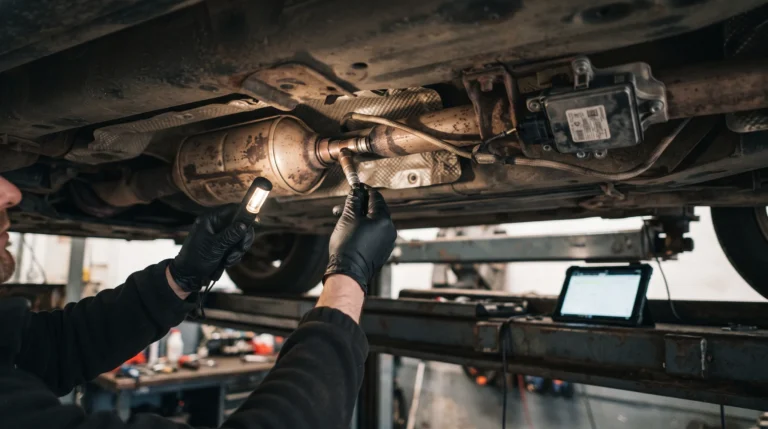
Our mobile technicians run this process using a dealer-level diagnostic kit, at your home, workplace, or the roadside, rather than needing the vehicle booked into a workshop. We’d rather confirm the actual fault first than start swapping parts on a hunch.
AdBlue Repair and Diagnosis Across the UK
We run mobile AdBlue repair and diagnosis across a wide stretch of the country, and we come to the vehicle rather than the other way round.
In and around London, we cover the city and the wider South East, including St Albans, Slough, Epsom, Sevenoaks, Dartford, Esher and Loughton full details on our London AdBlue repair and South East England pages.
Further north, we cover Leeds, Sheffield, Edinburgh and Glasgow.
Across the Midlands, our technicians handle West Midlands AdBlue repair work in Coventry, Dudley, Walsall, Solihull and Wolverhampton; Staffordshire towns including Stoke-on-Trent, Stafford, Cannock and Lichfield; Warwickshire including Warwick, Leamington Spa, Stratford-upon-Avon and Rugby; and Shropshire including Shrewsbury, Telford, Oswestry and Bridgnorth.
Over towards Lincolnshire and the East Midlands, we cover Peterborough, Grantham, Spalding, Stamford, Bourne and Market Deeping through our East Midlands / Lincolnshire page.
Whether it’s a low-fluid warning, a countdown, or a fault that’s come straight back after a top-up, we’ll come to your home, workplace or wherever’s easiest and diagnose it properly. Outside these areas? Get in touch anyway we regularly travel further than the list above suggests.
Frequently Asked Questions
Get clear answers about AdBlue warning lights, refilling AdBlue, countdowns, driving with a warning and when professional diagnosis may be needed.
It means the SCR system has flagged something, usually a low fluid level, a system fault, or a countdown toward a restart restriction. The colour, any message, and whether other lights are on together tell you which one you’re dealing with.
Usually yes for an early amber low-fluid warning. Less so once a countdown’s started, and worth getting checked sooner if there’s an engine light or reduced power alongside it.
Sometimes a low-level warning does. But a system fault warning can look almost identical and won’t clear with a top-up.
Could be a few things: not enough added, the car hasn’t registered it yet, a faulty sensor, or a genuine fault in the pump, injector or wiring. If it’s back quickly, that usually points to a fault rather than a level issue worth booking AdBlue repair at that point.
A mileage figure showing how far you can go before the engine won’t restart once switched off. It’s a legal emissions safeguard, not a manufacturer quirk, so it’s not one to ignore.
Most vehicles won’t restart once switched off, though it varies by manufacturer and model. At that point you’re usually looking at mobile assistance or recovery to get going again.
No. It can just as easily be the pump, injector, sensors, heater, wiring, or the SCR system itself. The dashboard symbol on its own doesn’t tell you which.
If it’s back after a proper top-up, a countdown’s started, it’s paired with another warning light, or you’ve topped up more than once without it staying clear. That’s the point to book AdBlue repair rather than keep guessing.
If your AdBlue warnings come back after a top-up, a countdown’s running, or it’s showing up alongside another dashboard light, our mobile technicians will come to you and find the actual cause. Get a free AdBlue repair quote and we’ll diagnose it properly before recommending anything.