
A steady AdBlue light can still point to low fluid or an early warning. A flashing warning often feels more urgent because the system is no longer happy with something on the SCR side and wants your attention before the problem gets worse.The distinction between a steady and a flashing AdBlue light is not just cosmetic; it points to different causes and requires a different response. A steady light is most commonly a level warning; a flashing light almost always indicates a system fault, an escalated level warning, or a fault code that is now actively progressing toward a no-restart countdown. Topping up the fluid may or may not help depending on the cause. This guide explains exactly what a flashing AdBlue light means on the most common UK vehicles, what causes it to flash rather than stay steady, and the correct response for each scenario.
Why Flashing Means Something Different From Steady
Every dashboard warning system uses flash patterns to communicate urgency and category and AdBlue warning lights are no different. Manufacturers design their warning systems so that escalating severity produces escalating visual behaviour. A light that flashes is demanding more immediate attention than one that remains steady, for a specific reason.
A solid warning light usually means that the AdBlue tank is almost empty. A flashing warning light indicates a more serious issue with the AdBlue system; a diagnostic scan is recommended to identify the exact problem.
This is the core distinction. A steady light is typically the system’s initial or middle-stage warning “take action soon.” A flashing light is typically either the system’s final-stage level warning “take action now” or a fault warning indicating that a component has failed and the no-restart countdown may already be active.
The specific meaning of a flashing pattern varies by manufacturer, and understanding which scenario applies to your vehicle determines whether topping up is the right first step or whether a diagnostic scan is needed before anything else.
The Three Scenarios That Produce a Flashing AdBlue Light
Scenario 1 Critical Low Level, Escalated Warning
Some manufacturers use a flashing AdBlue light specifically to indicate that the tank has reached a critical low the final stage before the no-restart lockout activates.
On these vehicles, the warning progresses from steady amber (first level warning, plenty of range remaining) through to a flashing light or red light (critically low, no-restart imminent). The flashing is the system’s way of communicating that the situation has escalated beyond the initial advisory stage.
If the fault isn’t dealt with, most cars escalate. The plain warning becomes an AdBlue countdown, a mileage figure that ticks down every time you drive. The engine won’t cut out while driving. When the counter hits zero, the car finishes its current journey normally, but the next time you switch off the ignition it refuses to start again.
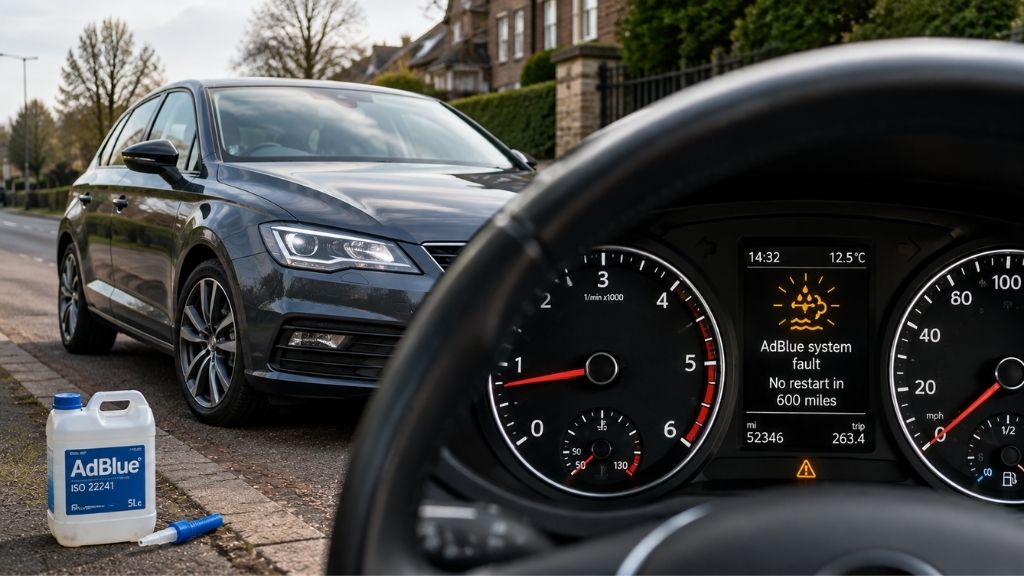
If your flashing light is accompanied by a mileage countdown, a specific figure telling you how many miles remain before the engine will not restart, this is a level warning at its most urgent stage. Top up immediately. Do not switch the engine off until you have added fluid. If the countdown is already at or near zero, you are at risk of the no-restart lockout activating the next time you switch off.
Scenario 2 Active System Fault, No-Restart Countdown Active
If the flashing light is accompanied by a fault message rather than a mileage countdown or if topping up did not clear the flashing the cause is a component failure within the SCR system rather than a low fluid level.
When the AdBlue warning light and the check engine light are both on, this may indicate a failure in the emission control system; a garage visit for corrective action is essential.
A flashing light with an active fault code means the ECU has detected a problem pump, injector, NOx sensor, quality sensor, or catalyst and has begun the escalation sequence. In this scenario, topping up the AdBlue tank will not clear the light, because the problem is not the fluid level. It is a failed component that has triggered the same countdown mechanism.
This is the scenario that most often catches drivers by surprise. The light is flashing, they top up, the light does not clear, and the countdown continues. The fix is a professional diagnostic scan to identify the specific fault code, not more fluid.
Scenario 3 Post-Refill Fault: The Light That Stays Flashing After a Top-Up
A specific and particularly confusing scenario: you top up the AdBlue tank, you expect the light to clear, and it continues flashing.
There are several reasons this happens:
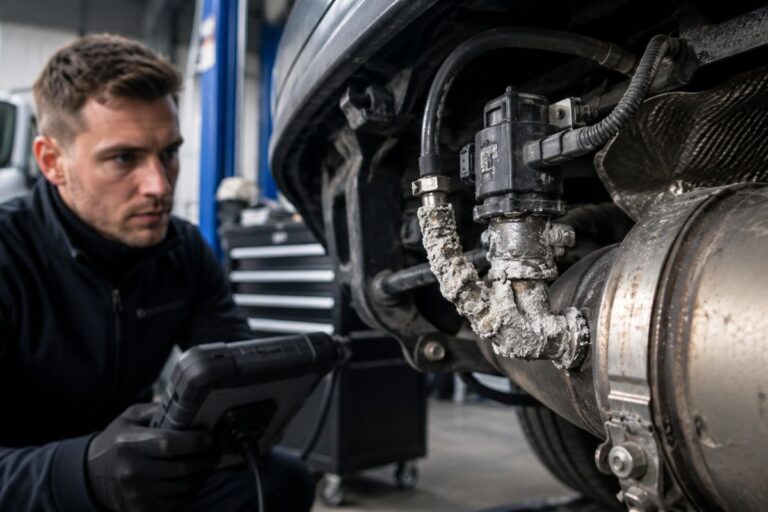
The level sensor has crystallised. Topped up my Boxer at Asda, drove 5 miles, and the warning was still flashing red. Turned out the level sensor was caked in white crystals and reading zero even though I’d just put in 10 litres. We pulled the sensor out, cleaned it with warm water, cleared the codes, and the light went off instantly.” Crystallised urea deposits on the level sensor cause it to report an empty tank even after correct refilling. The system does not believe the tank has been refilled because the sensor cannot read the new fluid level accurately.
The fluid was contaminated or had the wrong concentration. A quality fault code (P203A, P2BAD) produces a flashing warning that does not clear after top-up, because the system has detected that the fluid is incorrect either diluted, contaminated, or degraded. The presence of correct fluid is not confirmed by topping up; the quality sensor evaluates the concentration and flags it as out of specification.
A fault code from a separate component. In some cases, the flashing light after a top-up is not about the fluid at all; a pump, injector, or NOx sensor fault that was already present is producing the flashing independently of the fluid level. Refilling is irrelevant to a component failure.
In all three cases, the correct next step is a professional diagnostic scan not a second top-up or a battery reset. Our common AdBlue fault codes guide covers what each stored code means and which component it points to.
What Causes an AdBlue Light to Flash on Specific Makes
Different manufacturers implement their AdBlue warning systems differently, and the specific meaning of a flashing pattern varies:
| Make | What a flashing AdBlue light typically means |
| BMW | Flashing or red light indicates critical level or active fault countdown is either near zero or a system fault is stored |
| Mercedes-Benz | Flashing typically accompanies an active SCR fault or a critical-stage countdown Mercedes systems escalate quickly once a fault is confirmed |
| Peugeot / Citroën | Flashing urea/AdBlue light is common after a top-up with a crystallised level sensor one of the most frequent presentations we see |
| Volkswagen / Audi | Flashing alongside the check engine light indicates an active emissions fault code level warnings on VW Group vehicles tend to stay steady until very late stage |
| Ford Transit | Flashing in the instrument display indicates an escalated warning either a critical level or an active SCR system fault |
| Renault Trafic / Master | Flashing SCR warning indicates fault escalation van range commonly develops flashing warnings from pump and sensor faults |
| Fiat Ducato / Iveco Daily | A flashing warning on the Iveco Daily often means the fault has gone past a simple reminder stage and the system is not happy with something on the SCR side. Crystallisation faults are common on these commercial vans in the flashing presentation |
Why a Flashing Light Is Worse Than a Steady One for the No-Restart Timeline
Ignoring the AdBlue warning light may lead to vehicle immobilisation. Once the fluid runs out, the car may not start, requiring professional servicing.
The escalation from steady to flashing compresses the remaining timeline significantly. Most manufacturers design their warning systems so that the steady light gives a relatively generous window sometimes 1,500 miles or more while the escalation to a flashing or red light indicates that window is either nearly closed or already closed in the case of a fault code.
Eventually, the warning turns red, before the car will not restart when the ignition is turned off.
For level-related flashing warnings, the action window is typically under 500 miles, sometimes considerably less. For fault-related flashing warnings, the window depends on the specific fault and when the countdown was triggered. In both cases, treating a flashing AdBlue light as a “deal with it later” situation regularly results in a vehicle that will not restart after the next switch-off.
The most common version of this discovery, as described by drivers repeatedly: they switch off the engine at a petrol station, a car park, or their own driveway, and the vehicle refuses to restart. This is not a dramatic failure, it is the system doing exactly what it was designed to do, at exactly the point at which it was designed to do it.
Can You Drive With a Flashing AdBlue Light?
For a short distance, typically yes the engine will not cut out mid-journey. But the correct answer to this question is: only as far as necessary to address the situation.
You can usually drive a short distance after the warning appears, but prolonged driving without AdBlue can trigger engine limp mode or prevent starting.
Driving with a flashing AdBlue light falls into two categories:
Flashing level warning: If the countdown is active and showing a specific mileage figure, you can drive that distance before the no-restart lockout activates. Use that distance to reach a location where you can top up or arrange diagnosis not to carry on with your usual schedule while the problem remains unresolved.
Flashing system fault: The vehicle will drive normally until the countdown reaches zero. Once at zero, it will complete its current journey but will not restart after the next switch-off. Without knowing how long the countdown has been running before you noticed the flashing, you cannot know how close to zero it is.
In both cases, the correct response is to address the flashing light as a priority rather than a future task.
What to Do When the AdBlue Light Is Flashing Step by Step
Step 1 Read the dashboard message.
Note exactly what text accompanies the flashing light. A specific mileage countdown indicates a level warning at critical stages. A fault message (“SCR system fault,” “workshop,” “emissions fault”) indicates a component failure. No message at all alongside the flashing still requires checking both level and fault codes.
Step 2 Check whether a top-up is appropriate.
If the flashing is accompanied by a low-level countdown and the message indicates level rather than fault, top up immediately with correct ISO 22241 certified AdBlue fluid. Drive for 5–10 minutes to allow the system to confirm the new level. If the flashing clears, the cause was level-related.
Step 3 If the light stays flashing after a top-up, do not top up again.
A second top-up does not address a fault code or a crystallised sensor. Contact us for a mobile diagnostic visit. The fault code needs to be read and the cause identified before any repair decision is made.
Step 4 Do not use a generic OBD scanner as your only diagnostic tool.
Generic scanners can read basic fault codes but typically cannot access live data from the AdBlue system pump pressure, actual NOx values, and injector delivery rate that is needed to diagnose the actual cause rather than just the symptom. On Mercedes vehicles specifically, the SCR system requires Mercedes-compatible software for a proper reset and accurate live data.
Step 5 Do not simply clear the code and drive on.
Clearing the fault code without addressing the underlying cause does not resolve the countdown; it restarts it from the same position. The light will return within days, often more urgently than before.
Repair or Delete After a Flashing Warning
Once the fault has been diagnosed, the same decision framework applies as for any AdBlue fault: repair if the fault is isolated and first-time, consider delete if the fault has recurred or multiple faults are active.
A flashing AdBlue light that turns out to be a single, first-time NOx sensor fault on an otherwise healthy system is a repair job. A flashing light that follows a previous repair that did not hold, or that comes alongside multiple simultaneous fault codes, is more often the correct candidate for a software AdBlue delete.
Our AdBlue delete vs repair guide covers the full decision framework. Our pricing page sets out fixed costs for both options.
Our Mobile Service for Flashing AdBlue Lights
We attend vehicles with flashing AdBlue warnings as a same-day and next-day mobile service at your home, workplace, or roadside. We do not require recovery to a garage.
For every flashing AdBlue light we attend, our process is:
- Full diagnostic scan with live data not just fault code reading to confirm the cause of the flashing
- AdBlue level confirmation separate from sensor reading, to distinguish a genuine low level from a sensor misread
- Identification of any stored fault codes and their likely component cause
- Clear recommendation on whether top-up, repair, or delete is the appropriate response with a fixed price for each before work begins
All AdBlue repair and urea repair services, AdBlue delete and urea delete services, and all AdBlue removal services are available as mobile visits across our full coverage area.
For commercial vehicles and HGVs where a flashing warning means a day off the road for the vehicle, see our HGV remapping and AdBlue solutions page.
Areas We Cover
- AdBlue flashing light diagnosis London
- AdBlue flashing light diagnosis Slough
- AdBlue flashing light diagnosis Esher
- AdBlue flashing light diagnosis Epsom
- AdBlue flashing light diagnosis Loughton
- AdBlue flashing light diagnosis St Albans
- AdBlue flashing light diagnosis Sevenoaks
- AdBlue flashing light diagnosis Dartford
Not listed? Check our full locations page or contact us with your postcode.
Frequently Asked Questions
Get clear answers about flashing AdBlue warning lights, topping up AdBlue, diagnostics, driving with a warning and mobile AdBlue repair.
A flashing AdBlue warning often means the fault has gone past a simple reminder stage; the system is not happy with something on the SCR side and wants your attention before the problem gets worse. In practice, it means either the AdBlue level is critically low and the no-restart countdown is near zero, or an active SCR system fault has been detected and a fault code is stored. The flashing is more urgent than a steady light and requires immediate attention rather than a planned response.
If the flashing is accompanied by a low-level mileage countdown, a specific figure counting down in miles, top up immediately. If the flashing persists after topping up, or if it is accompanied by a fault message rather than a level message, the cause is a component fault rather than a fluid level issue. Topping up will not clear a fault code.
The most common causes are: a crystallised level sensor reading the tank as empty despite correct refilling, a fluid quality fault from contaminated or incorrect concentration fluid, or an active component fault such as a pump, injector or NOx sensor that exists independently of the fluid level. A diagnostic scan to read the specific stored fault code is the correct next step, not a second top-up.
For a short distance, typically yes; the engine will not cut out mid-journey. But the countdown to a no-restart lockout is either active or near activation when the light is flashing. Without knowing how long the countdown has been running, you cannot know how close to zero it is. Treat it as urgent and address it before switching the engine off.
A solid warning light usually means the AdBlue tank is almost empty. A flashing warning light indicates a more serious issue with the AdBlue system. The steady light is the system’s advisory warning to take action within a reasonable window. The flashing light is the system’s urgent escalation: action now, before the next time you switch off the engine.
Temporarily, in some cases, but the fault code will return. Disconnecting the battery clears the ECU’s stored fault data, which may extinguish the light for a short period. The underlying cause, whether a failed sensor, pump or quality fault, remains present, and the ECU will detect it again on the next diagnostic cycle and reactivate the warning. Battery resets are not a fix and do not reset the countdown in the way a proper diagnostic procedure does.
Yes, we carry out same-day and next-day mobile diagnosis and repair for flashing AdBlue warnings across London, Slough, Esher, Epsom, Loughton, St Albans, Sevenoaks, Dartford, and surrounding areas. See our locations page for full coverage or contact us with your vehicle details and postcode.
Book Mobile Diagnosis for a Flashing AdBlue Light
If your AdBlue light is flashing whether it appeared after a top-up, alongside a fault message, or has been present and escalating, we carry out same-day and next-day mobile diagnosis across London and the surrounding area.
Contact us today with your vehicle make, model, year, and a description of what the dashboard is showing. We will confirm availability, advise on the most likely cause based on your specific vehicle, and provide a fixed-price quote for diagnosis and repair or delete before any work begins.