
If your AdBlue warning light is on and you’ve been quoted for a repair, or if the same fault keeps coming back, you’re probably weighing up two options: fix the component that’s failed, or delete the AdBlue system from the ECU entirely. The honest answer is that neither is universally better: repair is right for some vehicles and fault types, delete is right for others, and the decision comes down to five factors: the specific fault, the repair cost, the vehicle’s age and value, your use case, and the legal implications of each option. This guide covers all five so you can make the right call before spending money.
What Is AdBlue Repair?
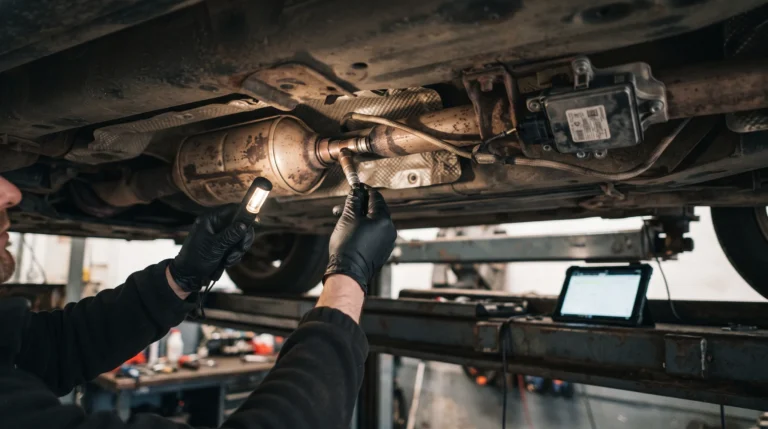
AdBlue repair means diagnosing the specific failed component within your SCR (Selective Catalytic Reduction) system and replacing or fixing it restoring the system to its original factory function.
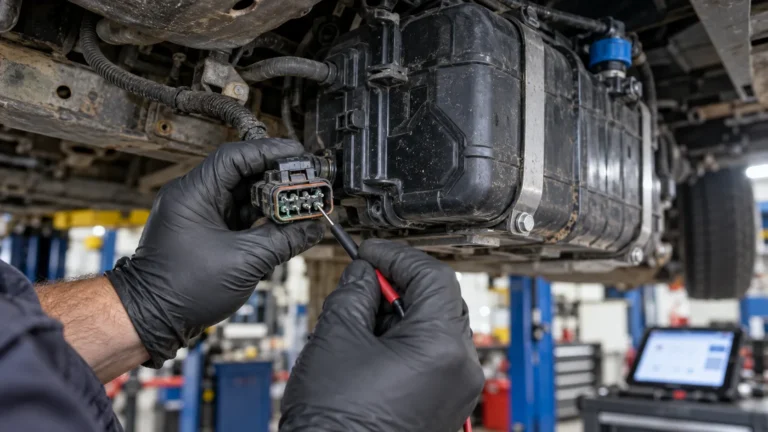
Common components replaced during an AdBlue repair include:
- AdBlue pump or pump module — the unit that draws fluid from the tank and delivers it to the injector
- AdBlue injector — the nozzle that sprays fluid into the exhaust stream
- NOx sensor — the upstream or downstream sensor that monitors SCR effectiveness
- AdBlue quality sensor — detects whether the fluid in the tank is the correct concentration
- AdBlue level sensor — monitors how much fluid remains in the tank
- SCR catalyst — the catalyst itself, in cases of severe degradation
After repair, the warning light is cleared via a diagnostic reset, the SCR system functions as intended, and the vehicle meets its original emissions specification.
What Is an AdBlue Delete?
An AdBlue delete is a software modification carried out on the vehicle’s ECU. It removes the SCR system’s requirement from the engine management software the vehicle no longer monitors AdBlue levels, no longer requires AdBlue fluid to be present, and no longer generates AdBlue-related fault codes or warning lights.
The physical AdBlue hardware tank, pump, injector remains in place. The delete works at the software level, not the hardware level. The ECU is reprogrammed so that it treats the AdBlue system as if it does not exist.
An AdBlue delete is a permanent solution to a recurring or uneconomical AdBlue fault. It is distinct from an AdBlue bypass, which achieves a similar outcome through a different technical method and from an AdBlue fix, which addresses the specific fault without modifying the ECU permanently.
The Key Differences at a Glance
| Factor | AdBlue Repair | AdBlue Delete |
| What it does | Fixes the failed component | Removes SCR requirement from ECU |
| Warning light after | Cleared by diagnostic reset | Permanently cleared |
| AdBlue fluid needed after | Yes system continues as normal | No |
| Cost | Varies by component | Fixed cost regardless of fault complexity |
| Best for | Isolated, first-time component failures | Recurring faults, uneconomical repairs |
| MOT implications | System restored to OEM spec | Legal and MOT implications apply |
| Permanence | Reversible fault can recur | Permanent software modification |
| Downtime | Same-day mobile in most cases | Same-day mobile in most cases |
When AdBlue Repair Is the Right Choice
The fault is isolated to a single component
If your diagnostic scan shows one specific fault code a NOx sensor circuit fault (P2201/P2202), an injector fault (P2047/P204B), or a quality fault from contaminated fluid (P203A/P2BAD) and the rest of the AdBlue system is functioning correctly, repair is almost always the right starting point.
A single component failure on an otherwise healthy system is exactly what repair is designed for. Replacing a failed NOx sensor, cleaning or replacing a blocked injector, or draining and refilling a contaminated tank resolves the fault cleanly. The system is restored, the warning light clears, and there is no permanent modification to the vehicle.
The vehicle is relatively new or high value
A three-year-old vehicle with a first-time pump fault is a repair candidate. The vehicle has significant remaining life, the fault is isolated, and the repair cost is proportionate to the car’s value. Deleting the AdBlue system on a vehicle that is likely to be sold within a few years also introduces complications at point of sale a buyer or dealer may identify the modification.
The fault is covered under warranty
If your vehicle is still within manufacturer warranty or an extended warranty, repair through an authorised route is almost always the appropriate path. A delete carried out on a vehicle under warranty voids the warranty for any fault related to the emissions system, and potentially for the vehicle as a whole depending on the warranty terms.
The repair cost is proportionate
A NOx sensor replacement costs significantly less than an AdBlue delete in most cases. For isolated sensor or injector faults, repair is the more cost-effective option; the delete is not needed and would be disproportionate. Our pricing page sets out fixed costs for both options so you can compare directly.
When an AdBlue Delete Is the Right Choice
The same fault has come back after a previous repair
This is the most common scenario that leads people to delete. The pump was replaced six months ago. Or the NOx sensor was changed at a dealer. Or the injector was cleaned and replaced. And the fault has returned.
Recurring AdBlue faults usually indicate one of two things: either the replacement component has also failed (common with lower-quality parts), or there is an underlying system condition — contamination, electrical fault, or SCR catalyst degradation that keeps affecting the repaired component. When repair has already been attempted and has not held, delete removes the cycle entirely.
Multiple fault codes are active simultaneously
A vehicle showing P20EE (catalyst efficiency), P20BA (pump circuit), and P2201 (NOx sensor) simultaneously is not a single-component repair job. Working through each fault individually is expensive and time-consuming — and there is no guarantee that fixing each component one by one resolves the underlying cause rather than temporarily suppressing it.
Where three or more AdBlue fault codes are active at the same time, the total repair cost typically exceeds the cost of a delete. At that point, delete is the more rational economic decision: a fixed cost that resolves all active faults permanently rather than an accumulating repair bill with uncertain outcomes.
The repair cost exceeds the vehicle’s value or a rational threshold
SCR catalyst replacement and pump module replacement on certain makes particularly BMW and Mercedes can run to significant figures. When a repair quote approaches or exceeds the vehicle’s value, or when it represents a disproportionate investment in a high-mileage vehicle approaching the end of its useful life, delete makes more financial sense.
This is particularly common on commercial vans and older diesel cars where the AdBlue system components are expensive and the vehicle itself is not. A urea delete or urea removal on a high-mileage Peugeot Boxer or Mercedes Sprinter is a common commercial decision, not an unusual one.
The vehicle is commercial and downtime is the priority
For fleet operators and sole traders whose livelihood depends on their vehicle being on the road, the calculus is different from a private driver. A repair that might fail again in six months means another day off the road, another mobile diagnostic visit, another repair bill. A delete is a permanent resolution the vehicle runs without AdBlue indefinitely.
Our urea repair service is available where repair is the right call for commercial vehicles. But for operators who have already been through a repair cycle, our mobile AdBlue removal services provide a permanent fix at a known cost.
For HGV operators specifically, see our HGV remapping and AdBlue solutions page commercial vehicle AdBlue systems have different characteristics and failure patterns to passenger cars, and the economics of repair vs delete shift accordingly.
The Legal Question: What You Need to Know Before Deciding
This is the part of the comparison most guides skim over. It needs to be addressed honestly.
AdBlue repair is straightforward from a legal and regulatory standpoint. The system is restored to OEM specification. The vehicle meets its original emissions standards. There are no implications for MOT, insurance, or road legality.
AdBlue delete is more complex legally. In the UK, it is an offence under the Road Vehicles (Construction and Use) Regulations 1986 to use a vehicle on a public road that has been modified to exceed its type-approved emissions levels. An AdBlue delete removes the SCR system that reduces NOx emissions the vehicle will emit more NOx than its type approval permits.
At the same time, AdBlue deletes are widely carried out across the UK, they are not illegal to perform as a workshop service, and they are not currently subject to enforcement at MOT in the same way that DPF removal is. MOT emissions tests check CO and HC (hydrocarbons) levels, not NOx specifically, which means many deleted vehicles pass MOT without issue.
However, there are risks:
- Insurance: Some insurers treat an AdBlue delete as a modification that must be declared. Failure to declare a known modification can affect a claim. Check your policy terms or contact your insurer before proceeding.
- Manufacturer warranty: A delete on a vehicle still under manufacturer warranty voids the warranty for emissions-related work and potentially more broadly.
- Future sale: A vehicle with a software delete may be flagged by a dealer or independent mechanic using diagnostic tools, which can affect its saleability or disclosed value.
We provide full information on the legal position before carrying out any delete contact us if you want to discuss the implications for your specific vehicle and situation.
Cost Comparison: What You Actually Pay
Cost is often the deciding factor, but it needs to be assessed over time rather than just as a single transaction.
| Scenario | Repair route | Delete route |
| Single NOx sensor fault | Repair is cheaper | Delete is disproportionate |
| Pump module replacement | Similar cost territory | Delete may be comparable or cheaper |
| SCR catalyst replacement | Repair is significantly more expensive | Delete is substantially cheaper |
| Second fault after previous repair | Repair costs accumulate | Delete is a fixed, final cost |
| Multiple simultaneous faults | Repair costs stack per component | Delete covers all at one fixed cost |
| Commercial vehicle, high mileage | Repair economics deteriorate fast | Delete gives known, permanent resolution |
Check our pricing page for current fixed costs on both repair and delete services. For a specific quote based on your fault codes, vehicle make, and model, contact us directly.
What Happens After Each Option
After a repair
- The AdBlue system functions as standard
- The vehicle requires AdBlue fluid to be topped up as normal
- If the same component fails again, you return for another repair
- The vehicle meets its original emissions specification
After a delete
- The AdBlue warning light is permanently cleared
- No AdBlue fluid is required — the tank can be left empty or removed
- No further AdBlue-related fault codes will appear
- The vehicle’s ECU no longer monitors the SCR system
- The vehicle produces more NOx emissions than its type approval permits
Vehicle-Specific Considerations
Different makes have different AdBlue failure patterns and that affects which option makes more sense.
BMW 3 and 5 Series diesel (B47/N47 engines): Pump module and SCR catalyst faults are common on high-mileage examples. First-time pump faults are worth repairing; recurring pump faults or catalyst failures often tip the economics toward delete.
Mercedes C and E Class diesel: NOx sensor faults and injector faults are the most common presentation. First-time NOx sensor replacements are relatively straightforward repairs. Where a second NOx fault appears after replacement, delete is worth considering.
Peugeot Boxer and Citroën Relay van: AdBlue quality faults and pump faults are frequent on the high-mileage commercial van range. The urea system on these vehicles is prone to crystallisation around the injector nozzle on vehicles that do short urban runs. For owner-operators on tight margins, urea delete is a common and pragmatic choice.
VW Group (VW, Audi, SEAT, Skoda) diesel: Quality faults and catalyst efficiency faults (P20EE) are the most common presentations. Software recalibration is often needed after repair which means a delete is not significantly more complex to execute than a repair-plus-reset workflow.
Renault Trafic and Master diesel: SCR system faults are common on the van range, particularly on vehicles used for urban distribution runs. Repair is appropriate for first-time faults; delete is frequently chosen by operators after a first repair has not been held.
How We Help You Decide
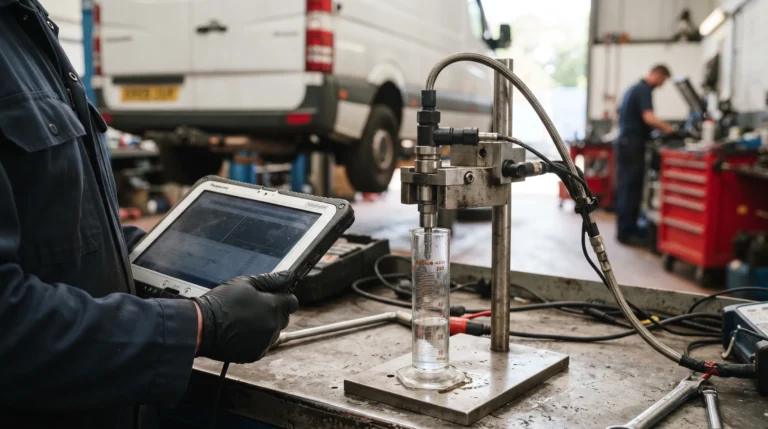
We do not have a financial incentive to push one option over the other. Our mobile diagnosis is the starting point where we read the full fault data, including active codes, stored codes, freeze frame data, and live sensor values, before recommending anything.
In practice, our recommendation follows a straightforward logic:
- First fault, single component, vehicle under 5 years old or high value → repair
- Recurring fault after previous repair, or multiple simultaneous faults → discuss delete
- Repair cost approaches or exceeds vehicle value → delete
- Commercial vehicle operator with a history of AdBlue issues → delete
- Vehicle under warranty → repair through appropriate channel
We carry out both services as a mobile operation at your home, workplace, or roadside across our full coverage area.
Areas We Cover
- AdBlue repair and delete London
- AdBlue repair and delete Slough
- AdBlue repair and delete Esher
- AdBlue repair and delete Epsom
- AdBlue repair and delete Loughton
- AdBlue repair and delete St Albans
- AdBlue repair and delete Sevenoaks
- AdBlue repair and delete Dartford
Not listed? Check our full locations page or contact us directly.
AdBlue system fault codes, answered straight
The questions we’re actually asked on the phone before a diagnostic booking — no jargon, no sales pitch.
AdBlue repair fixes the specific failed component pump, injector, NOx sensor, or quality sensor and restores the SCR system to its original factory function. An AdBlue delete is a software modification that removes the SCR system requirement from the ECU entirely, permanently clearing the warning light without repairing the hardware. Repair is better for isolated, first-time faults. Delete is more appropriate for recurring faults, multiple simultaneous faults, or situations where the repair cost is disproportionate to the vehicle’s value.
The legal position is nuanced. Carrying out an AdBlue delete is not illegal as a workshop service, and most deleted vehicles pass MOT because the standard emissions test does not check NOx specifically. However, using a modified vehicle on a public road that exceeds its type-approved emissions levels is a technical offence under the Road Vehicles (Construction and Use) Regulations 1986. Insurance implications also apply; some insurers require modifications to be declared. We discuss the full legal position with every customer before carrying out a delete.
In practice, most vehicles with an AdBlue delete pass MOT because the standard test checks CO and hydrocarbons, not NOx. However, an MOT tester who identifies that an emissions system has been modified can refuse to pass the vehicle. This is not common, but it is not impossible. The MOT implications are more straightforward for repair the system is restored to OEM spec and there are no modification considerations.
For isolated single-component faults a NOx sensor or injector repair is typically cheaper than a delete. For pump module replacements, SCR catalyst replacements, or multiple simultaneous faults, the costs converge or delete becomes the more economical option. Our pricing page sets out current fixed costs for both services.
Yes, repair and delete are not mutually exclusive decisions. Repairing a first-time fault is entirely reasonable; if the same fault recurs or a new fault develops, a delete remains available. Many customers follow exactly this path.
An AdBlue delete is typically completed within one to two hours as a mobile visit. No recovery to a garage is required. We connect to the vehicle’s OBD port, reprogram the ECU, and verify the delete with a post-modification diagnostic scan before leaving.
Yes — an AdBlue delete permanently clears all AdBlue and SCR-related fault codes and warning lights. If additional fault codes are present from unrelated systems (DPF, EGR, or other engine faults), these are separate and are not affected by the AdBlue delete. A full diagnostic scan beforehand confirms which codes are AdBlue-related and which are not.
Yes. We carry out both services as mobile visits across London, Slough, Esher, Epsom, Loughton, St Albans, Sevenoaks, Dartford, and the surrounding areas. See our locations page for full coverage, or contact us with your postcode to confirm availability.
Book a Mobile Diagnosis — Then Decide
You do not need to have made a decision between repair and delete before calling us. The right starting point is a mobile diagnostic visit — we read the full fault data and give you a clear recommendation with fixed costs for both options before any work begins.
Contact us today with your vehicle make, model, year, and any fault codes already showing. We’ll confirm availability, come to you, and give you a straight answer on which option is right for your vehicle.